Pearson Edexcel · GCSE · Business
Course version: 1BS0 · Version from Sept 2017
Methods of market research: ● primary research: survey, questionnaire,…
Full specification wording
Market research: Methods of market research: ● primary research: survey, questionnaire, focus group, observation ● secondary research: internet, market reports, government reports.
Market research helps businesses understand customer needs.
Checked against the Pearson Edexcel 1BS0 specification (opens in a new tab) on .
- Point 2 of 3
- 2 key terms
Study notes
From the checked teaching notes for this specification point.
The idea
Market research helps businesses understand customer needs. Primary research involves gathering new, original data directly for a specific purpose. Methods include surveys (asking questions directly), questionnaires (written or online forms), focus groups (small group discussions providing in-depth feedback), and observation (watching customer behaviour). Secondary research uses existing data collected by others. This includes using the internet to research competitors, purchasing detailed market reports from specialist agencies, or analysing government reports for demographic trends.
For example: A new café might use a questionnaire to find popular local flavours (primary) and government reports to check local population ages (secondary).
What earns the marks
- Define primary research as collecting new, first-hand data tailored to the business's specific needs.
- Identify specific primary methods: surveys, questionnaires, focus groups, and observation.
- Define secondary research as the use of existing data that has already been collected by another organisation.
- Identify specific secondary sources: internet research, commercial market reports, and government reports.
- Compare the benefits, such as primary being specific but costly, while secondary is often cheaper and faster to access.
Common mistakes and how to put them right
Confusing surveys and questionnaires as entirely different concepts.
Put it right: Understand that a questionnaire is the written set of questions often used to conduct a survey.
Stating that secondary research is always free.
Put it right: Recognise that while some internet data is free, professional market reports often cost money to purchase.
Believing primary research is always better than secondary.
Put it right: Acknowledge that both have distinct roles; secondary research is often a better starting point for broad market trends before conducting specific primary research.
Exam tips
- When asked to recommend a research method, always link your choice to the specific context of the business in the case study.
- Use the exact terminology from the specification, such as 'focus group' rather than 'group chat'.
- If evaluating a method, contrast the time and cost implications of primary research against the speed and general nature of secondary research.
Try the lesson
The start of the Market research: Methods of market research: ● primary research: survey, questionnaire, focus group, observation ● secondary research: internet, market reports, government reports. lesson, made from checked teaching notes for this specification point.
Have a go first
A new café wants to gather first-hand opinions from local residents about the types of coffee they prefer. Which of the following is a method of primary research the café could use?
Listen
Market research helps businesses understand customer needs. Primary research involves gathering new, original data directly for a specific purpose. Methods include surveys (asking questions directly), questionnaires (written or online forms), focus groups (small group discussions providing in-depth feedback), and observation (watching customer behaviour). Secondary research uses existing data collected by others. This includes using the internet to research competitors, purchasing detailed market reports from specialist agencies, or analysing government reports for demographic trends. For example, a new café might use a questionnaire to find popular local flavours (primary) and government reports to check local population ages (secondary). A strong answer earns marks for these points. Define primary research as collecting new, first-hand data tailored to the business's specific needs. Identify specific primary methods: surveys, questionnaires, focus groups, and observation. Define secondary research as the use of existing data that has already been collected by another organisation. Identify specific secondary sources: internet research, commercial market reports, and government reports. A common slip: Confusing surveys and questionnaires as entirely different concepts. Instead, Understand that a questionnaire is the written set of questions often used to conduct a survey. Exam tip: When asked to recommend a research method, always link your choice to the specific context of the business in the case study.
See it

Key words
Say what each word means before you turn the card.
Primary research
Try answering aloud or in your head before turning the card.
Secondary research
Try answering aloud or in your head before turning the card.
See every definition
- Primary research
- Gathering new, original data directly for a specific purpose, such as through surveys, questionnaires, focus groups and observation.
- Secondary research
- Using existing data that has already been collected by another organisation, such as the internet, market reports and government reports.
Label the diagram
Some boxes have lost their names. Pick the right name for each number.
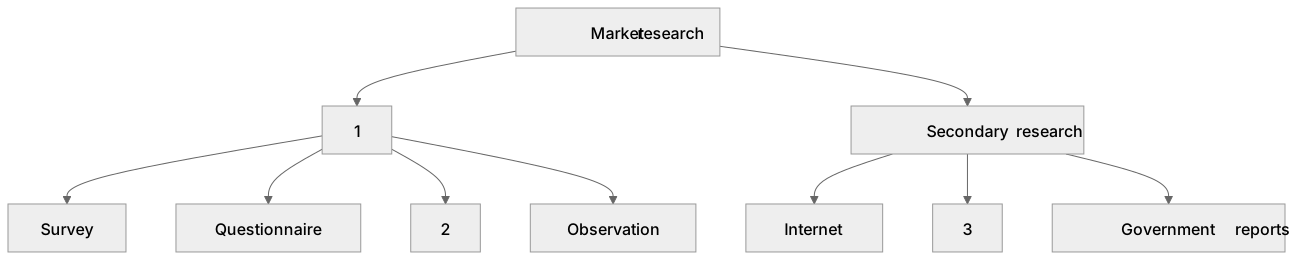
1Box 1
2Box 2
3Box 3
There is more to this lesson
The full lesson goes on to check your understanding and help you earn the marks. Create a free account to carry on, with your progress saved.
A week of Premium from your first lesson · Then the free plan continues · No card, no charge
Test your understanding of Market research: Methods of market research: ● primary research: survey, questionnaire, focus group, observation ● secondary research: internet, market reports, government reports.
Active recall beats re-reading. Take an instant quiz now to test what you’ve learned and lock it into long-term memory.
A week of Premium from your first lesson · Then the free plan continues · No card, no charge