Pearson Edexcel · GCSE · Business
Course version: 1BS0 · Version from Sept 2017
The use of data in market research: ● qualitative and quantitative data ●…
Full specification wording
Market research: The use of data in market research: ● qualitative and quantitative data ● the role of social media in collecting market research data ● the importance of the reliability of market research data.
Businesses must analyse different types of data to make informed decisions.
Checked against the Pearson Edexcel 1BS0 specification (opens in a new tab) on .
- Point 3 of 3
- 2 key terms
Study notes
From the checked teaching notes for this specification point.
The idea
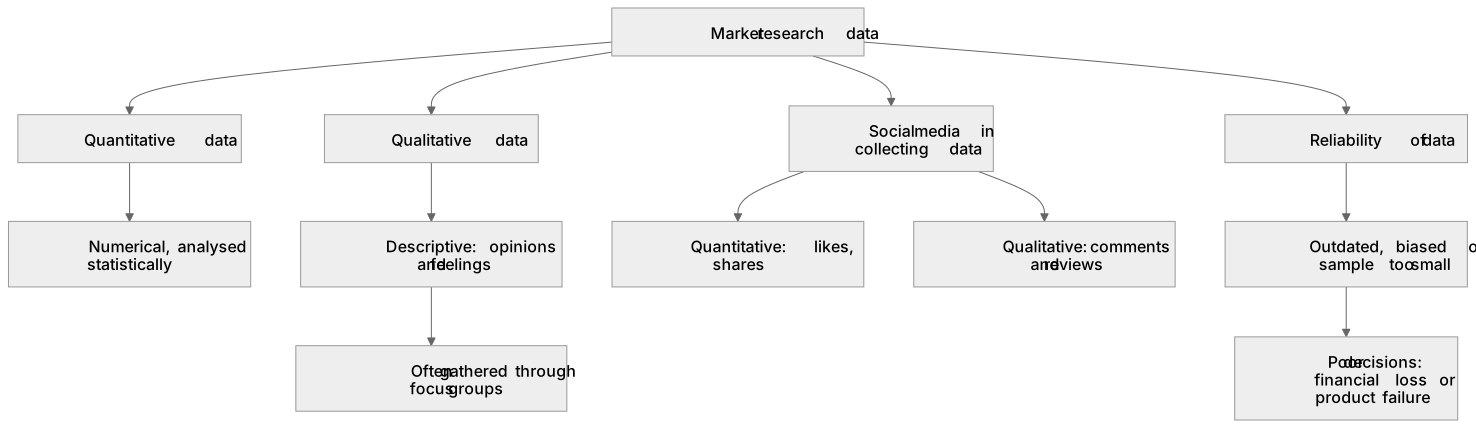
Businesses must analyse different types of data to make informed decisions. Quantitative data is numerical and can be analysed statistically, such as finding the percentage of customers who prefer a specific product. Qualitative data is descriptive, focusing on opinions and feelings, often gathered through focus groups. Social media plays a crucial role in modern research, allowing businesses to quickly gather both quantitative data (likes, shares) and qualitative data (customer comments and reviews) at a low cost. However, the reliability of market research data is vital. If data is outdated, biased, or based on a sample size that is too small, the business might make poor decisions that lead to financial loss or product failure.
What earns the marks
- Distinguish between quantitative data (numerical, statistical) and qualitative data (opinions, feelings, attitudes).
- Explain how social media platforms are used to track trends, gather customer feedback, and conduct quick polls.
- Define data reliability as the extent to which research findings are accurate, trustworthy, and representative of the target market.
- Explain the consequences of using unreliable data, such as launching a product that fails to meet actual customer needs.
- Link the type of data collected to the research method used, such as focus groups generating qualitative data.
Common mistakes and how to put them right
Mixing up qualitative and quantitative data.
Put it right: Quantitative relates to quantities (numbers), while qualitative relates to qualities (opinions and feelings).
Assuming social media research is always highly reliable.
Put it right: Recognise that social media data can be biased or unrepresentative, as it only reflects the views of active users on that specific platform.
Stating that a large amount of data automatically means it is reliable.
Put it right: Understand that data must also be unbiased, up-to-date, and gathered from a representative sample to be considered reliable.
Exam tips
- Use the terms 'qualitative' and 'quantitative' accurately when discussing the outcomes of different market research methods.
- When discussing social media, mention its dual ability to provide both numerical metrics and detailed customer opinions.
- In evaluation questions, question the reliability of the data presented in the case study, considering sample size and potential bias.
Try the lesson
The start of the Market research: The use of data in market research: ● qualitative and quantitative data ● the role of social media in collecting market research data ● the importance of the reliability of market research data. lesson, made from checked teaching notes for this specification point.
Have a go first
A mobile phone manufacturer collects data showing that 75% of its customers upgrade their phone every two years. What type of market research data is this?
Listen
Businesses must analyse different types of data to make informed decisions. Quantitative data is numerical and can be analysed statistically, such as finding the percentage of customers who prefer a specific product. Qualitative data is descriptive, focusing on opinions and feelings, often gathered through focus groups. Social media plays a crucial role in modern research, allowing businesses to quickly gather both quantitative data (likes, shares) and qualitative data (customer comments and reviews) at a low cost. However, the reliability of market research data is vital. If data is outdated, biased, or based on a sample size that is too small, the business might make poor decisions that lead to financial loss or product failure. A strong answer earns marks for these points. Distinguish between quantitative data (numerical, statistical) and qualitative data (opinions, feelings, attitudes). Explain how social media platforms are used to track trends, gather customer feedback, and conduct quick polls. Define data reliability as the extent to which research findings are accurate, trustworthy, and representative of the target market. Explain the consequences of using unreliable data, such as launching a product that fails to meet actual customer needs. A common slip: Mixing up qualitative and quantitative data. Instead, quantitative relates to quantities (numbers), while qualitative relates to qualities (opinions and feelings). Exam tip: Use the terms 'qualitative' and 'quantitative' accurately when discussing the outcomes of different market research methods.
See it
Key words
Say what each word means before you turn the card.
Quantitative data
Try answering aloud or in your head before turning the card.
Qualitative data
Try answering aloud or in your head before turning the card.
See every definition
- Quantitative data
- Numerical data that can be analysed statistically, such as finding the percentage of customers who prefer a specific product.
- Qualitative data
- Descriptive data focusing on opinions and feelings, often gathered through focus groups.
Label the diagram
Some boxes have lost their names. Pick the right name for each number.
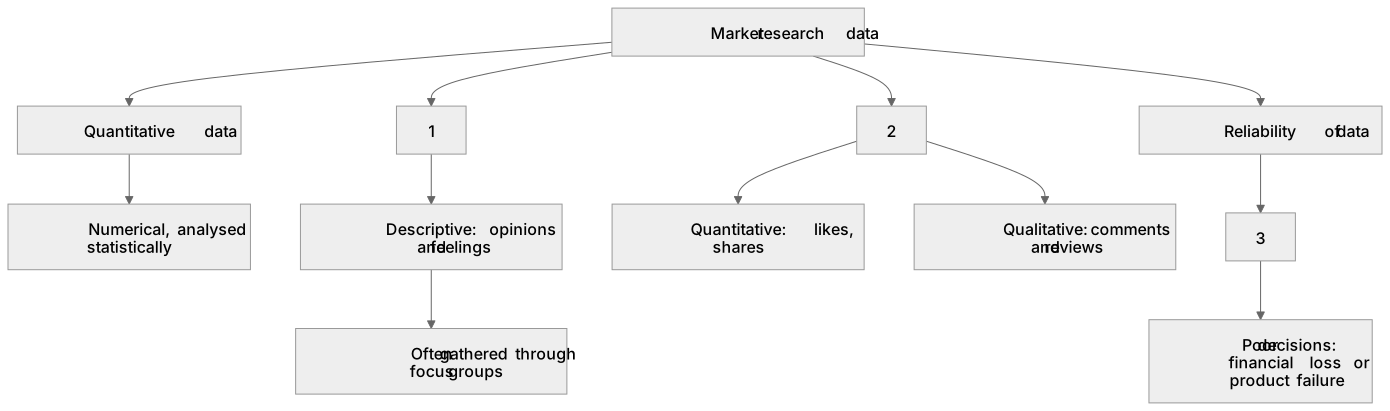
1Box 1
2Box 2
3Box 3
There is more to this lesson
The full lesson goes on to check your understanding and help you earn the marks. Create a free account to carry on, with your progress saved.
A week of Premium from your first lesson · Then the free plan continues · No card, no charge
Test your understanding of Market research: The use of data in market research: ● qualitative and quantitative data ● the role of social media in collecting market research data ● the importance of the reliability of market research data.
Active recall beats re-reading. Take an instant quiz now to test what you’ve learned and lock it into long-term memory.
A week of Premium from your first lesson · Then the free plan continues · No card, no charge