Pearson Edexcel · GCSE · Business
Course version: 1BS0 · Version from Sept 2017
Appropriate: ● hierarchical and flat ● centralised and decentralised.
Full specification wording
Organisational structures: appropriate: ● hierarchical and flat ● centralised and decentralised.
Organisational structures dictate how authority is distributed.
Checked against the Pearson Edexcel 1BS0 specification (opens in a new tab) on .
- Point 2 of 4
- 4 key terms
Study notes
From the checked teaching notes for this specification point.
The idea
Organisational structures dictate how authority is distributed. A hierarchical structure has many management layers and narrow spans of control, offering clear progression but slower communication. Conversely, a flat structure has fewer layers and wider spans of control, encouraging faster decisions and staff autonomy. Centralised structures keep decision-making authority at the top (e.g. head office), ensuring consistency. Decentralised structures delegate authority to local managers, allowing rapid responses to local market changes. The appropriate structure depends on business size, workforce skill, and the need for consistency versus flexibility.
What earns the marks
- Define a hierarchical structure as having many layers of management and a long chain of command.
- Define a flat structure as having few layers of management and a short chain of command.
- Explain that centralised structures retain decision-making power at the top of the hierarchy, ensuring uniform policies.
- Explain that decentralised structures delegate decision-making power to lower levels, increasing local responsiveness.
- Evaluate the appropriateness of a structure based on business context, such as a retail chain needing centralisation for brand consistency.
Common mistakes and how to put them right
Confusing a flat structure with decentralisation.
Put it right: A flat structure refers to the number of layers (chain of command), whereas decentralisation refers to where decision-making power lies.
Assuming hierarchical structures are always bad.
Put it right: Acknowledge that hierarchical structures provide clear promotional routes and tight control, which is appropriate for some businesses.
Stating that decentralised businesses have no managers.
Put it right: State that decentralised businesses still have managers, but authority is delegated to lower-level managers rather than kept at head office.
Exam tips
- When evaluating which structure is appropriate, always link your choice to the specific context of the business provided in the case study.
- Use the terms 'chain of command' and 'span of control' when discussing hierarchical and flat structures to demonstrate strong subject knowledge.
- Discuss the trade-off between consistency (centralised) and motivation or responsiveness (decentralised) when analysing decision-making structures.
Try the lesson
The start of the Organisational structures: appropriate: ● hierarchical and flat ● centralised and decentralised. lesson, made from checked teaching notes for this specification point.
Have a go first
A small, innovative technology start-up needs to respond rapidly to changes in the market and encourages all employees to share ideas directly with the founders. Which organisational structure is most appropriate for this business?
Listen
Organisational structures dictate how authority is distributed. A hierarchical structure has many management layers and narrow spans of control, offering clear progression but slower communication. Conversely, a flat structure has fewer layers and wider spans of control, encouraging faster decisions and staff autonomy. Centralised structures keep decision-making authority at the top (e.g. head office), ensuring consistency. Decentralised structures delegate authority to local managers, allowing rapid responses to local market changes. The appropriate structure depends on business size, workforce skill, and the need for consistency versus flexibility. A strong answer earns marks for these points. Define a hierarchical structure as having many layers of management and a long chain of command. Define a flat structure as having few layers of management and a short chain of command. Explain that centralised structures retain decision-making power at the top of the hierarchy, ensuring uniform policies. Explain that decentralised structures delegate decision-making power to lower levels, increasing local responsiveness. A common slip: Confusing a flat structure with decentralisation. Instead, a flat structure refers to the number of layers (chain of command), whereas decentralisation refers to where decision-making power lies. Exam tip: When evaluating which structure is appropriate, always link your choice to the specific context of the business provided in the case study.
See it

Key words
Say what each word means before you turn the card.
Hierarchical structure
Try answering aloud or in your head before turning the card.
Flat structure
Try answering aloud or in your head before turning the card.
Centralised structure
Try answering aloud or in your head before turning the card.
Decentralised structure
Try answering aloud or in your head before turning the card.
See every definition
- Hierarchical structure
- A structure with many layers of management and a long chain of command, offering clear progression but slower communication.
- Flat structure
- A structure with few layers of management and a short chain of command, encouraging faster decisions and staff autonomy.
- Centralised structure
- A structure that keeps decision-making authority at the top, such as head office, ensuring consistency and uniform policies.
- Decentralised structure
- A structure that delegates decision-making authority to lower-level local managers, allowing rapid responses to local market changes.
Label the diagram
Some boxes have lost their names. Pick the right name for each number.
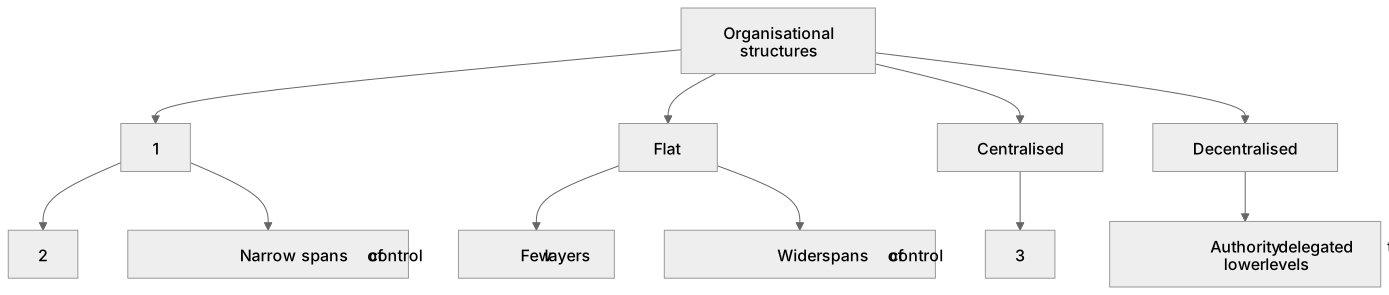
1Box 1
2Box 2
3Box 3
There is more to this lesson
The full lesson goes on to check your understanding and help you earn the marks. Create a free account to carry on, with your progress saved.
A week of Premium from your first lesson · Then the free plan continues · No card, no charge
Test your understanding of Organisational structures: appropriate: ● hierarchical and flat ● centralised and decentralised.
Active recall beats re-reading. Take an instant quiz now to test what you’ve learned and lock it into long-term memory.
A week of Premium from your first lesson · Then the free plan continues · No card, no charge