Pearson Edexcel · GCSE · Business
Course version: 1BS0 · Version from Sept 2017
Product: The design mix: ● function, aesthetics, cost.
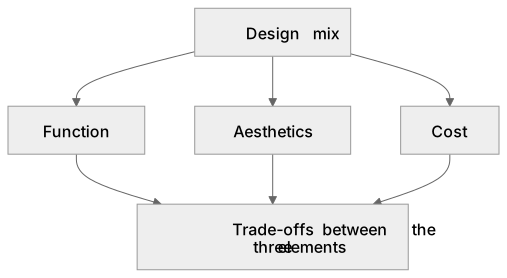
The design mix consists of three fundamental elements that a business must balance when developing a new product: function, aesthetics, and cost.
Checked against the Pearson Edexcel 1BS0 specification (opens in a new tab) on .
- Point 1 of 2
- 4 key terms
Study notes
From the checked teaching notes for this specification point.
The idea
The design mix consists of three fundamental elements that a business must balance when developing a new product: function, aesthetics, and cost. Function ensures the product is fit for purpose, reliable, and performs its intended task effectively, such as a waterproof jacket keeping the wearer dry. Aesthetics refers to the sensory appeal of the product, including its look, feel, and style, which is crucial in fashion or technology markets. Cost involves designing the product so it can be manufactured and sold profitably. Businesses often face trade-offs within this mix; for example, using premium materials to improve aesthetics and function will inevitably increase the manufacturing cost, requiring a higher selling price to maintain profit margins.
What earns the marks
- Define function as how well a product does its job and its overall reliability.
- Define aesthetics as the visual and sensory appeal of a product to the consumer.
- Define cost as the financial expense of manufacturing the product, which must be low enough to allow for a profitable selling price.
- Explain the dynamic relationship and trade-offs between the three elements, such as sacrificing some aesthetic appeal to keep production costs viable.
Common mistakes and how to put them right
Treating the three elements in isolation.
Put it right: Explain how changing one element, like improving aesthetics, directly impacts another, such as increasing cost.
Confusing cost with price.
Put it right: Use 'cost' to refer to the expense of making the product, and 'price' for what the customer pays.
Assuming aesthetics only means visual appearance.
Put it right: Include other sensory aspects like feel, smell, or taste depending on the product type.
Exam tips
- Apply the design mix to the specific product in the case study, highlighting which of the three elements is most critical for that target market.
- When discussing trade-offs, clearly state which element is being prioritised and which is being compromised.
- Use the concept of added value to explain how superior function or aesthetics can justify a higher selling price despite increased costs.
Try the lesson
The start of the Product: The design mix: ● function, aesthetics, cost. lesson, made from checked teaching notes for this specification point.
Have a go first
Which three elements make up the design mix of a product?
Listen
The design mix consists of three fundamental elements that a business must balance when developing a new product: function, aesthetics, and cost. Function ensures the product is fit for purpose, reliable, and performs its intended task effectively, such as a waterproof jacket keeping the wearer dry. Aesthetics refers to the sensory appeal of the product, including its look, feel, and style, which is crucial in fashion or technology markets. Cost involves designing the product so it can be manufactured and sold profitably. Businesses often face trade-offs within this mix; for example, using premium materials to improve aesthetics and function will inevitably increase the manufacturing cost, requiring a higher selling price to maintain profit margins. A strong answer earns marks for these points. Define function as how well a product does its job and its overall reliability. Define aesthetics as the visual and sensory appeal of a product to the consumer. Define cost as the financial expense of manufacturing the product, which must be low enough to allow for a profitable selling price. Explain the dynamic relationship and trade-offs between the three elements, such as sacrificing some aesthetic appeal to keep production costs viable. A common slip: Treating the three elements in isolation. Instead, explain how changing one element, like improving aesthetics, directly impacts another, such as increasing cost. Exam tip: Apply the design mix to the specific product in the case study, highlighting which of the three elements is most critical for that target market.
See it
Key words
Say what each word means before you turn the card.
Function
Try answering aloud or in your head before turning the card.
Aesthetics
Try answering aloud or in your head before turning the card.
Cost
Try answering aloud or in your head before turning the card.
Design mix
Try answering aloud or in your head before turning the card.
See every definition
- Function
- How well a product does its job and its overall reliability, ensuring it is fit for purpose and performs its intended task effectively.
- Aesthetics
- The visual and sensory appeal of a product to the consumer, including its look, feel, and style.
- Cost
- The financial expense of manufacturing the product, which must be low enough to allow for a profitable selling price.
- Design mix
- Three fundamental elements that a business must balance when developing a new product: function, aesthetics, and cost.
Label the diagram
Some boxes have lost their names. Pick the right name for each number.
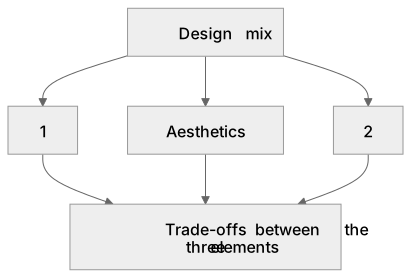
1Box 1
2Box 2
There is more to this lesson
The full lesson goes on to check your understanding and help you earn the marks. Create a free account to carry on, with your progress saved.
A week of Premium from your first lesson · Then the free plan continues · No card, no charge
Test your understanding of Product: The design mix: ● function, aesthetics, cost.
Active recall beats re-reading. Take an instant quiz now to test what you’ve learned and lock it into long-term memory.
A week of Premium from your first lesson · Then the free plan continues · No card, no charge