Pearson Edexcel · GCSE · Business
Course version: 1BS0 · Version from Sept 2017
Activity: ● to produce goods or services ● to meet customer needs ● to add…
Full specification wording
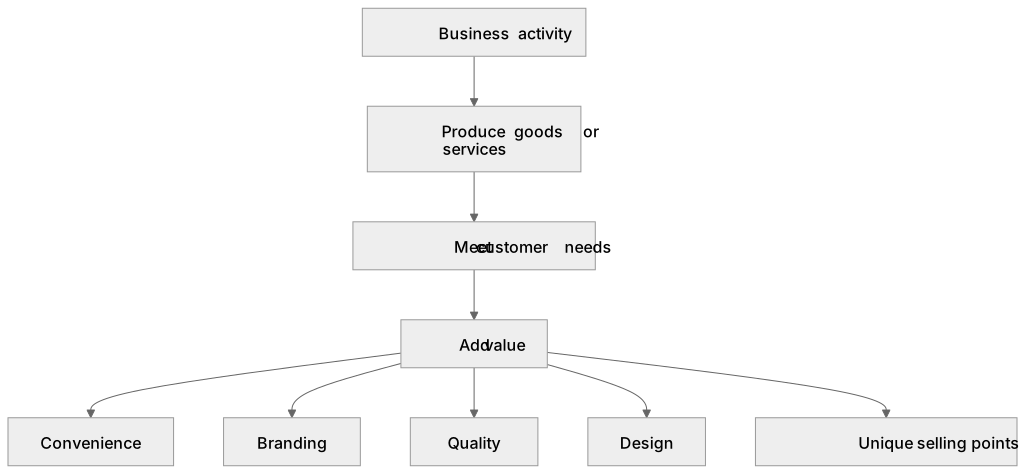
The role of business enterprise: activity: ● to produce goods or services ● to meet customer needs ● to add value: convenience, branding, quality, design, unique selling points.
Business activity exists to produce tangible goods, like smartphones, or intangible services, like haircuts, to meet specific customer needs.
Checked against the Pearson Edexcel 1BS0 specification (opens in a new tab) on .
- Point 2 of 3
- 4 key terms
Study notes
From the checked teaching notes for this specification point.
The idea
Business activity exists to produce tangible goods, like smartphones, or intangible services, like haircuts, to meet specific customer needs. By fulfilling these needs, businesses aim to add value, which is the difference between the cost of materials and the final selling price. Value can be added through several methods: offering convenience (such as a local shop open late), building strong branding that customers trust, ensuring high manufacturing quality, creating an appealing aesthetic design, or developing unique selling points (USPs) that differentiate the product from competitors.
For example: A coffee shop adds value to raw beans by providing a comfortable environment, skilled baristas, and a recognisable brand.
What earns the marks
- Define business activity as the process of producing goods or providing services to satisfy customer needs.
- Explain that adding value allows a business to charge a higher price than the cost of the raw materials used.
- Identify specific methods of adding value, including convenience, branding, quality, design, and unique selling points (USPs).
- Link the ability to meet customer needs directly to the business's capacity to generate sales and survive in a competitive market.
Common mistakes and how to put them right
Confusing goods and services.
Put it right: Goods are tangible physical products, whereas services are intangible actions performed for a customer.
Assuming adding value is the same as making a profit.
Put it right: Adding value is the difference between selling price and material costs, while profit must also deduct all other operating expenses.
Thinking a unique selling point (USP) just means being better.
Put it right: A USP must be a specific feature that competitors do not offer, not just a general claim of high quality.
Exam tips
- When asked how a business adds value, always apply your answer to the specific context provided in the case study, such as mentioning their specific brand or design feature.
- Use the formula 'Selling Price minus Cost of Raw Materials' to clearly define added value if asked for an explanation.
- If evaluating the best way to add value, consider the target market; convenience might be best for a busy commuter, while design might appeal more to a luxury shopper.
Try the lesson
The start of the The role of business enterprise: activity: ● to produce goods or services ● to meet customer needs ● to add value: convenience, branding, quality, design, unique selling points. lesson, made from checked teaching notes for this specification point.
Have a go first
A business activity aims to add value to its products. Which of the following is a way a business can achieve this?
Listen
Business activity exists to produce tangible goods, like smartphones, or intangible services, like haircuts, to meet specific customer needs. By fulfilling these needs, businesses aim to add value, which is the difference between the cost of materials and the final selling price. Value can be added through several methods: offering convenience (such as a local shop open late), building strong branding that customers trust, ensuring high manufacturing quality, creating an appealing aesthetic design, or developing unique selling points (USPs) that differentiate the product from competitors. For example, a coffee shop adds value to raw beans by providing a comfortable environment, skilled baristas, and a recognisable brand. A strong answer earns marks for these points. Define business activity as the process of producing goods or providing services to satisfy customer needs. Explain that adding value allows a business to charge a higher price than the cost of the raw materials used. Identify specific methods of adding value, including convenience, branding, quality, design, and unique selling points (USPs). Link the ability to meet customer needs directly to the business's capacity to generate sales and survive in a competitive market. Exam tip: When asked how a business adds value, always apply your answer to the specific context provided in the case study, such as mentioning their specific brand or design feature.
See it
Key words
Say what each word means before you turn the card.
Added value
Try answering aloud or in your head before turning the card.
Customer needs
Try answering aloud or in your head before turning the card.
Unique selling points
Try answering aloud or in your head before turning the card.
Branding
Try answering aloud or in your head before turning the card.
See every definition
- Added value
- The difference between the cost of materials and the final selling price.
- Customer needs
- The specific needs that business activity exists to meet by producing goods or services.
- Unique selling points
- Features that differentiate the product from competitors.
- Branding
- A method of adding value by building strong branding that customers trust.
Label the diagram
Some boxes have lost their names. Pick the right name for each number.
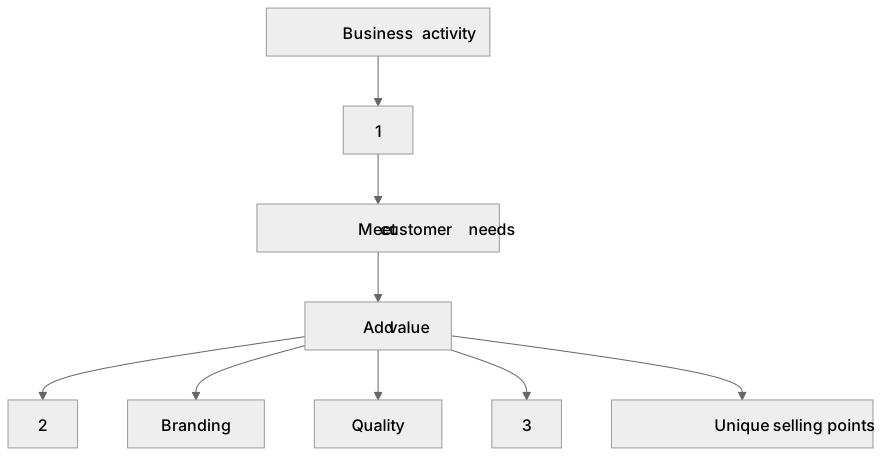
1Box 1
2Box 2
3Box 3
There is more to this lesson
The full lesson goes on to check your understanding and help you earn the marks. Create a free account to carry on, with your progress saved.
A week of Premium from your first lesson · Then the free plan continues · No card, no charge
Test your understanding of The role of business enterprise: activity: ● to produce goods or services ● to meet customer needs ● to add value: convenience, branding, quality, design, unique selling points.
Active recall beats re-reading. Take an instant quiz now to test what you’ve learned and lock it into long-term memory.
A week of Premium from your first lesson · Then the free plan continues · No card, no charge