Pearson Edexcel · GCSE · Business
Course version: 1BS0 · Version from Sept 2017
The role of entrepreneurship: ● an entrepreneur: organises resources,…
Full specification wording
The role of business enterprise: The role of entrepreneurship: ● an entrepreneur: organises resources, makes business decisions, takes risks.
Entrepreneurship plays a vital role in the economy by driving innovation and creating new businesses.
Checked against the Pearson Edexcel 1BS0 specification (opens in a new tab) on .
- Point 3 of 3
- 4 key terms
Study notes
From the checked teaching notes for this specification point.
The idea
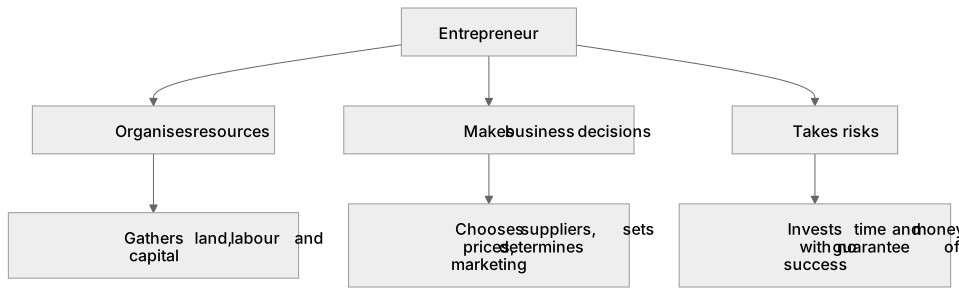
Entrepreneurship plays a vital role in the economy by driving innovation and creating new businesses. An entrepreneur is an individual who takes on the responsibility of starting and running a business enterprise. Their role involves three key functions: organising resources, making business decisions, and taking risks. Organising resources means gathering the necessary land, labour, and capital, such as hiring staff or renting a premises. Making business decisions involves choosing suppliers, setting prices, and determining marketing strategies. Finally, taking risks is essential, as the entrepreneur invests their own time and money with no guarantee of success, facing the possibility of financial loss if the business fails.
What earns the marks
- Define an entrepreneur as a person who sets up a business, taking on financial risks in the hope of profit.
- Explain that organising resources involves combining the factors of production (land, labour, capital) to create goods or services.
- Describe the decision-making role, which includes strategic choices like pricing, location, and product development.
- Identify that taking risks involves the potential loss of invested capital and personal time if the business venture is unsuccessful.
Common mistakes and how to put them right
Stating that entrepreneurs only take financial risks.
Put it right: They also risk their personal time, reputation, and opportunity costs (like giving up a stable salary).
Confusing an entrepreneur with a standard manager.
Put it right: While both make decisions, the entrepreneur is the one who assumes the ultimate risk of the business failing.
Assuming all entrepreneurs invent new products.
Put it right: Many entrepreneurs start businesses using existing ideas but organise resources more effectively or target a new market.
Exam tips
- When defining an entrepreneur, ensure you mention risk-taking, as this is the defining characteristic that examiners look for.
- Link the role of organising resources to the specific context of the exam question, such as an entrepreneur hiring web developers for a new app.
- If asked to evaluate the hardest part of being an entrepreneur, weigh the stress of financial risk against the complexity of making daily operational decisions.
Try the lesson
The start of the The role of business enterprise: The role of entrepreneurship: ● an entrepreneur: organises resources, makes business decisions, takes risks. lesson, made from checked teaching notes for this specification point.
Have a go first
Which of the following is a key role of an entrepreneur when starting a new business?
Listen
Entrepreneurship plays a vital role in the economy by driving innovation and creating new businesses. An entrepreneur is an individual who takes on the responsibility of starting and running a business enterprise. Their role involves three key functions: organising resources, making business decisions, and taking risks. Organising resources means gathering the necessary land, labour, and capital, such as hiring staff or renting a premises. Making business decisions involves choosing suppliers, setting prices, and determining marketing strategies. Finally, taking risks is essential, as the entrepreneur invests their own time and money with no guarantee of success, facing the possibility of financial loss if the business fails. A strong answer earns marks for these points. Define an entrepreneur as a person who sets up a business, taking on financial risks in the hope of profit. Explain that organising resources involves combining the factors of production (land, labour, capital) to create goods or services. Describe the decision-making role, which includes strategic choices like pricing, location, and product development. Identify that taking risks involves the potential loss of invested capital and personal time if the business venture is unsuccessful. Exam tip: When defining an entrepreneur, ensure you mention risk-taking, as this is the defining characteristic that examiners look for.
See it
Key words
Say what each word means before you turn the card.
Entrepreneur
Try answering aloud or in your head before turning the card.
Organising resources
Try answering aloud or in your head before turning the card.
Making business decisions
Try answering aloud or in your head before turning the card.
Taking risks
Try answering aloud or in your head before turning the card.
See every definition
- Entrepreneur
- An individual who takes on the responsibility of starting and running a business enterprise.
- Organising resources
- Gathering the necessary land, labour, and capital, such as hiring staff or renting a premises.
- Making business decisions
- Choosing suppliers, setting prices, and determining marketing strategies.
- Taking risks
- Investing own time and money with no guarantee of success, facing the possibility of financial loss if the business fails.
Label the diagram
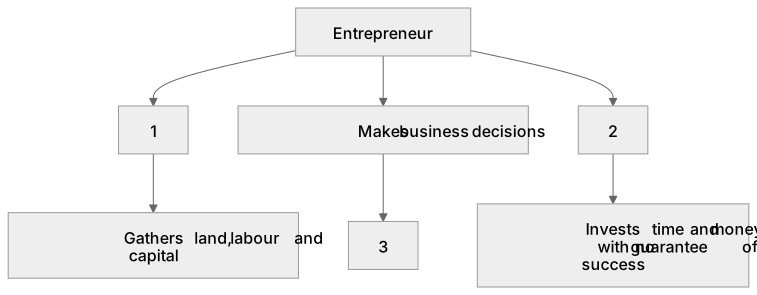
Some boxes have lost their names. Pick the right name for each number.
1Box 1
2Box 2
3Box 3
There is more to this lesson
The full lesson goes on to check your understanding and help you earn the marks. Create a free account to carry on, with your progress saved.
A week of Premium from your first lesson · Then the free plan continues · No card, no charge
Test your understanding of The role of business enterprise: The role of entrepreneurship: ● an entrepreneur: organises resources, makes business decisions, takes risks.
Active recall beats re-reading. Take an instant quiz now to test what you’ve learned and lock it into long-term memory.
A week of Premium from your first lesson · Then the free plan continues · No card, no charge