Pearson Edexcel · GCSE · Business
Course version: 1BS0 · Version from Sept 2017
The use and limitations of financial information in: ● understanding…
Full specification wording
Understanding business performance: The use and limitations of financial information in: ● understanding business performance ● making business decisions.
Financial data, such as profit margins and cash flow forecasts, is vital for understanding business performance and making informed decisions.
Checked against the Pearson Edexcel 1BS0 specification (opens in a new tab) on .
- Point 3 of 3
- 4 key terms
Study notes
From the checked teaching notes for this specification point.
The idea
Financial data, such as profit margins and cash flow forecasts, is vital for understanding business performance and making informed decisions. Managers use this quantitative data to assess profitability, allowing them to compare current performance against historical records or competitors. This directly informs strategic decisions, such as whether to expand operations or secure new finance. However, financial information has distinct limitations. Historical data reflects past performance rather than guaranteeing future success, while forecasts are only estimates. Furthermore, financial data ignores qualitative factors like staff morale and customer satisfaction, which are equally crucial for long-term decision-making.
What earns the marks
- Financial information allows stakeholders to evaluate profitability to judge overall business performance.
- Quantitative data supports objective business decisions, such as identifying areas to reduce costs or justifying expansion.
- A key limitation is that historical financial data reflects the past, meaning past performance does not guarantee future success, while forecasts are merely estimates.
- Financial information excludes qualitative variables, such as employee motivation or brand loyalty, which can significantly impact future performance.
Common mistakes and how to put them right
Assuming financial data provides a complete picture of business health.
Put it right: Recognise that qualitative factors like customer satisfaction are also essential.
Stating that all financial information is perfectly accurate.
Put it right: Explain that forward-looking financial statements, like cash flow forecasts, are estimates and may be incorrect.
Confusing the uses of financial data with its limitations.
Put it right: Clearly separate how data helps (e.g. spotting trends) from its drawbacks (e.g. ignoring staff morale).
Exam tips
- When evaluating a business decision, always balance financial data with at least one qualitative factor, such as the impact on the local community.
- Use specific examples of financial information, like gross profit margin or cash flow forecasts, rather than just saying 'numbers'.
- In 'Evaluate' questions, use the limitations of financial data as a strong counter-argument to a purely finance-driven decision.
Try the lesson
The start of the Understanding business performance: The use and limitations of financial information in: ● understanding business performance ● making business decisions. lesson, made from checked teaching notes for this specification point.
Have a go first
Which of the following is a common use of financial information when a manager is trying to understand business performance?
Listen
Financial data, such as profit margins and cash flow forecasts, is vital for understanding business performance and making informed decisions. Managers use this quantitative data to assess profitability, allowing them to compare current performance against historical records or competitors. This directly informs strategic decisions, such as whether to expand operations or secure new finance. However, financial information has distinct limitations. Historical data reflects past performance rather than guaranteeing future success, while forecasts are only estimates. Furthermore, financial data ignores qualitative factors like staff morale and customer satisfaction, which are equally crucial for long-term decision-making. A strong answer earns marks for these points. Financial information allows stakeholders to evaluate profitability to judge overall business performance. Quantitative data supports objective business decisions, such as identifying areas to reduce costs or justifying expansion. A key limitation is that historical financial data reflects the past, meaning past performance does not guarantee future success, while forecasts are merely estimates. Financial information excludes qualitative variables, such as employee motivation or brand loyalty, which can significantly impact future performance. A common slip: Assuming financial data provides a complete picture of business health. Instead, recognise that qualitative factors like customer satisfaction are also essential. Exam tip: When evaluating a business decision, always balance financial data with at least one qualitative factor, such as the impact on the local community.
See it
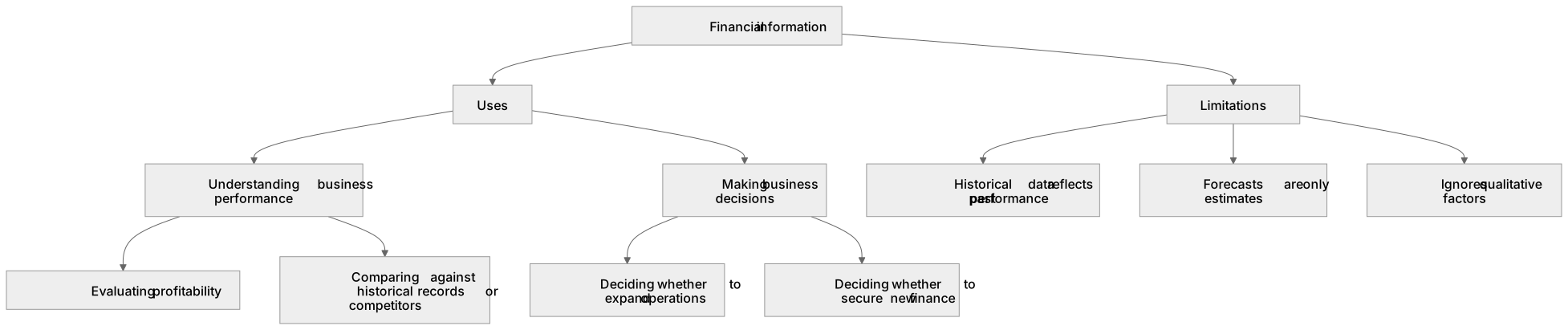
Key words
Say what each word means before you turn the card.
Business performance
Try answering aloud or in your head before turning the card.
Decision making
Try answering aloud or in your head before turning the card.
Quantitative vs qualitative data
Try answering aloud or in your head before turning the card.
Financial limitations
Try answering aloud or in your head before turning the card.
See every definition
- Business performance
- Financial data, such as profit margins and cash flow forecasts, is vital for understanding it, allowing profitability to be assessed and compared against historical records or competitors.
- Decision making
- Quantitative data supports objective business decisions, such as identifying areas to reduce costs or justifying expansion, and informs strategic decisions.
- Quantitative vs qualitative data
- Quantitative data supports objective business decisions, while financial information excludes qualitative variables, such as employee motivation or brand loyalty, which can significantly impact future performance.
- Financial limitations
- Historical data reflects past performance rather than guaranteeing future success, while forecasts are only estimates, and qualitative factors like staff morale and customer satisfaction are ignored.
Label the diagram
Some boxes have lost their names. Pick the right name for each number.
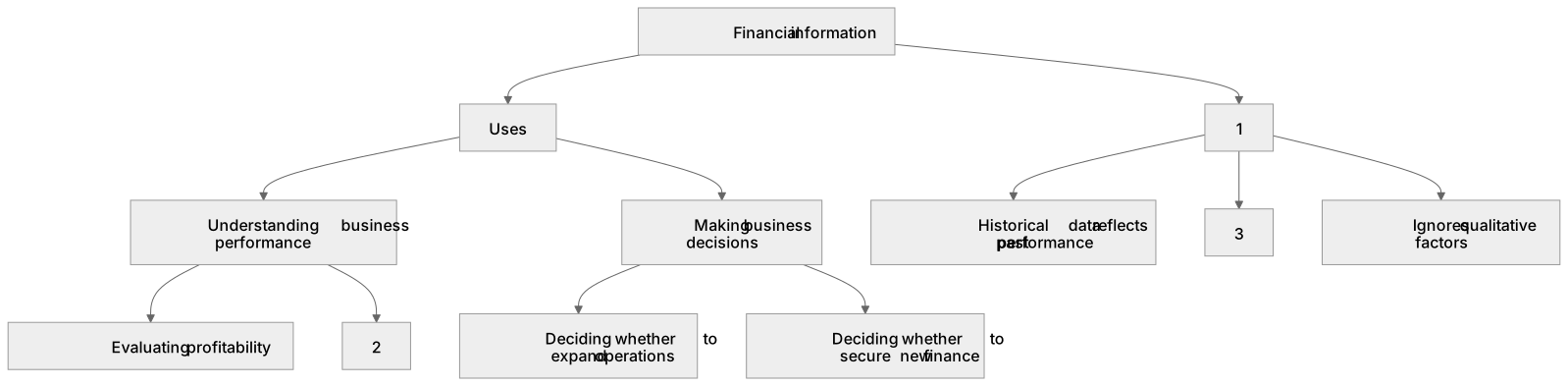
1Box 1
2Box 2
3Box 3
There is more to this lesson
The full lesson goes on to check your understanding and help you earn the marks. Create a free account to carry on, with your progress saved.
A week of Premium from your first lesson · Then the free plan continues · No card, no charge
Test your understanding of Understanding business performance: The use and limitations of financial information in: ● understanding business performance ● making business decisions.
Active recall beats re-reading. Take an instant quiz now to test what you’ve learned and lock it into long-term memory.
A week of Premium from your first lesson · Then the free plan continues · No card, no charge