Study Notes
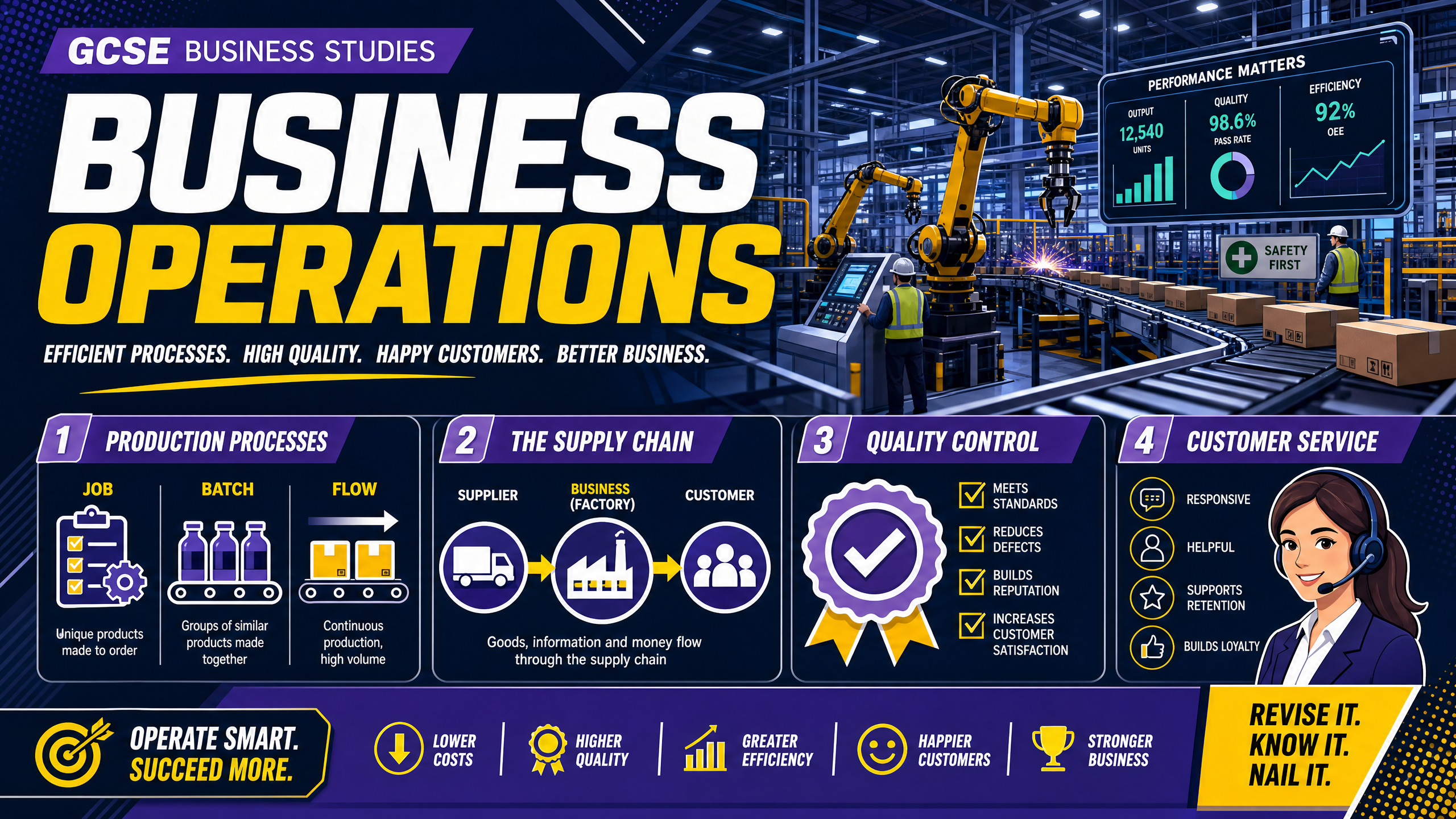
Overview
Business operations is the 'engine room' of any organisation. It focuses on the efficient management of key functions and resources to maximise profit while maintaining quality. For GCSE candidates, understanding operations is crucial because it forms the bridge between a business's aims and its day-to-day reality. Examiners expect you to not only understand the theory behind production methods, quality, and supply chains, but to apply these concepts to specific business scenarios. Strong answers will always link operational decisions back to costs, customer satisfaction, and overall business objectives.
Listen to our comprehensive revision podcast to solidify these concepts:
Production Methods
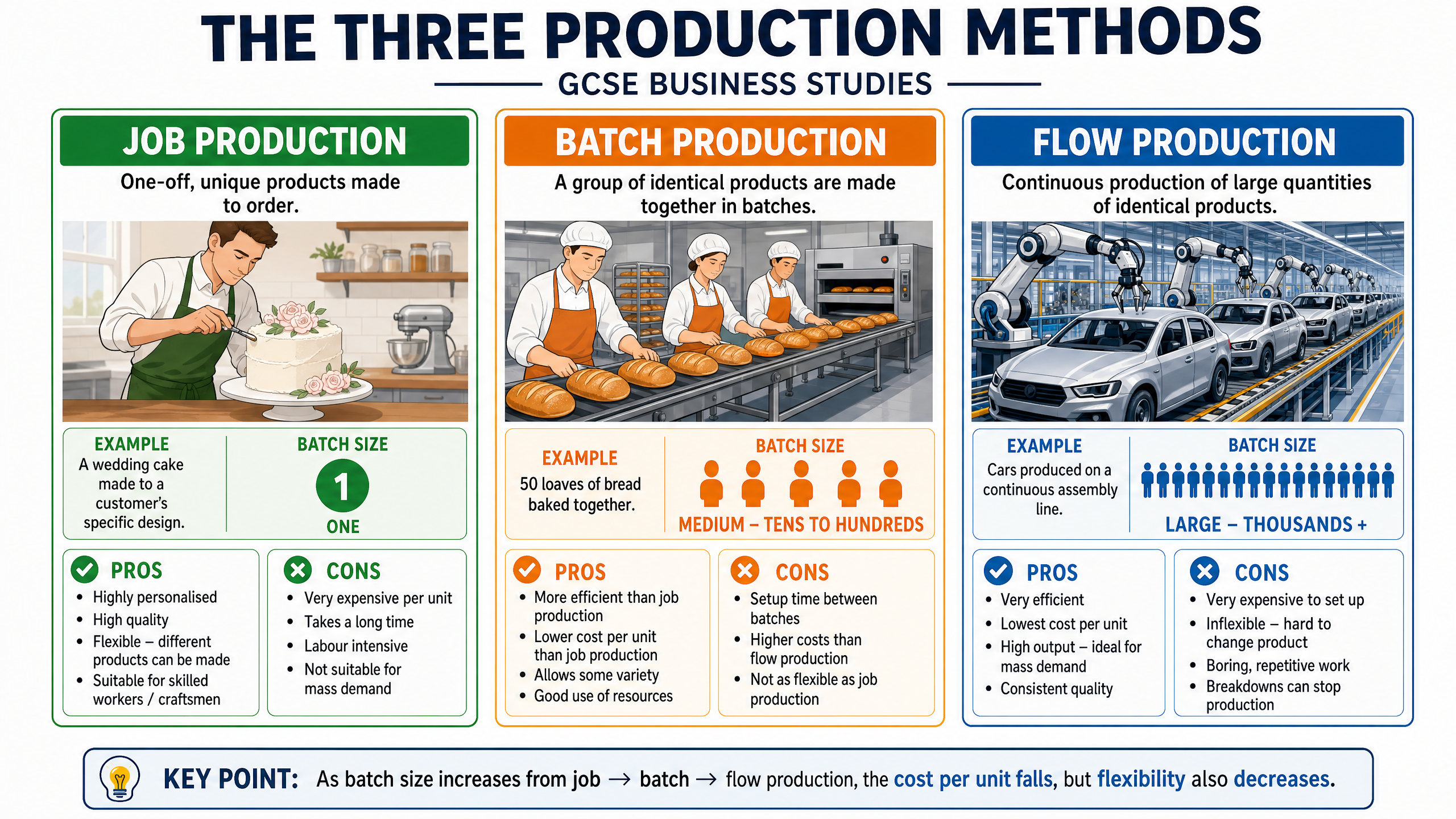
Job Production
What it is: Producing one unique, bespoke item at a time to a customer's specific requirements.
Key characteristics: Highly skilled labour, high cost per unit, low output volume.
Exam relevance: Candidates must recognize that while job production allows for premium pricing, it lacks economies of scale.
Batch Production
What it is: Producing a set quantity of identical items together before moving on to the next batch.
Key characteristics: Semi-skilled labour, lower cost per unit than job production, downtime between batches.
Exam relevance: Often tested in scenarios where a business needs to offer some variety but wants more efficiency than job production.
Flow Production
What it is: Continuous, automated production of large quantities of identical items.
Key characteristics: Capital intensive (expensive machinery), lowest cost per unit, inflexible.
Exam relevance: Crucial for understanding economies of scale. Candidates must weigh the huge setup costs against the long-term efficiency gains.
Quality Management
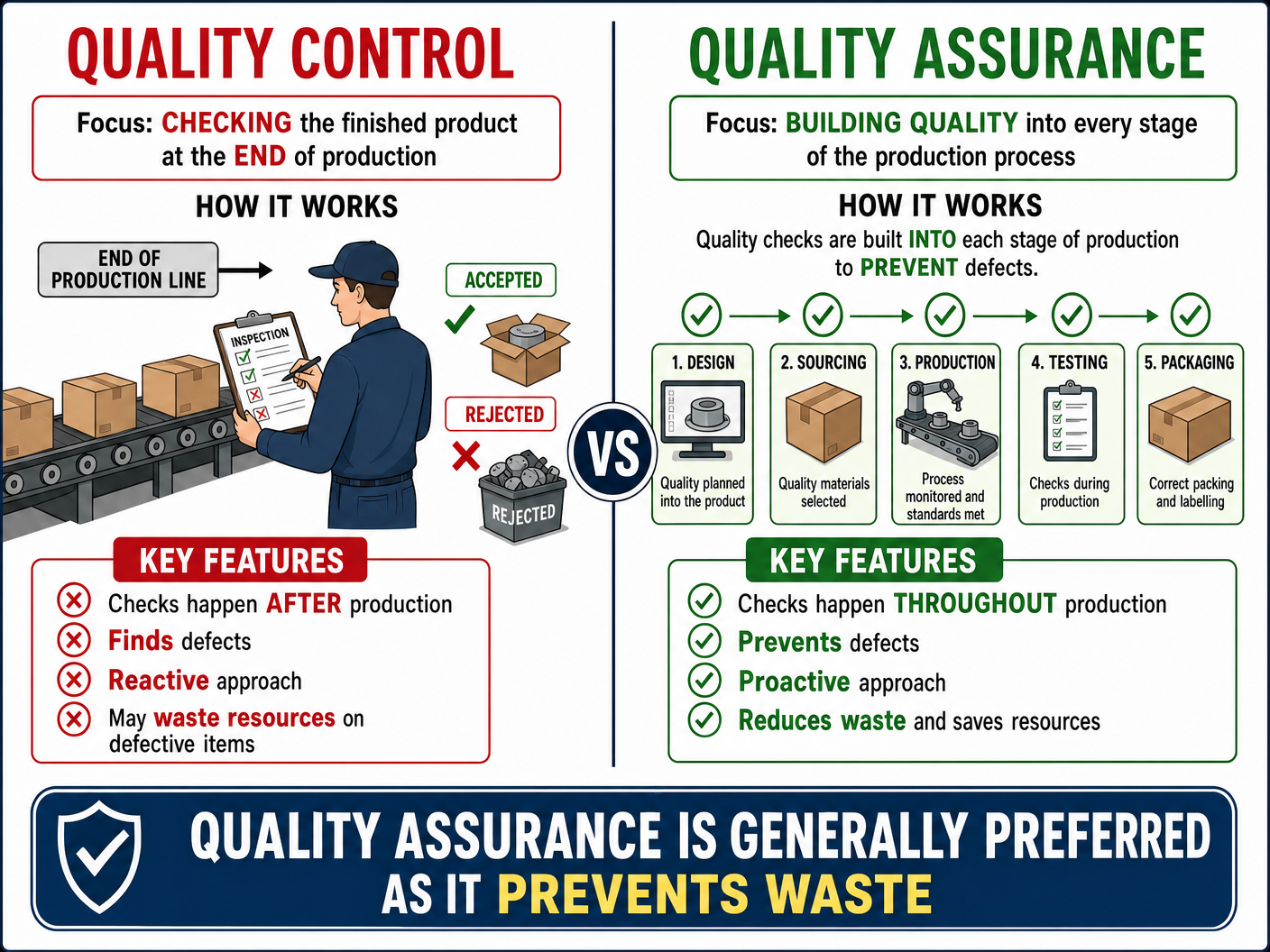
Quality Control
What it is: Inspecting products at the end of the production process to find defects.
Exam relevance: Examiners look for candidates who understand that this is a reactive approach that can lead to wasted resources if defective products are scrapped.
Quality Assurance
What it is: Building quality checks into every stage of the production process to prevent defects.
Exam relevance: This is a proactive approach. Strong candidates will explain how it reduces waste and long-term costs, even if it requires more initial training.
The Supply Chain
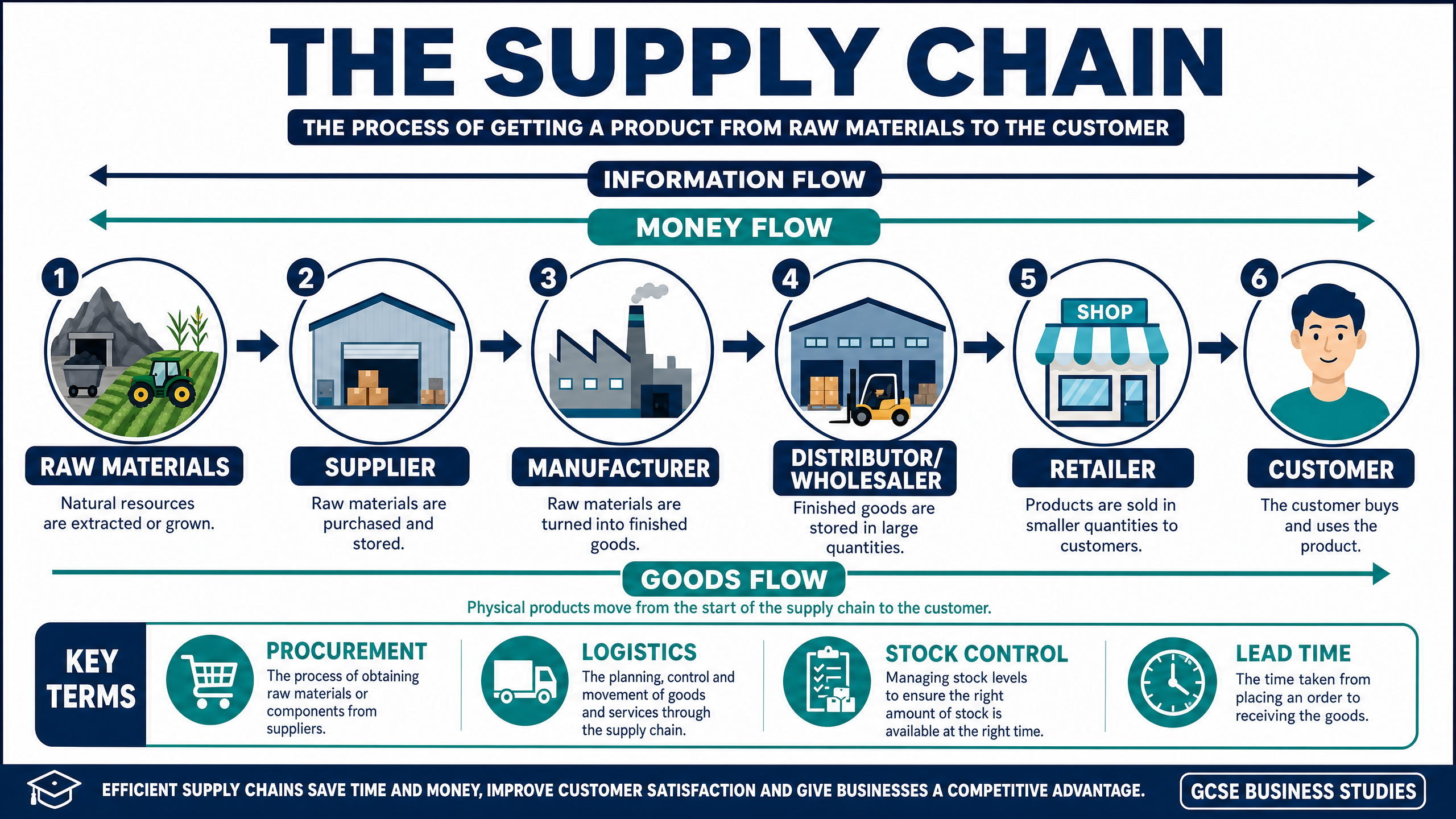
Procurement and Logistics
What it is: Procurement is obtaining raw materials; logistics is managing their movement.
Exam relevance: You must understand how reliable suppliers and efficient logistics impact a business's ability to meet customer demand.
Stock Control
What it is: Managing inventory levels. Key concepts include Just-in-Time (JIT) and Just-in-Case (JIC).
Exam relevance: JIT reduces storage costs but requires highly reliable suppliers. JIC ties up cash but provides a buffer against supply chain shocks.
Customer Service
The Sales Process
What it is: The steps taken to convert a potential lead into a paying customer.
Exam relevance: Excellent customer service builds brand loyalty, encourages repeat purchases, and differentiates a business in a competitive market.
Worked Examples
3 detailed examples with solutions and examiner commentary
Practice Questions
Test your understanding — click to reveal model answers
Explain two reasons why a smartphone manufacturer would choose flow production over batch production. (6 marks)
Hint: Think about the volume of smartphones needed and the impact on unit costs.
A local bakery currently uses quality control by checking cakes just before they are put in the shop window. Recommend whether they should switch to quality assurance. (9 marks)
Hint: Weigh the cost of wasted ingredients against the cost of training staff to check quality at every stage.
State two stages of a typical supply chain. (2 marks)
Hint: Think about the journey from raw materials to the customer.
Explain one impact of poor customer service on a business. (3 marks)
Hint: Think about the long-term effect on sales and reputation.
Analyze the impact on a business of implementing a Just-in-Time (JIT) stock control system. (6 marks)
Hint: Look at both the financial benefits and the operational risks.