Study Notes
Overview
The supplied curriculum label, 3.1.12 Acids and bases (A-level only), matches AQA A-level Chemistry 7405 rather than GCSE Chemistry. This guide therefore teaches the A-level content directly; GCSE students can use it as Higher-tier enrichment, but K_a, K_w, buffer calculations and full pH curves are A-level extensions. AQA places the topic in physical chemistry and assesses it in A-level Paper 1, so candidates need secure knowledge and reliable multi-step application. 1
At its heart, this topic is about moving protons and measuring the effect. You will identify Brønsted–Lowry acids and bases, calculate pH from concentrations, use the ionic product of water, calculate the pH of weak acids and buffers, and interpret titration curves. Questions may look numerical, practical or explanatory, but they all reward the same habits: identify the chemical system first, choose the correct relationship, show every substitution, and use precise equilibrium language. Candidates who can explain why an equilibrium shifts, rather than merely state that it does, gain the explanatory marks.
Key Concepts
1. Brønsted–Lowry acids, bases and conjugate pairs
A Brønsted–Lowry acid is a proton donor; a Brønsted–Lowry base is a proton acceptor. The proton is H^+. In an acid–base reaction, one species loses a proton and another gains it. The species formed when an acid loses H^+ is its conjugate base. The species formed when a base gains H^+ is its conjugate acid.
For ethanoic acid in water:
CH_3COOH(aq) + H_2O(l) \rightleftharpoons CH_3COO^-(aq) + H_3O^+(aq)
Ethanoic acid donates H^+, so it is the acid; ethanoate is its conjugate base. Water accepts H^+, so it is the base; H_3O^+ is its conjugate acid. The reversible arrow matters: weak acids establish an equilibrium rather than dissociating completely. Credit is given for pairing the acid with the species formed after it donates a proton, not merely for listing four labels. 1
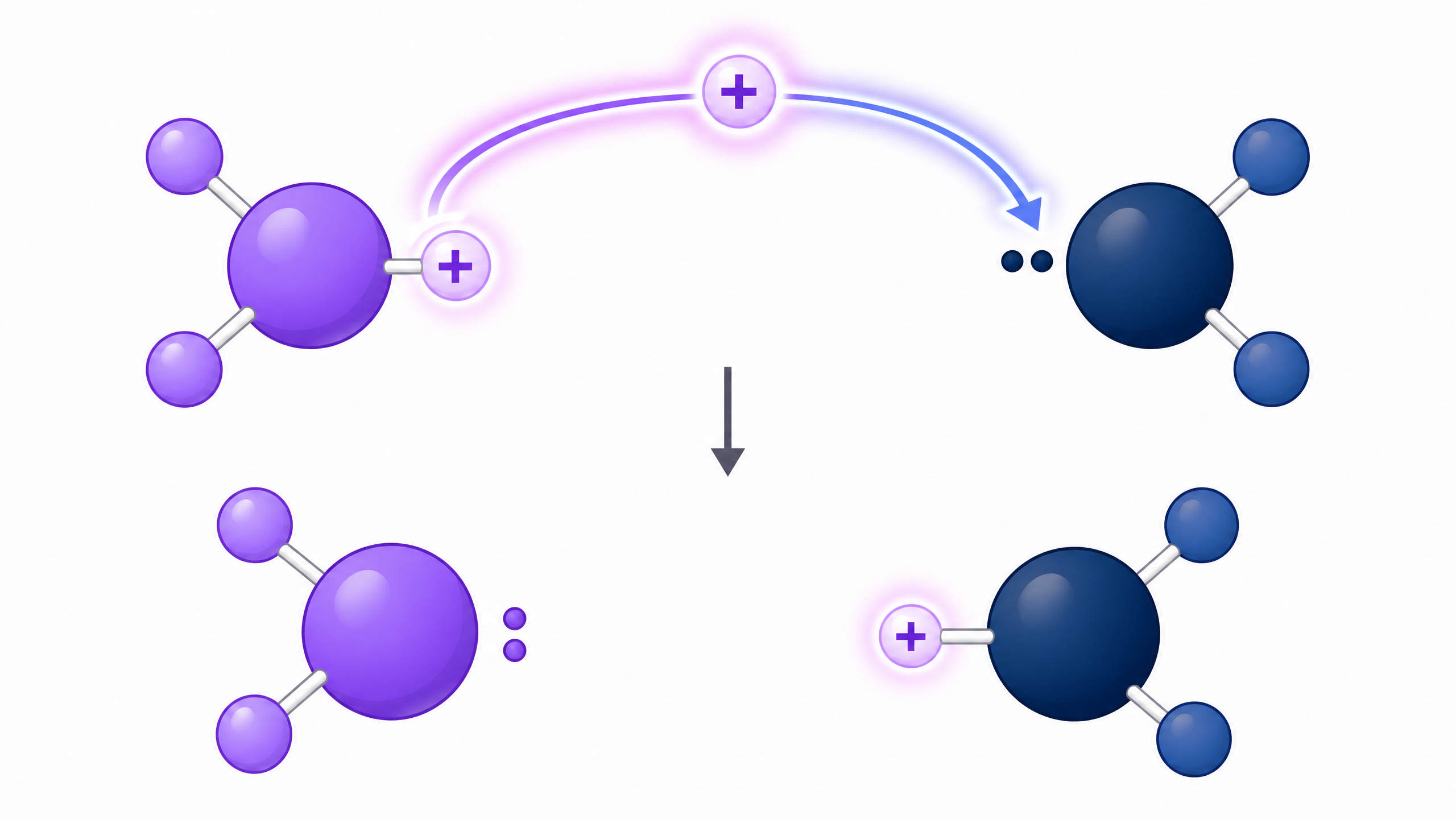
Memory hook — BAAD: Bases Accept; Acids Donate. When you identify a species, track the proton: if it leaves, that species was the acid; if it arrives, that species was the base.
2. pH is logarithmic, not linear
The pH scale makes very small hydrogen ion concentrations manageable:
pH = -\log_{10}[H^+]
A pH change of one is a ten-fold change in [H^+], not a one-unit change. A solution at pH 3 has ten times the hydrogen ion concentration of a solution at pH 4. When pH is given, reverse the calculation using [H^+] = 10^{-pH}.
For a strong monoprotic acid, assume complete dissociation. Therefore 0.0500 mol,dm^{-3} nitric acid gives [H^+] = 0.0500,mol,dm^{-3}, so pH = -\log_{10}(0.0500) = 1.30. Do not make this shortcut for a weak acid: its initial acid concentration is not its hydrogen ion concentration.
Strength and concentration are different ideas. Strength is the extent of dissociation; concentration is the amount dissolved per dm^3. A concentrated weak acid may contain more H^+ than a very dilute strong acid. Candidates lose marks when they call a strong acid “strong because it is concentrated”.
3. Water and $K_w$: use the temperature given
Water is slightly dissociated:
H_2O(l) \rightleftharpoons H^+(aq) + OH^-(aq)
The ionic product of water is:
K_w = [H^+][OH^-]
At 298 K, K_w = 1.00 \times 10^{-14},mol^2,dm^{-6}. A strong base supplies OH^-, so first calculate [OH^-], then rearrange to [H^+] = \frac{K_w}{[OH^-]}, and finally calculate pH. For 0.150 mol,dm^{-3} Ba(OH)_2, two hydroxide ions are released per formula unit, giving [OH^-] = 0.300,mol,dm^{-3}. Missing this factor of two is a common lost mark.
K_w varies with temperature. Neutrality means [H^+] = [OH^-]; it does not always mean pH 7. At a higher temperature, pure water can have a pH below 7 and still be neutral because both ion concentrations have increased by the same amount. A precise explanation names both the changed K_w and the equal ion concentrations. 1
4. Weak acids, $K_a$ and $pK_a$
A weak acid only partially dissociates. For a general weak acid HA:
HA(aq) \rightleftharpoons H^+(aq) + A^-(aq)
K_a = \frac{[H^+][A^-]}{[HA]}
A larger K_a means the equilibrium lies further right and the acid dissociates more: the acid is stronger. pK_a = -\log_{10}K_a, so a stronger acid has a larger K_a but a smaller pK_a.
In most A-level weak-acid calculations, make two stated approximations. First, only a small amount of HA dissociates, so equilibrium [HA] \approx initial [HA]. Second, every dissociated HA produces one H^+ and one A^-, so [H^+] \approx [A^-]. The expression becomes:
K_a = \frac{[H^+]^2}{[HA]}, so [H^+] = \sqrt{K_a[HA]}
Use this only for a weak acid when the approximation is reasonable. The reliable workflow is: write the formula; substitute with brackets; calculate [H^+]; then apply the negative logarithm. Never take -\log before taking the square root.
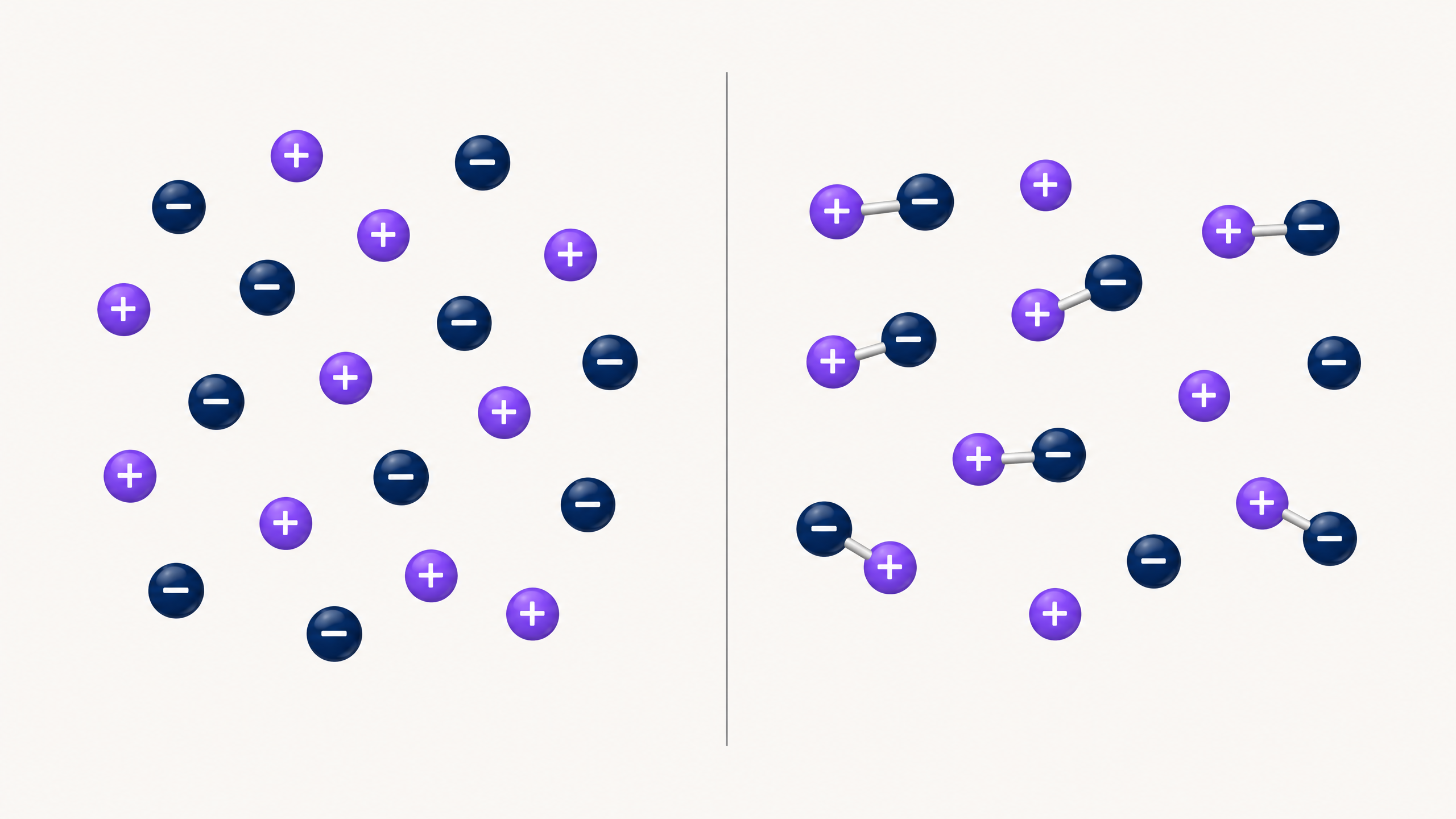
Memory hook — “To find the H, root the K times A.” It prompts [H^+] = \sqrt{K_a \times [HA]} for the simplified weak-acid calculation.
5. Titration curves, equivalence points and indicators
A pH curve plots pH on the y-axis against volume of titrant added on the x-axis. It shows the gradual and rapid pH changes during a titration. The equivalence point is the stoichiometric point where the reacting acid and base have exactly neutralised each other according to the balanced equation. It is not automatically pH 7.
| Titration | Curve features to explain | Equivalence point | Indicator implication |
|---|---|---|---|
| Strong acid + strong base | Very low starting pH; steep vertical region | About pH 7 | Methyl orange or phenolphthalein can work |
| Weak acid + strong base | Higher starting pH; buffer region; sharp rise | Above pH 7 | Phenolphthalein is suitable |
| Strong acid + weak base | Low starting pH; smaller steep region | Below pH 7 | Methyl orange is suitable |
| Weak acid + weak base | Gradual change; no useful sharp vertical section | Less distinct | Visual indicators are unsuitable |
Select an indicator whose colour-change range lies inside the vertical section. The endpoint is the observed colour change; the equivalence point is the exact stoichiometric neutralisation point. Examiners can test this distinction in a practical or graph question. At the half-neutralisation point of a weak acid–strong base titration, half the acid has become conjugate base, so [HA] = [A^-]. Therefore [H^+] = K_a and pH = pK_a. 1
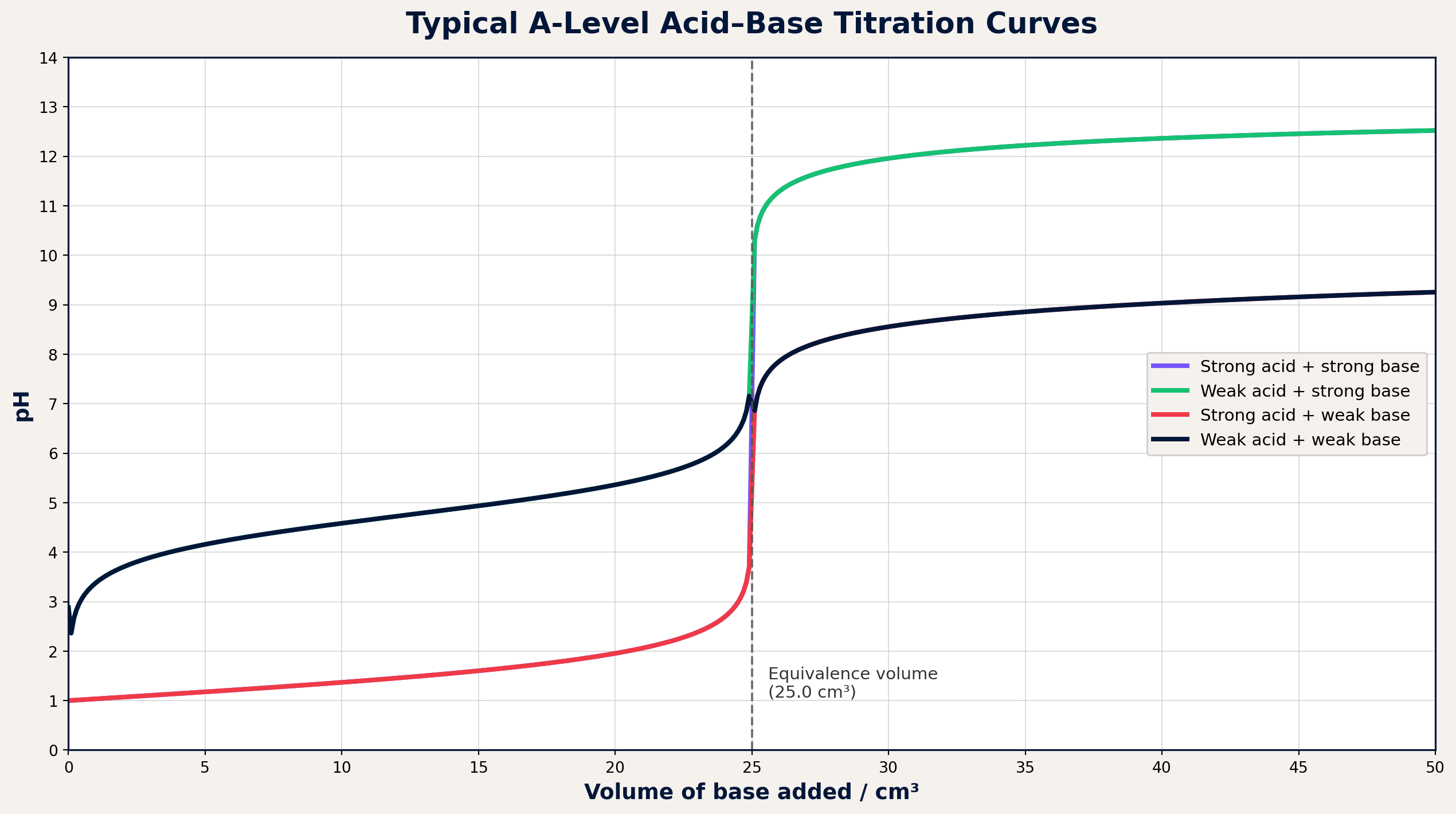
Memory hook — “Half-way there, pH is pK_a.” Find the equivalence volume, halve it, then read the pH at that half-volume.
6. Buffers: two reservoirs working together
A buffer maintains an approximately constant pH after dilution or addition of a small amount of acid or base. An acidic buffer contains a weak acid and the salt of that acid, for example CH_3COOH and sodium ethanoate. The salt supplies a high concentration of CH_3COO^-; the weak acid supplies CH_3COOH.
If a small amount of strong acid is added, the added H^+ reacts with ethanoate ions:
CH_3COO^-(aq) + H^+(aq) \rightarrow CH_3COOH(aq)
This removes most added H^+; the equilibrium shifts left. If a small amount of alkali is added, hydroxide ions react with the weak acid:
CH_3COOH(aq) + OH^-(aq) \rightarrow CH_3COO^-(aq) + H_2O(l)
This removes most added OH^-; the weak acid dissociation equilibrium shifts right to replace some lost H^+. For full explanatory credit, name the species that reacts, write or describe the reaction, and state the effect on [H^+] or pH. Avoid the vague phrase “the buffer neutralises it” without identifying how.
For an acidic buffer, rearrange the K_a expression:
[H^+] = K_a \times \frac{[HA]}{[A^-]}
If both components are mixed into one final volume, moles can be used in the ratio because the common final volume cancels. However, candidates must first ensure they have used the amounts after any neutralisation reaction, not simply the original label concentrations.
Mathematical and Scientific Relationships
| Relationship | What it tells you | When to use it | Formula-sheet status |
|---|---|---|---|
| $pH = -\log_{10}[H^+]$ | Converts hydrogen ion concentration into pH | Any aqueous solution when $[H^+]$ is known | Must memorise |
| $[H^+] = 10^{-pH}$ | Converts pH into hydrogen ion concentration | Finding $K_a$, or working backwards from pH | Must memorise |
| $K_w = [H^+][OH^-]$ | Links ion concentrations in water | Strong-base and temperature questions | Must memorise |
| $K_a = \frac{[H^+][A^-]}{[HA]}$ | Describes weak-acid dissociation | Constructing or rearranging an acid equilibrium | Must memorise |
| $[H^+] = \sqrt{K_a[HA]}$ | Simplified weak-acid relationship | Only where both weak-acid approximations apply | Must memorise |
| $pK_a = -\log_{10}K_a$ | Links $K_a$ to p$K_a$ | Comparing acid strengths and half-neutralisation questions | Must memorise |
| $[H^+] = K_a\frac{[HA]}{[A^-]}$ | Acidic-buffer relationship | Buffer pH calculations | Must memorise |
Unit conversion check: 1000,cm^3 = 1,dm^3; convert a volume in cm^3 to dm^3 before using n = cV. Concentration is normally mol,dm^{-3}; K_w has units mol^2,dm^{-6} in the concentration treatment used here. pH and pK_a have no units. In a pH answer, two decimal places is normally appropriate because it reflects the logarithmic calculation.
Required Practical 9: pH curves from titrations
AQA Required Practical 9 investigates how pH changes when a weak acid reacts with a strong base and when a strong acid reacts with a weak base. It connects apparatus technique, graph plotting, indicator choice and equilibrium reasoning. 1
| Aspect | What a high-quality practical response includes |
|---|---|
| Apparatus | pH meter and electrode, calibration buffers, burette and stand, 25.0 $cm^3$ pipette and filler, conical flask, white tile, wash bottle, and the acid/base solutions |
| Core method | Calibrate the pH meter with buffer solutions; pipette a measured acid volume into a flask; record initial pH; add base from a burette in measured increments; stir and record pH after each addition; use smaller, dropwise increments near equivalence; repeat for the second acid–base combination |
| Graph method | Put volume of base added / $cm^3$ on the x-axis, pH on the y-axis; use a sensible even scale; plot accurately; draw a smooth best-fit curve rather than joining points with ruler segments |
| Expected pattern | Weak acid + strong base has an initial buffer region and equivalence pH above 7; strong acid + weak base has an equivalence pH below 7 |
| Accuracy and reliability | Rinse apparatus with the solution it will contain, rinse the pH electrode with deionised water and blot gently, keep the electrode immersed, allow readings to stabilise, repeat trials, and use smaller additions near the vertical section |
Common errors include failing to calibrate the pH meter, reading pH before mixing is complete, using large titrant additions near equivalence, leaving air bubbles in the burette tip, and plotting the axes the wrong way round. In written papers, examiners may ask why smaller additions are needed near the endpoint, how to improve repeatability, why a pH meter is better than a colour change for continuous data, or which indicator is justified by the curve. A strong answer links each improvement to the error it reduces.
Exam-Focused Checklist
Before submitting a calculation, candidates should check four things. First, have you identified the system as strong acid, strong base, weak acid or buffer? Second, have you used the correct concentrations after dilution, stoichiometry or the number of hydroxide ions released? Third, have you shown the formula, substitution and intermediate value so method marks can be awarded? Finally, does the answer make chemical sense: pH below 7 for acids, above 7 for bases at 298 K, with a realistic magnitude?
For a graph question, describe the data before explaining it. For example: “The pH rises gradually from about 3, then rises steeply at 25.0 cm^3.” Then explain: “The initial gradual region is a buffer because both weak acid and ethanoate are present; the steep change occurs as the weak acid is neutralised.” This separates observation from chemical reasoning and makes every marking point easy to credit.
GCSE Bridge and Tier Note
There is no GCSE Foundation/Higher tier split for this topic because AQA 3.1.12 is A-level only. GCSE knowledge of neutralisation, indicators, the pH scale and simple acid reactions is useful prior knowledge. The A-level step-up is the use of Brønsted–Lowry definitions, logarithms, equilibrium constants, temperature-dependent K_w, buffers and fully interpreted pH curves. If you are revising GCSE only, prioritise the bridge concepts and use the rest as extension work.
References
Visual Resources
3 diagrams and illustrations
Interactive Diagrams
2 interactive diagrams to visualise key concepts
Conceptual Flow Outline
Flowchart for deciding which pH calculation pathway to use.
Conceptual Flow Outline
How an acidic buffer responds to the addition of acid or base.
Worked Examples
4 detailed examples with solutions and examiner commentary
Practice Questions
Test your understanding — click to reveal model answers
Calculate the pH of water at 323 K, given that K_w at this temperature is 5.48 \times 10^{-14},mol^2,dm^{-6}. State whether the water is acidic, alkaline, or neutral at this temperature.
Hint: In pure water, every $H_2O$ molecule that dissociates produces one $H^+$ and one $OH^-$.
A 0.100 mol,dm^{-3} solution of propanoic acid has a pH of 2.94. Calculate the K_a of propanoic acid.
Hint: Work backwards from the pH to find $[H^+]$, then use the simplified $K_a$ expression.
A buffer solution contains 0.400 mol,dm^{-3} methanoic acid (K_a = 1.78 \times 10^{-4},mol,dm^{-3}) and 0.600 mol,dm^{-3} sodium methanoate. Calculate the pH of this buffer.
Hint: Use the rearranged $K_a$ expression for a buffer: $[H^+] = K_a \times \frac{[HA]}{[A^-]}$.
Explain qualitatively how a buffer solution made from ethanoic acid and sodium ethanoate maintains a nearly constant pH when a small amount of hydrochloric acid is added.
Hint: Identify the ions present in the buffer and explain which one reacts with the added $H^+$.
Sketch the pH curve for the titration of 25.0 cm^3 of 0.100 mol,dm^{-3} ethanoic acid with 0.100 mol,dm^{-3} sodium hydroxide. Label the equivalence point.
Hint: Think about the starting pH of a weak acid, the vertical section, and the final pH of a strong base.