AQA · A-Level · Chemistry
Course version: 7405 · Version from Sept 2016
Students should be able to: explain why cisplatin prevents DNA replication…
Full specification wording
Action of anticancer drugs (A-level only): Students should be able to: explain why cisplatin prevents DNA replication explain why such drugs can have adverse effects.
Two explain commands, and each needs a chain of reasoning rather than a fact.
Checked against the AQA 7405 specification (opens in a new tab) on .
- Point 4 of 4
- 4 key terms
Study notes
From the checked teaching notes for this specification point.
The idea
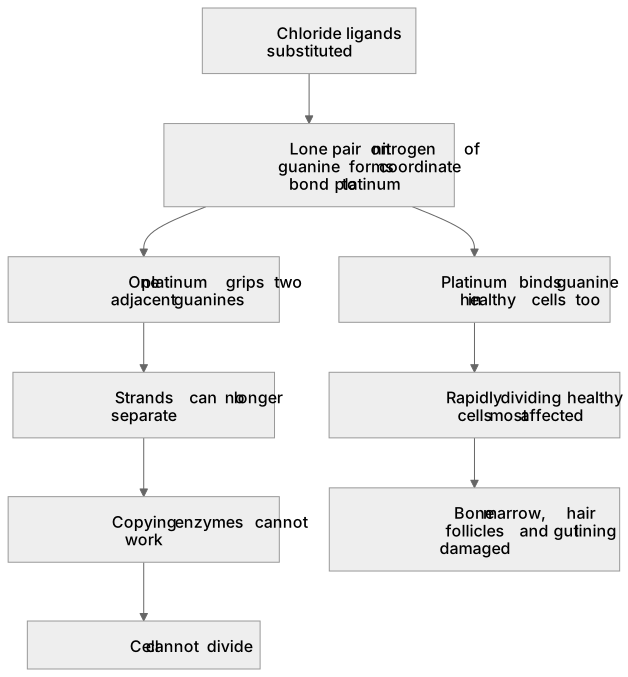
Two explain commands, and each needs a chain of reasoning rather than a fact. For the first, the chain runs: the chloride ligands are substituted, a lone pair on a nitrogen atom of guanine forms a coordinate bond to platinum, the adjacent arrangement lets one platinum grip two guanines, the strands can no longer separate, so the copying enzymes cannot work and the cell cannot divide. For the second, the chain runs: platinum binds guanine wherever it finds it, healthy cells contain the same base, and the tissues hit hardest are those dividing fastest, so bone marrow, hair follicles and the gut lining are damaged. Both chains end at a consequence, for the cell or for the patient, and that is where the final mark usually sits.
What earns the marks
- Naming ligand substitution of the chloride ligands as the first step.
- The coordinate bond from a nitrogen atom of guanine to the platinum.
- The consequence that the strands cannot separate, so replication is prevented.
- Explaining adverse effects by the same binding happening in healthy cells.
- Identifying rapidly dividing healthy cells as the ones most affected.
Common mistakes and how to put them right
Describing what the drug does but never reaching the consequence that the cell cannot divide.
Explaining adverse effects as an allergic reaction rather than as binding to DNA in healthy cells.
Writing that it attacks the cancer, which explains nothing.
Muddling the two explanations, so the answer about side effects repeats the replication mechanism.
Exam tips
- Write the mechanism as numbered steps; explain marks are awarded for the links between steps.
- Check that you have answered both halves of a two-part explain question; students routinely answer the first and forget the second.
- Reuse the specification's own words, ligand replacement and coordinate bond, because the mark scheme is written from them.
Try the lesson
The start of the Action of anticancer drugs (A-level only): Students should be able to: explain why cisplatin prevents DNA replication explain why such drugs can have adverse effects. lesson, made from checked teaching notes for this specification point.
Have a go first
Cisplatin is an effective anticancer drug. How does the action of cisplatin prevent DNA replication in cancer cells?
Listen
Two explain commands, and each needs a chain of reasoning rather than a fact. For the first, the chain runs: the chloride ligands are substituted, a lone pair on a nitrogen atom of guanine forms a coordinate bond to platinum, the adjacent arrangement lets one platinum grip two guanines, the strands can no longer separate, so the copying enzymes cannot work and the cell cannot divide. For the second, the chain runs: platinum binds guanine wherever it finds it, healthy cells contain the same base, and the tissues hit hardest are those dividing fastest, so bone marrow, hair follicles and the gut lining are damaged. Both chains end at a consequence, for the cell or for the patient, and that is where the final mark usually sits. A strong answer earns marks for these points. naming ligand substitution of the chloride ligands as the first step. the coordinate bond from a nitrogen atom of guanine to the platinum. the consequence that the strands cannot separate, so replication is prevented. explaining adverse effects by the same binding happening in healthy cells. Exam tip: Write the mechanism as numbered steps; explain marks are awarded for the links between steps.
See it
Key words
Say what each word means before you turn the card.
chain of reasoning
Try answering aloud or in your head before turning the card.
ligand replacement
Try answering aloud or in your head before turning the card.
coordinate bond
Try answering aloud or in your head before turning the card.
rapidly dividing cells
Try answering aloud or in your head before turning the card.
See every definition
- chain of reasoning
- A sequence of linked steps that ends at a consequence, for the cell or for the patient, rather than a single fact.
- ligand replacement
- The substitution of the chloride ligands, which is the first step in the mechanism.
- coordinate bond
- Formed from a lone pair on a nitrogen atom of guanine to the platinum.
- rapidly dividing cells
- The healthy cells most affected, such as bone marrow, hair follicles and the gut lining.
Label the diagram
Some boxes have lost their names. Pick the right name for each number.
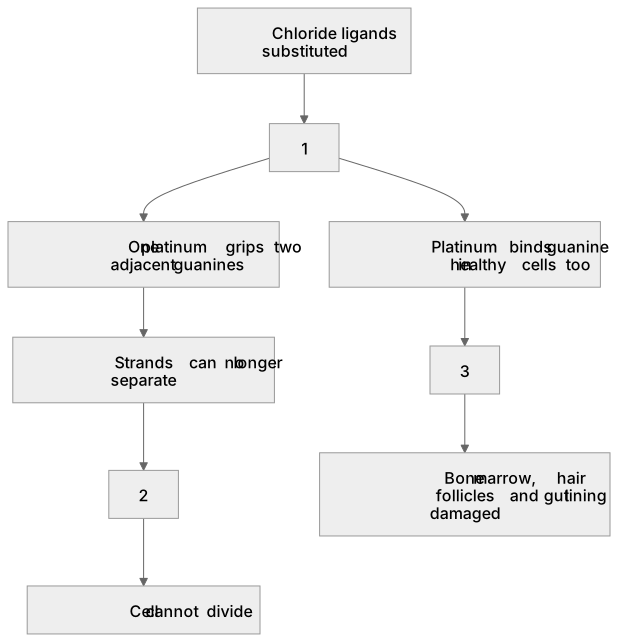
1Box 1
2Box 2
3Box 3
There is more to this lesson
The full lesson goes on to check your understanding and help you earn the marks. Create a free account to carry on, with your progress saved.
A week of Premium from your first lesson · Then the free plan continues · No card, no charge
Test your understanding of Action of anticancer drugs (A-level only): Students should be able to: explain why cisplatin prevents DNA replication explain why such drugs can have adverse effects.
Active recall beats re-reading. Take an instant quiz now to test what you’ve learned and lock it into long-term memory.
A week of Premium from your first lesson · Then the free plan continues · No card, no charge