AQA · A-Level · Chemistry
Course version: 7405 · Version from Sept 2016
Required practical 10 Preparation of: a pure organic solid and test of its…
Full specification wording
Acylation (A-level only): Required practical 10 Preparation of: a pure organic solid and test of its purity a pure organic liquid.
The solid preparation, typically aspirin, is purified by recrystallisation: dissolve the crude solid in the minimum volume of hot solvent, filter hot to take out insoluble impurities, cool so the…
Checked against the AQA 7405 specification (opens in a new tab) on .
- Point 5 of 5
- 4 key terms
Study notes
From the checked teaching notes for this specification point.
The idea
The solid preparation, typically aspirin, is purified by recrystallisation: dissolve the crude solid in the minimum volume of hot solvent, filter hot to take out insoluble impurities, cool so the product crystallises while the soluble impurities stay in solution, filter under reduced pressure, wash the crystals with a little cold solvent and dry them. Purity is tested by melting point: a pure sample melts sharply at the value in the data book, and an impure one melts lower and over a range. The liquid preparation, typically an ester, is distilled, then shaken in a separating funnel with sodium carbonate solution to remove acid, venting the carbon dioxide, dried with an anhydrous salt and redistilled over the right boiling range.
What earns the marks
- Dissolving the crude solid in the minimum volume of hot solvent.
- A sharp melting point at the literature value as the test of purity.
- Washing the organic liquid with sodium carbonate solution, with carbon dioxide released.
- Drying the liquid with an anhydrous salt before redistillation.
- Collecting the distillate over the correct boiling range.
Common mistakes and how to put them right
Using more hot solvent than the minimum, so much of the product stays dissolved on cooling and the yield falls.
Washing the crystals with hot solvent, which redissolves them.
Saying impurities raise the melting point, when they lower it and widen the range.
Failing to vent the separating funnel, when carbon dioxide from the carbonate raises the pressure.
Keeping the aqueous layer and discarding the organic layer after the wash.
Exam tips
- Learn the order of the liquid purification: distil, wash, separate, dry, redistil. Questions often ask you to justify one step in that sequence.
- When justifying a melting point measurement, say both things AQA wants: sharp, and matching the data book value.
Try the lesson
The start of the Acylation (A-level only): Required practical 10 Preparation of: a pure organic solid and test of its purity a pure organic liquid. lesson, made from checked teaching notes for this specification point.
Have a go first
In Required practical 10, which technique is used to purify a solid organic product by dissolving it in the minimum volume of hot solvent and allowing it to crystallise as it cools?
Listen
The solid preparation, typically aspirin, is purified by recrystallisation: dissolve the crude solid in the minimum volume of hot solvent, filter hot to take out insoluble impurities, cool so the product crystallises while the soluble impurities stay in solution, filter under reduced pressure, wash the crystals with a little cold solvent and dry them. Purity is tested by melting point: a pure sample melts sharply at the value in the data book, and an impure one melts lower and over a range. The liquid preparation, typically an ester, is distilled, then shaken in a separating funnel with sodium carbonate solution to remove acid, venting the carbon dioxide, dried with an anhydrous salt and redistilled over the right boiling range. A strong answer earns marks for these points. dissolving the crude solid in the minimum volume of hot solvent. a sharp melting point at the literature value as the test of purity. washing the organic liquid with sodium carbonate solution, with carbon dioxide released. drying the liquid with an anhydrous salt before redistillation. Exam tip: Learn the order of the liquid purification: distil, wash, separate, dry, redistil. Questions often ask you to justify one step in that sequence.
See it
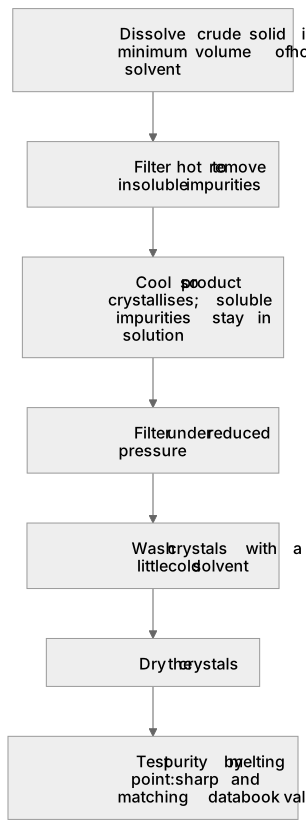
Put it in order
Put these steps in the order they happen.
- 1. Test purity by melting point: sharp and matching data book value
- 2. Dry the crystals
- 3. Cool so product crystallises; soluble impurities stay in solution
- 4. Wash crystals with a little cold solvent
- 5. Dissolve crude solid in minimum volume of hot solvent
- 6. Filter hot to remove insoluble impurities
- 7. Filter under reduced pressure
Key words
Say what each word means before you turn the card.
recrystallisation
Try answering aloud or in your head before turning the card.
melting point as a purity test
Try answering aloud or in your head before turning the card.
separating funnel
Try answering aloud or in your head before turning the card.
drying agents
Try answering aloud or in your head before turning the card.
See every definition
- recrystallisation
- Dissolve the crude solid in the minimum volume of hot solvent, filter hot to take out insoluble impurities, then cool so the product crystallises while the soluble impurities stay in solution.
- melting point as a purity test
- A pure sample melts sharply at the value in the data book, and an impure one melts lower and over a range.
- separating funnel
- The organic liquid is shaken in it with sodium carbonate solution to remove acid, venting the carbon dioxide.
- drying agents
- An anhydrous salt is used to dry the organic liquid before redistillation.
Label the diagram
Some boxes have lost their names. Pick the right name for each number.
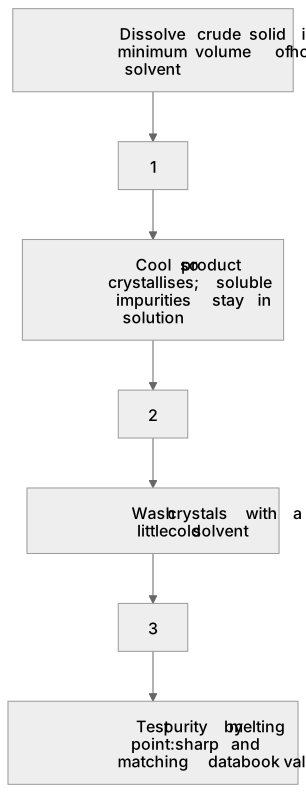
1Box 1
2Box 2
3Box 3
There is more to this lesson
The full lesson goes on to check your understanding and help you earn the marks. Create a free account to carry on, with your progress saved.
A week of Premium from your first lesson · Then the free plan continues · No card, no charge
Test your understanding of Acylation (A-level only): Required practical 10 Preparation of: a pure organic solid and test of its purity a pure organic liquid.
Active recall beats re-reading. Take an instant quiz now to test what you’ve learned and lock it into long-term memory.
A week of Premium from your first lesson · Then the free plan continues · No card, no charge