AQA · A-Level · Chemistry
Course version: 7405 · Version from Sept 2016
Aldehydes and unsymmetrical ketones form mixtures of enantiomers when they…
Full specification wording
Aldehydes and ketones (A-level only): Aldehydes and unsymmetrical ketones form mixtures of enantiomers when they react with KCN followed by dilute acid.
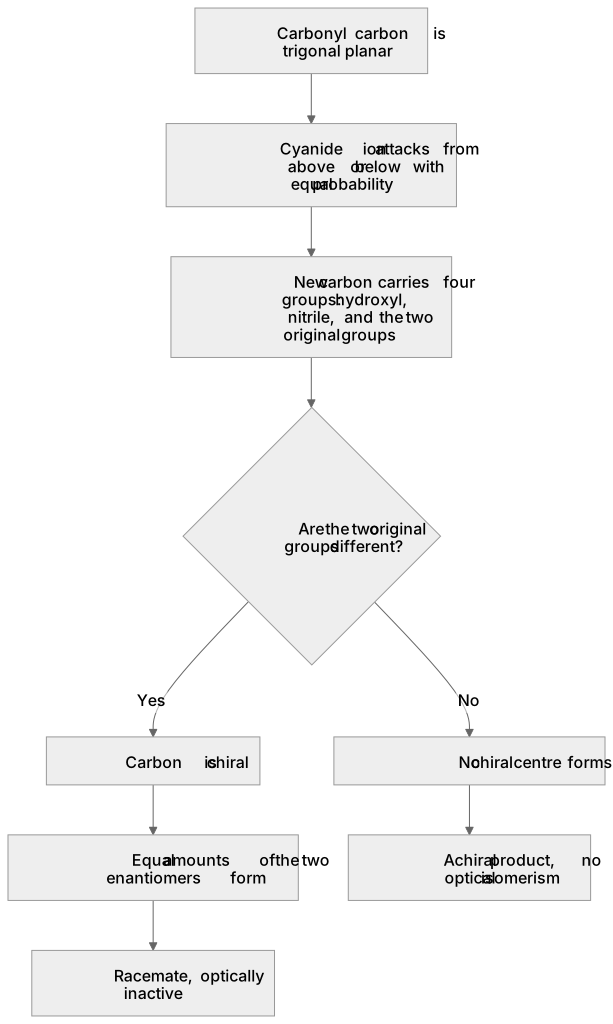
The carbonyl carbon is trigonal planar, so the cyanide ion can approach from above or below the plane with equal probability.
Checked against the AQA 7405 specification (opens in a new tab) on .
- Point 5 of 7
- 4 key terms
Study notes
From the checked teaching notes for this specification point.
The idea
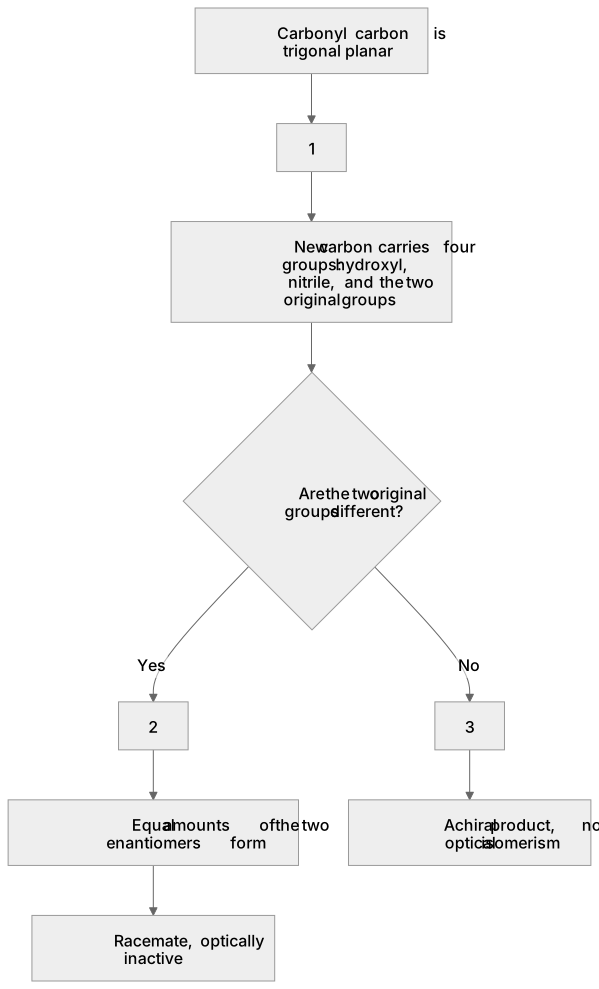
The carbonyl carbon is trigonal planar, so the cyanide ion can approach from above or below the plane with equal probability. In the product, that carbon carries four groups: hydroxyl, nitrile, and the two original groups. If these two are different, the carbon is chiral. Equal approach from both faces produces equal amounts of the two enantiomers, forming an optically inactive racemate. However, if the original groups are identical, no chiral centre forms. Methanal (two hydrogens) and symmetrical ketones like propanone (two methyls) are key exceptions; their reaction with KCN/H+ yields achiral products that do not exhibit optical isomerism.
What earns the marks
- Stating that the carbonyl carbon is planar.
- Saying the cyanide ion attacks from above or from below with equal probability.
- Identifying the new chiral centre as a carbon with four different groups.
- Stating that equal amounts of the two enantiomers are formed, so the product is a racemate and optically inactive.
Common mistakes and how to put them right
Saying the product is chiral without explaining that attack occurs equally from both faces.
Claiming methanal or propanone gives a racemate, when their products lack a chiral centre due to identical groups.
Arguing that one enantiomer forms in excess because it is more stable.
Describing the planar species as a carbocation, when here it is the neutral carbonyl carbon.
Exam tips
- Check the four groups on the new carbon before claiming enantiomers; two identical groups (e.g., in methanal) means none.
- Use the three-step chain: planar carbon, attack from either side, equal amounts of enantiomers.
- Finish by saying the mixture is optically inactive, since that is often the final mark.
Try the lesson
The start of the Aldehydes and ketones (A-level only): Aldehydes and unsymmetrical ketones form mixtures of enantiomers when they react with KCN followed by dilute acid. lesson, made from checked teaching notes for this specification point.
Have a go first
Which compound forms a racemic mixture of enantiomers when it reacts with KCN followed by dilute acid?
Listen
The carbonyl carbon is trigonal planar, so the cyanide ion can approach from above or below the plane with equal probability. In the product, that carbon carries four groups: hydroxyl, nitrile, and the two original groups. If these two are different, the carbon is chiral. Equal approach from both faces produces equal amounts of the two enantiomers, forming an optically inactive racemate. However, if the original groups are identical, no chiral centre forms. Methanal (two hydrogens) and symmetrical ketones like propanone (two methyls) are key exceptions; their reaction with KCN/H+ yields achiral products that do not exhibit optical isomerism. A strong answer earns marks for these points. stating that the carbonyl carbon is planar. saying the cyanide ion attacks from above or from below with equal probability. identifying the new chiral centre as a carbon with four different groups. stating that equal amounts of the two enantiomers are formed, so the product is a racemate and optically inactive. Exam tip: Check the four groups on the new carbon before claiming enantiomers; two identical groups (e.g., in methanal) means none.
See it
Key words
Say what each word means before you turn the card.
planar carbonyl carbon
Try answering aloud or in your head before turning the card.
new chiral centre
Try answering aloud or in your head before turning the card.
racemic product
Try answering aloud or in your head before turning the card.
achiral exceptions
Try answering aloud or in your head before turning the card.
See every definition
- planar carbonyl carbon
- The carbonyl carbon is trigonal planar, so the cyanide ion can approach from above or below the plane with equal probability.
- new chiral centre
- In the product, that carbon carries four groups: hydroxyl, nitrile, and the two original groups, and if these two are different, the carbon is chiral.
- racemic product
- Equal approach from both faces produces equal amounts of the two enantiomers, forming an optically inactive racemate.
- achiral exceptions
- If the original groups are identical, no chiral centre forms, so methanal and symmetrical ketones like propanone yield achiral products that do not exhibit optical isomerism.
Label the diagram
Some boxes have lost their names. Pick the right name for each number.
1Box 1
2Box 2
3Box 3
There is more to this lesson
The full lesson goes on to check your understanding and help you earn the marks. Create a free account to carry on, with your progress saved.
A week of Premium from your first lesson · Then the free plan continues · No card, no charge
Test your understanding of Aldehydes and ketones (A-level only): Aldehydes and unsymmetrical ketones form mixtures of enantiomers when they react with KCN followed by dilute acid.
Active recall beats re-reading. Take an instant quiz now to test what you’ve learned and lock it into long-term memory.
A week of Premium from your first lesson · Then the free plan continues · No card, no charge