AQA · A-Level · Chemistry
Course version: 7405 · Version from Sept 2016
Aldehydes are readily oxidised to carboxylic acids.
Full specification wording
Aldehydes and ketones (A-level only): Aldehydes are readily oxidised to carboxylic acids.
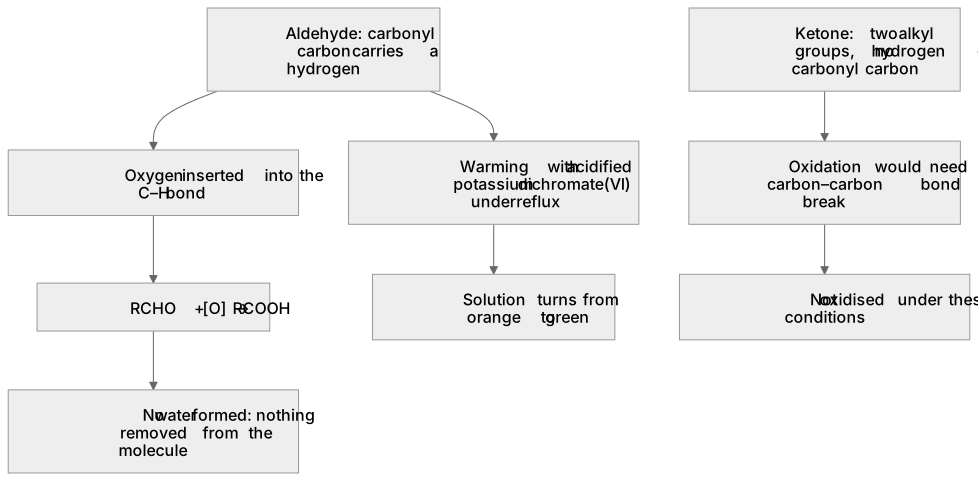
The carbonyl carbon of an aldehyde carries a hydrogen atom, so an oxygen can be inserted into that C–H bond without disturbing the carbon skeleton: RCHO + [O] → RCOOH.
Checked against the AQA 7405 specification (opens in a new tab) on .
- Point 1 of 7
- 4 key terms
Study notes
From the checked teaching notes for this specification point.
The idea
The carbonyl carbon of an aldehyde carries a hydrogen atom, so an oxygen can be inserted into that C–H bond without disturbing the carbon skeleton: RCHO + [O] → RCOOH. No water is formed, because nothing is removed from the molecule. Warming with acidified potassium dichromate(VI) under reflux does the job, the solution turning from orange to green. A ketone has two alkyl groups on its carbonyl carbon and no hydrogen, so the same oxidation would require a carbon–carbon bond to break and does not happen. That difference in ease of oxidation is what the mild oxidising agents Tollens' reagent and Fehling's solution exploit when they distinguish an aldehyde from a ketone.
What earns the marks
- The equation RCHO + [O] → RCOOH with the correct carboxylic acid drawn or named.
- Naming acidified potassium dichromate(VI) and heating under reflux.
- Saying the aldehyde carbon carries a hydrogen, so no carbon–carbon bond need break.
- Contrasting the ketone, which is not oxidised under these conditions.
Common mistakes and how to put them right
Including water as a product of the aldehyde oxidation, when no atoms leave the molecule.
Saying ketones are oxidised more slowly rather than not at all by this reagent.
Naming the product of oxidising ethanal as ethanol rather than ethanoic acid.
Omitting the word acidified from the name of the oxidising agent.
Exam tips
- Count atoms across your equation; if water has appeared from nowhere, the equation is wrong.
- Reflux is the condition for making the acid, since nothing needs to be removed as it forms.
- Use the hydrogen on the carbonyl carbon as your one-line explanation for every aldehyde and ketone comparison.
Try the lesson
The start of the Aldehydes and ketones (A-level only): Aldehydes are readily oxidised to carboxylic acids. lesson, made from checked teaching notes for this specification point.
Have a go first
Which product is formed when ethanal is oxidised?
Listen
The carbonyl carbon of an aldehyde carries a hydrogen atom, so an oxygen can be inserted into that C–H bond without disturbing the carbon skeleton: RCHO + [O] → RCOOH. No water is formed, because nothing is removed from the molecule. Warming with acidified potassium dichromate(VI) under reflux does the job, the solution turning from orange to green. A ketone has two alkyl groups on its carbonyl carbon and no hydrogen, so the same oxidation would require a carbon–carbon bond to break and does not happen. That difference in ease of oxidation is what the mild oxidising agents Tollens' reagent and Fehling's solution exploit when they distinguish an aldehyde from a ketone. A strong answer earns marks for these points. the equation RCHO + [O] → RCOOH with the correct carboxylic acid drawn or named. naming acidified potassium dichromate(VI) and heating under reflux. saying the aldehyde carbon carries a hydrogen, so no carbon–carbon bond need break. contrasting the ketone, which is not oxidised under these conditions. Exam tip: Count atoms across your equation; if water has appeared from nowhere, the equation is wrong.
See it
Key words
Say what each word means before you turn the card.
oxidation of aldehydes
Try answering aloud or in your head before turning the card.
hydrogen on the carbonyl carbon
Try answering aloud or in your head before turning the card.
carboxylic acid product
Try answering aloud or in your head before turning the card.
contrast with ketones
Try answering aloud or in your head before turning the card.
See every definition
- oxidation of aldehydes
- Aldehydes are readily oxidised to carboxylic acids, with an oxygen inserted into the C–H bond of the carbonyl carbon.
- hydrogen on the carbonyl carbon
- The carbonyl carbon of an aldehyde carries a hydrogen atom, so no carbon–carbon bond need break during oxidation.
- carboxylic acid product
- The product of oxidising an aldehyde, shown as RCOOH in the equation RCHO + [O] → RCOOH.
- contrast with ketones
- A ketone has two alkyl groups on its carbonyl carbon and no hydrogen, so it is not oxidised under these conditions.
Label the diagram
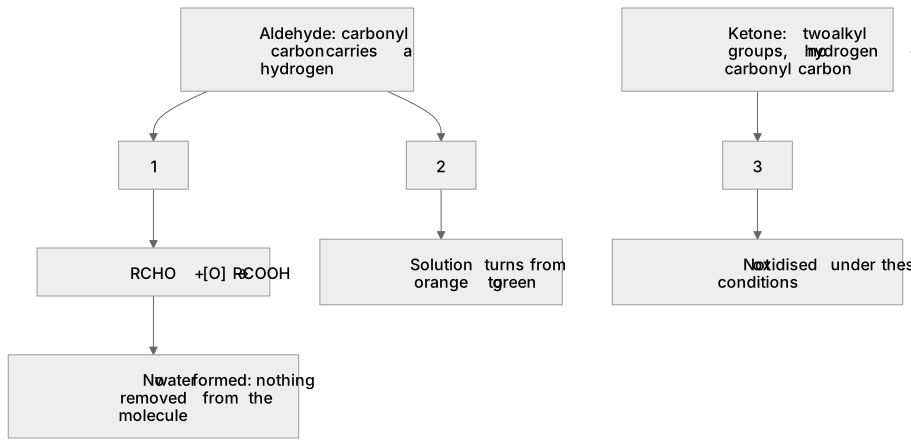
Some boxes have lost their names. Pick the right name for each number.
1Box 1
2Box 2
3Box 3
There is more to this lesson
The full lesson goes on to check your understanding and help you earn the marks. Create a free account to carry on, with your progress saved.
A week of Premium from your first lesson · Then the free plan continues · No card, no charge
Test your understanding of Aldehydes and ketones (A-level only): Aldehydes are readily oxidised to carboxylic acids.
Active recall beats re-reading. Take an instant quiz now to test what you’ve learned and lock it into long-term memory.
A week of Premium from your first lesson · Then the free plan continues · No card, no charge