AQA · A-Level · Chemistry
Course version: 7405 · Version from Sept 2016
Students should be able to: write overall equations for reduction…
Full specification wording
Aldehydes and ketones (A-level only): Students should be able to: write overall equations for reduction reactions using [H] as the reductant outline the nucleophilic addition mechanism for reduction reactions with NaBH (the nucleophile – should be shown as H ) write overall equations for the formation of hydroxynitriles using HCN outline the nucleophilic addition mechanism for the reaction with KCN followed by dilute acid explain why nucleophilic addition reactions of KCN, followed by dilute acid, can produce a mixture of enantiomers.
Five linked skills.
Checked against the AQA 7405 specification (opens in a new tab) on .
- Point 7 of 7
- 3 key terms
Study notes
From the checked teaching notes for this specification point.
The idea
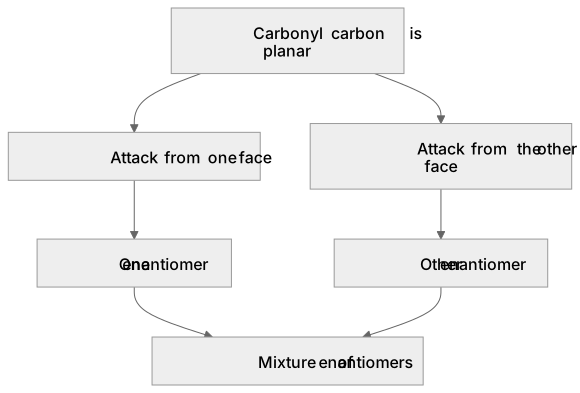
Five linked skills. Write reduction equations with 2[H] as the reductant: CH₃CHO + 2[H] → CH₃CH₂OH, and CH₃COCH₃ + 2[H] → CH₃CH(OH)CH₃. Outline the NaBH₄ mechanism with the nucleophile drawn as H⁻: arrow from its lone pair to the δ⁺ carbon, arrow from the C=O bond to the oxygen, then an arrow from the lone pair on the resulting negative oxygen to H⁺ from water. Write the hydroxynitrile equation using HCN, for example CH₃CHO + HCN → CH₃CH(OH)CN. Outline the cyanide mechanism the same way, protonating with dilute acid at the end. Finally explain the enantiomers: the carbonyl carbon is planar, so attack from either face is equally likely.
What earns the marks
- The overall reduction equation using 2[H] as the reductant.
- The arrow from the lone pair on H⁻, or on the carbon of CN⁻, to the carbonyl carbon.
- The arrow from the C=O bond to the oxygen.
- The negatively charged intermediate and the arrow from its lone pair to H⁺.
- Explaining the racemate by equal attack on either face of the planar carbonyl carbon.
Common mistakes and how to put them right
Writing [H] once instead of 2[H], so the equation does not balance.
Drawing NaBH₄ or CN with no charge as the attacking species instead of H⁻ and CN⁻.
Starting a curly arrow at the negative sign rather than at a lone pair, which AQA does not credit.
Omitting the final protonation step, leaving a charged product.
Exam tips
- Balance every [H] equation by counting hydrogens; carbonyl reductions almost always need 2[H].
- Draw the lone pair and the charge on the nucleophile before drawing any arrow from it.
- Keep the two mechanisms parallel in your revision; only the nucleophile and the final acid differ.
Try the lesson
The start of the Aldehydes and ketones (A-level only): Students should be able to: write overall equations for reduction reactions using [H] as the reductant outline the nucleophilic addition mechanism for reduction reactions with NaBH (the nucleophile – should be shown as H ) write overall equations for the formation of hydroxynitriles using HCN outline the nucleophilic addition mechanism for the reaction with KCN followed by dilute acid explain why nucleophilic addition reactions of KCN, followed by dilute acid, can produce a mixture of enantiomers. lesson, made from checked teaching notes for this specification point.
Have a go first
Which equation represents the reduction of propanal using [H] as the reductant?
Listen
Five linked skills. Write reduction equations with 2[H] as the reductant: CH₃CHO + 2[H] → CH₃CH₂OH, and CH₃COCH₃ + 2[H] → CH₃CH(OH)CH₃. Outline the NaBH₄ mechanism with the nucleophile drawn as H⁻: arrow from its lone pair to the δ⁺ carbon, arrow from the C=O bond to the oxygen, then an arrow from the lone pair on the resulting negative oxygen to H⁺ from water. Write the hydroxynitrile equation using HCN, for example CH₃CHO + HCN → CH₃CH(OH)CN. Outline the cyanide mechanism the same way, protonating with dilute acid at the end. Finally explain the enantiomers: the carbonyl carbon is planar, so attack from either face is equally likely. A strong answer earns marks for these points. the overall reduction equation using 2[H] as the reductant. the arrow from the lone pair on H⁻, or on the carbon of CN⁻, to the carbonyl carbon. the arrow from the C=O bond to the oxygen. the negatively charged intermediate and the arrow from its lone pair to H⁺. Exam tip: Balance every [H] equation by counting hydrogens; carbonyl reductions almost always need 2[H].
See it
Key words
Say what each word means before you turn the card.
equations using 2[H]
Try answering aloud or in your head before turning the card.
hydride and cyanide nucleophiles
Try answering aloud or in your head before turning the card.
charged intermediate protonated
Try answering aloud or in your head before turning the card.
See every definition
- equations using 2[H]
- Overall equations for reduction reactions use 2[H] as the reductant, and writing [H] once instead of 2[H] leaves the equation unbalanced.
- hydride and cyanide nucleophiles
- The nucleophile is shown as H⁻ for NaBH₄ and as CN⁻ for the reaction with KCN, with the lone pair and charge drawn before any arrow.
- charged intermediate protonated
- The negatively charged intermediate has an arrow from its lone pair to H⁺, and omitting this final protonation step leaves a charged product.
Label the diagram
Some boxes have lost their names. Pick the right name for each number.
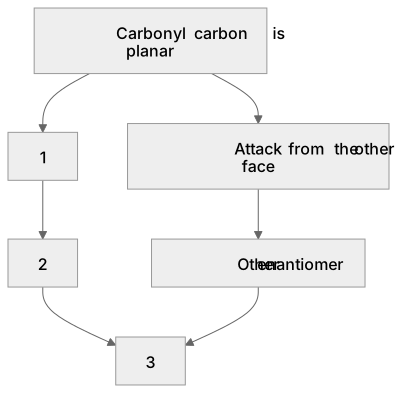
1Box 1
2Box 2
3Box 3
There is more to this lesson
The full lesson goes on to check your understanding and help you earn the marks. Create a free account to carry on, with your progress saved.
A week of Premium from your first lesson · Then the free plan continues · No card, no charge
Test your understanding of Aldehydes and ketones (A-level only): Students should be able to: write overall equations for reduction reactions using [H] as the reductant outline the nucleophilic addition mechanism for reduction reactions with NaBH (the nucleophile – should be shown as H ) write overall equations for the formation of hydroxynitriles using HCN outline the nucleophilic addition mechanism for the reaction with KCN followed by dilute acid explain why nucleophilic addition reactions of KCN, followed by dilute acid, can produce a mixture of enantiomers.
Active recall beats re-reading. Take an instant quiz now to test what you’ve learned and lock it into long-term memory.
A week of Premium from your first lesson · Then the free plan continues · No card, no charge