AQA · A-Level · Chemistry
Course version: 7405 · Version from Sept 2016
Students should be able to draw the structures of amino acids as…
Full specification wording
Amino acids (A-level only): Students should be able to draw the structures of amino acids as zwitterions and the ions formed from amino acids: in acid solution in alkaline solution.
Draw the skeleton once and then decide only which groups carry a hydrogen.
Checked against the AQA 7405 specification (opens in a new tab) on .
- Point 2 of 2
- 4 key terms
Study notes
From the checked teaching notes for this specification point.
The idea
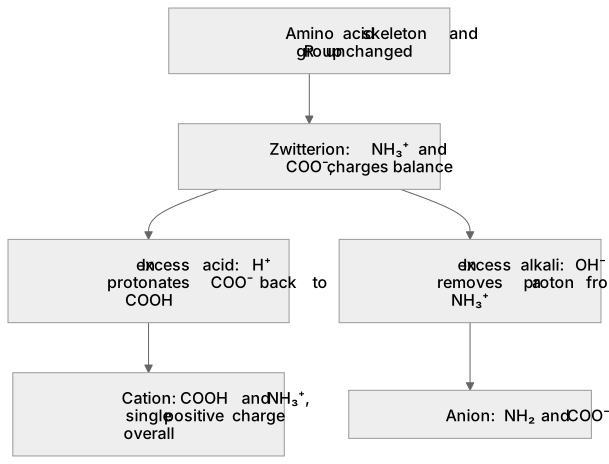
Draw the skeleton once and then decide only which groups carry a hydrogen. The zwitterion has NH₃⁺ and COO⁻ and is the form present around the isoelectric point, the pH at which the positive and negative centres balance. In excess acid there is plenty of H⁺, so the weaker base, the carboxylate ion, is protonated back to COOH while the nitrogen keeps its extra proton, so the species is a cation carrying a single positive charge overall. In excess alkali the OH⁻ removes a proton from NH₃⁺, leaving NH₂ and COO⁻, so the species is an anion. The R group and the carbon skeleton are untouched in all three forms, so only the ends change.
What earns the marks
- The zwitterion drawn with both charges shown and balancing.
- The cation in excess acid, with COOH and NH₃⁺ and a single positive charge overall.
- The anion in excess alkali, with COO⁻ and NH₂.
- The R group and the rest of the skeleton drawn unchanged in all three forms.
Common mistakes and how to put them right
Moving a negative charge onto the nitrogen atom, which AQA does not accept.
Changing the R group when the pH changes.
Drawing a positive nitrogen and a neutral COOH and calling it a zwitterion.
Drawing NH₃⁺ with only two hydrogen atoms on the nitrogen.
Exam tips
- Count the hydrogens on the nitrogen every time: two in NH₂, three in NH₃⁺.
- Skeletal formulae are accepted, but the hydrogens on the nitrogen must still be shown - NH₂ or NH₃⁺. The skeletal exemption covers only aldehydes, secondary amines and N-substituted amides, not a primary amine. A negative sign on the nitrogen is always wrong.
Try the lesson
The start of the Amino acids (A-level only): Students should be able to draw the structures of amino acids as zwitterions and the ions formed from amino acids: in acid solution in alkaline solution. lesson, made from checked teaching notes for this specification point.
Have a go first
Which structure represents the zwitterion formed by glycine, H₂NCH₂COOH?
Listen
Draw the skeleton once and then decide only which groups carry a hydrogen. The zwitterion has NH₃⁺ and COO⁻ and is the form present around the isoelectric point, the pH at which the positive and negative centres balance. In excess acid there is plenty of H⁺, so the weaker base, the carboxylate ion, is protonated back to COOH while the nitrogen keeps its extra proton, so the species is a cation carrying a single positive charge overall. In excess alkali the OH⁻ removes a proton from NH₃⁺, leaving NH₂ and COO⁻, so the species is an anion. The R group and the carbon skeleton are untouched in all three forms, so only the ends change. A strong answer earns marks for these points. the zwitterion drawn with both charges shown and balancing. the cation in excess acid, with COOH and NH₃⁺ and a single positive charge overall. the anion in excess alkali, with COO⁻ and NH₂. the R group and the rest of the skeleton drawn unchanged in all three forms. Exam tip: Count the hydrogens on the nitrogen every time: two in NH₂, three in NH₃⁺.
See it
Key words
Say what each word means before you turn the card.
zwitterion
Try answering aloud or in your head before turning the card.
isoelectric point
Try answering aloud or in your head before turning the card.
cation in acid
Try answering aloud or in your head before turning the card.
anion in alkali
Try answering aloud or in your head before turning the card.
See every definition
- zwitterion
- The form present around the isoelectric point, with NH₃⁺ and COO⁻ and both charges shown and balancing.
- isoelectric point
- The pH at which the positive and negative centres balance.
- cation in acid
- In excess acid the carboxylate ion is protonated back to COOH while the nitrogen keeps its extra proton, giving a single positive charge overall.
- anion in alkali
- In excess alkali the OH⁻ removes a proton from NH₃⁺, leaving NH₂ and COO⁻.
Label the diagram
Some boxes have lost their names. Pick the right name for each number.
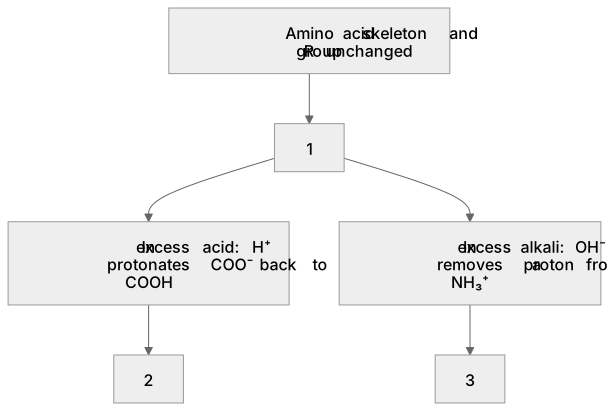
1Box 1
2Box 2
3Box 3
There is more to this lesson
The full lesson goes on to check your understanding and help you earn the marks. Create a free account to carry on, with your progress saved.
A week of Premium from your first lesson · Then the free plan continues · No card, no charge
Test your understanding of Amino acids (A-level only): Students should be able to draw the structures of amino acids as zwitterions and the ions formed from amino acids: in acid solution in alkaline solution.
Active recall beats re-reading. Take an instant quiz now to test what you’ve learned and lock it into long-term memory.
A week of Premium from your first lesson · Then the free plan continues · No card, no charge