Study Notes
Overview
Atomic structure is the foundational topic of your GCSE Chemistry specification. It explains the fundamental building blocks of all matter. Everything you will study—from how elements bond together to form compounds, to the rate at which chemical reactions occur—depends entirely on the arrangement of protons, neutrons, and electrons within atoms.
Examiners love testing this topic because it assesses both your factual recall (AO1) and your ability to apply mathematical concepts (AO2). You can expect a mix of short, 1-mark recall questions asking for relative charges or masses, alongside 3-to-4 mark calculation questions where you must determine relative atomic mass from isotopic abundances. You must also be prepared to interpret mass spectra to identify elements. Mastering atomic structure early on ensures you have the necessary toolkit to understand the rest of the course.
Key Concepts
Concept 1: Subatomic Particles
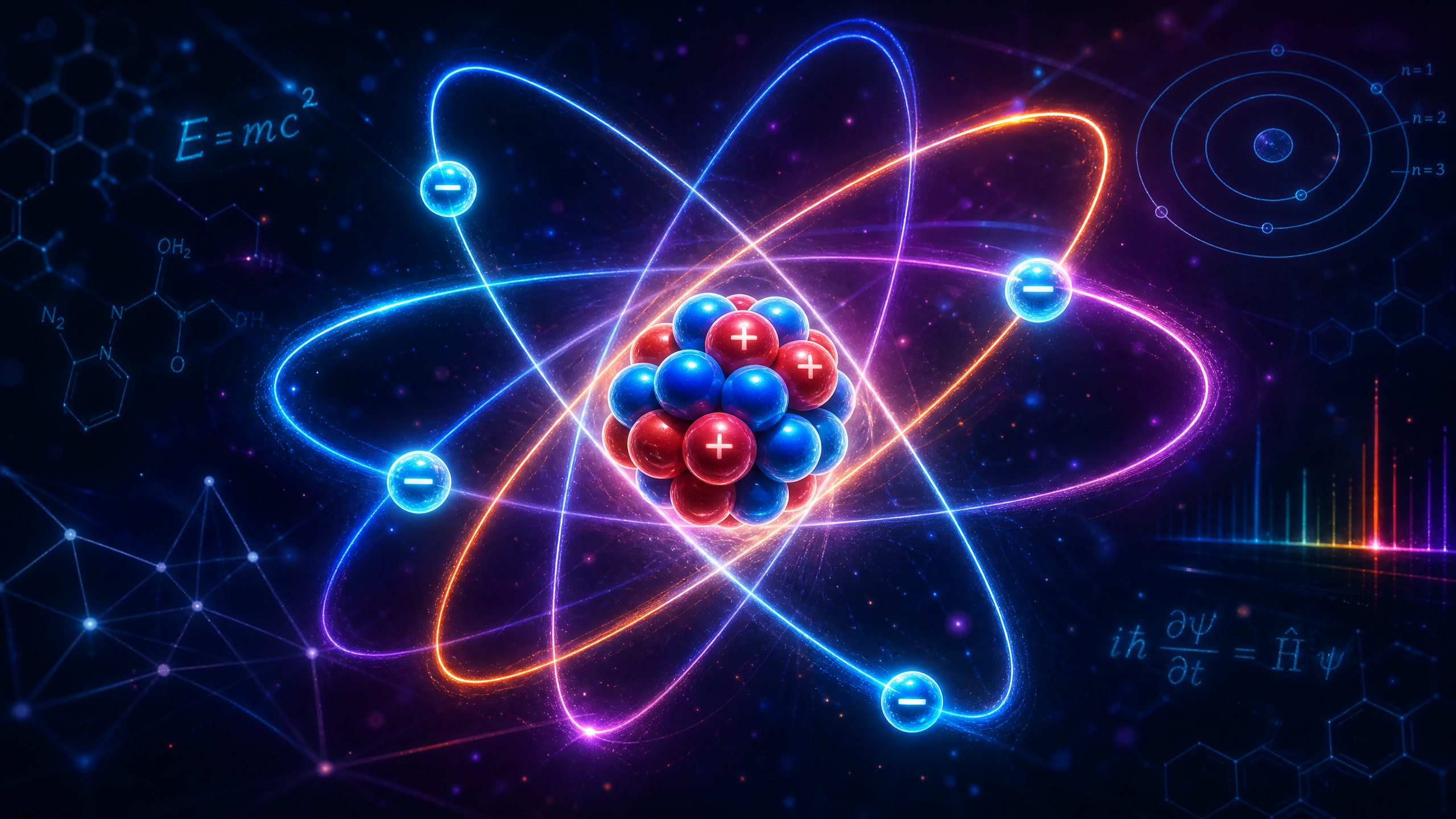
Atoms are incredibly small, but they are made up of even smaller components called subatomic particles: protons, neutrons, and electrons. The protons and neutrons are tightly packed in the central nucleus, which contains almost all of the atom's mass. The electrons orbit the nucleus in specific energy levels, or shells.
To earn marks, you must know their relative masses and charges:
- Proton: Relative mass = 1, Relative charge = +1
- Neutron: Relative mass = 1, Relative charge = 0
- Electron: Relative mass = 1/1840 (or very small/negligible), Relative charge = -1
Because atoms contain an equal number of positive protons and negative electrons, they have no overall electrical charge. If an atom loses or gains electrons, it becomes an ion.
Example: A sodium atom has 11 protons and 11 electrons. If it loses 1 electron, it becomes a sodium ion (Na⁺) with 11 protons and 10 electrons.
Concept 2: Atomic Number and Mass Number
When you look at the periodic table, you see two numbers next to each element's symbol.
- The Atomic Number (Z) is the smaller number. It tells you the number of protons in the nucleus. This number defines the element. For example, every atom in the universe with 6 protons is carbon.
- The Mass Number (A) is the larger number. It tells you the total number of protons AND neutrons in the nucleus.
To find the number of neutrons, simply subtract the atomic number from the mass number (Neutrons = Mass Number - Atomic Number).
Concept 3: Isotopes
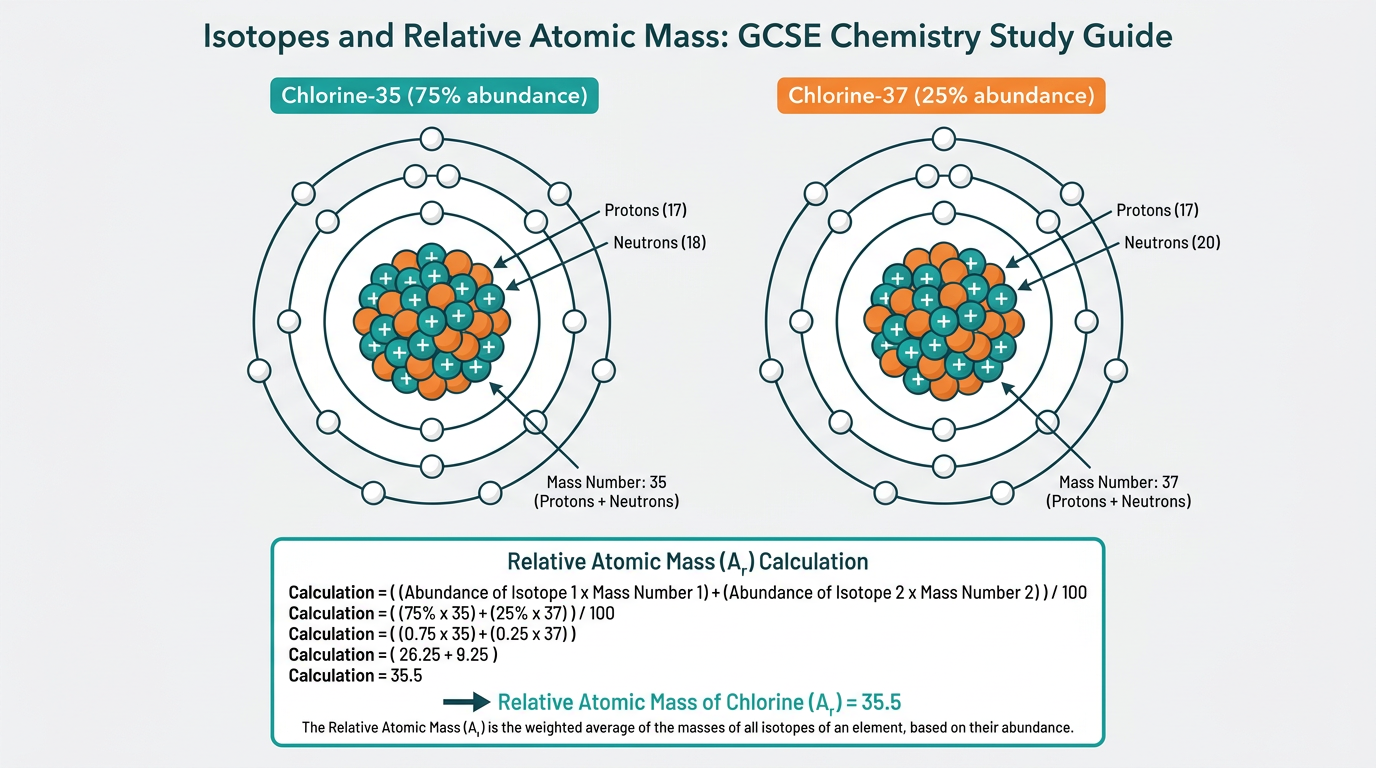
Not all atoms of the same element are exactly identical. Isotopes are atoms of the same element (so they have the same number of protons and the same atomic number) but with a different number of neutrons (so they have a different mass number).
Because isotopes have the exact same number of electrons in their outer shell, they have identical chemical properties and react in exactly the same way. Their physical properties, such as density or boiling point, might differ slightly due to the difference in mass.
Example: Chlorine has two common isotopes: Chlorine-35 (17 protons, 18 neutrons) and Chlorine-37 (17 protons, 20 neutrons).
Concept 4: Relative Atomic Mass (Ar)
Because elements exist as mixtures of isotopes, the mass number on the periodic table is actually a weighted average. The Relative Atomic Mass (Ar) is the average mass of an atom of an element compared to 1/12th of the mass of a carbon-12 atom. It takes into account both the mass of each isotope and its relative abundance (how common it is).
Concept 5: Time of Flight (TOF) Mass Spectrometry
Mass spectrometry is an analytical technique used to find the abundance and mass of each isotope in an element, allowing us to determine its relative atomic mass. The Time of Flight (TOF) mass spectrometer works in four main stages:
- Ionisation: The sample is dissolved in a volatile solvent and forced through a fine hollow needle connected to a positive terminal of a high voltage supply. This produces tiny positively charged droplets. The solvent evaporates into a vacuum, leaving single positively charged ions.
- Acceleration: The positive ions are attracted towards a negatively charged plate and accelerate towards it. All ions are given the same kinetic energy.
- Ion Drift: The ions pass through a hole in the negative plate, forming a beam, and travel along a tube called the flight tube.
- Detection: The positive ions hit a negatively charged detector plate. When they hit the plate, the positive ions gain an electron from the plate. This movement of electrons generates an electric current. The size of the current is proportional to the abundance of the isotope.
Lighter ions travel faster and reach the detector first. Heavier ions travel slower and arrive later.
Concept 6: Electron Configuration
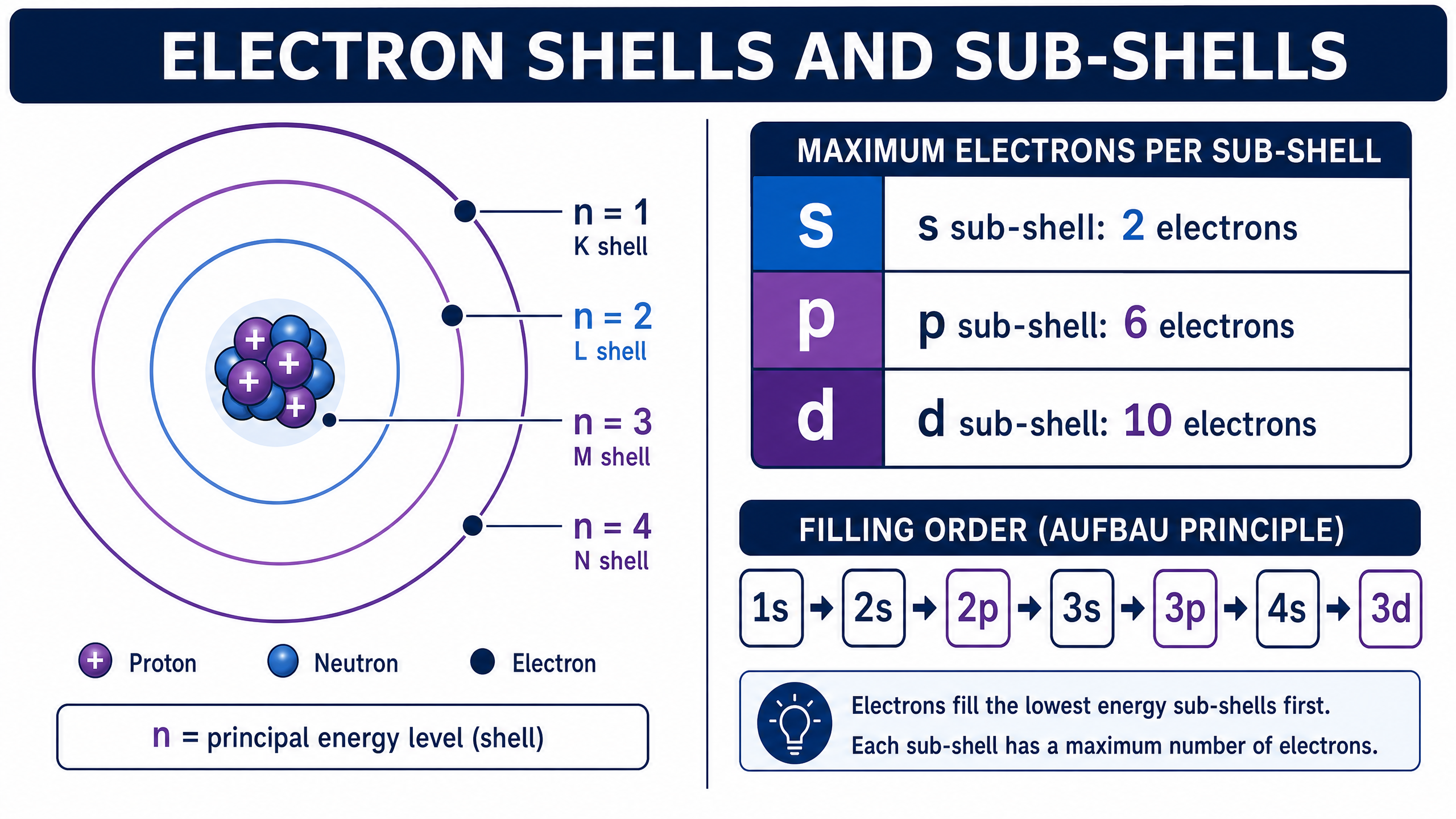
Electrons are arranged in shells around the nucleus, but these shells are further divided into sub-shells (s, p, d, and f). Each sub-shell contains orbitals, and each orbital can hold a maximum of 2 electrons with opposite spins.
- s sub-shell: 1 orbital, holds up to 2 electrons.
- p sub-shell: 3 orbitals, holds up to 6 electrons.
- d sub-shell: 5 orbitals, holds up to 10 electrons.
The order of filling is determined by energy levels. Electrons fill the lowest energy sub-shells first. The order is: 1s, 2s, 2p, 3s, 3p, 4s, 3d, 4p. Notice that the 4s sub-shell is at a lower energy level than the 3d sub-shell, so it fills first.
Example: The electron configuration of Iron (Z=26) is 1s² 2s² 2p⁶ 3s² 3p⁶ 4s² 3d⁶.
Concept 7: Ionisation Energy
First Ionisation Energy is the energy required to remove one mole of electrons from one mole of gaseous atoms to form one mole of gaseous 1+ ions.
The equation for the first ionisation energy of sodium is:
Na(g) → Na⁺(g) + e⁻
Ionisation energy is influenced by three main factors:
- Nuclear Charge: More protons mean a stronger attraction to the electrons, increasing ionisation energy.
- Distance from Nucleus: Electrons further from the nucleus are less strongly attracted, decreasing ionisation energy.
- Shielding: Inner shells of electrons repel the outer electrons, reducing the pull of the nucleus and decreasing ionisation energy.
Across a period (e.g., Period 3), first ionisation energy generally increases because nuclear charge increases while shielding remains similar. Down a group (e.g., Group 2), first ionisation energy decreases because the outer electron is further from the nucleus and experiences more shielding.
Concept 8: Historical Development of the Atomic Model
The model of the atom we use today was not discovered overnight. It developed over centuries as new scientific evidence emerged. Examiners often test your understanding of how and why the model changed. Here is the chronological progression:
- John Dalton (early 1800s): Proposed that all matter is made of tiny, solid, indivisible spheres called atoms. He believed atoms of the same element were identical.
- J.J. Thomson (1897): Discovered the electron. Since atoms are neutral, he proposed the 'Plum Pudding Model'. He described the atom as a ball of positive charge with negative electrons embedded in it, much like plums in a pudding.
- Ernest Rutherford (1909): Conducted the famous alpha particle scattering experiment. He fired positively charged alpha particles at a very thin sheet of gold foil. Most passed straight through, but a few were deflected backwards. This proved the Plum Pudding model wrong. He concluded that the atom's mass and positive charge must be concentrated in a tiny, dense, central nucleus, and that the atom is mostly empty space. This became the 'Nuclear Model'.
- Niels Bohr (1913): Adapted the nuclear model by suggesting that electrons orbit the nucleus at specific distances in fixed energy levels (shells). This explained why the atom didn't collapse inward.
- James Chadwick (1932): Provided the experimental evidence for the existence of the neutron within the nucleus. This explained the missing mass of atoms and accounted for the existence of isotopes.
Concept 9: Successive Ionisation Energies
While the first ionisation energy removes the outermost electron, successive ionisation energies refer to the energy required to remove the second, third, fourth, and subsequent electrons from an atom.
Successive ionisation energies always increase. As each electron is removed, the remaining electrons experience less repulsion and are pulled closer to the positive nucleus, making them harder to remove.
Crucially, analyzing successive ionisation energies provides evidence for the existence of electron shells. When you plot or look at a table of successive ionisation energies for a specific element, you will notice massive 'jumps' in the energy required. A large jump occurs when an electron is removed from a shell that is closer to the nucleus and less shielded than the previous electron. By counting how many electrons are removed before the first big jump, you can deduce the group number of the element. For example, if the big jump happens between the 2nd and 3rd ionisation energies, the element has two outer electrons and belongs to Group 2.
Mathematical/Scientific Relationships
**Calculating Relative Atomic Mass (Ar)**Ar = Σ(Isotopic Mass × Relative Abundance) / Total Abundance
- Isotopic Mass: The mass number of the specific isotope.
- Relative Abundance: The percentage or ratio of that isotope in the sample.
- Total Abundance: Usually 100 if abundances are given as percentages.
Must memorise: You will not be given this formula in the exam.
Kinetic Energy in TOF Mass SpectrometryKE = ½mv²
- KE: Kinetic Energy (Joules, J)
- m: Mass of the ion (Kilograms, kg)
- v: Velocity of the ion (Metres per second, m/s)
Since all ions are given the same kinetic energy, we can rearrange this to find the velocity or time of flight (t = d/v, where d is the distance of the flight tube).
Practical Applications
Understanding isotopes and mass spectrometry is vital in the real world. Carbon-14 dating is used by archaeologists to determine the age of ancient artifacts. In medicine, specific radioactive isotopes are used as tracers to diagnose blockages in blood vessels or to target and destroy cancer cells. Mass spectrometry is used in forensic science to analyze crime scene samples and in sports to test athletes for performance-enhancing drugs.
Visual Resources
2 diagrams and illustrations
Interactive Diagrams
2 interactive diagrams to visualise key concepts
Conceptual Flow Outline
The basic structure of an atom showing subatomic particles.
Conceptual Flow Outline
The four main stages of Time of Flight (TOF) Mass Spectrometry.
Worked Examples
3 detailed examples with solutions and examiner commentary
Practice Questions
Test your understanding — click to reveal model answers
State the relative charge and relative mass of a neutron. [2 marks]
Hint: Think about the word 'neutral'.
An atom of an element contains 19 protons, 19 electrons, and 20 neutrons. Determine the atomic number and mass number of this atom, and identify the element. [3 marks]
Hint: Atomic number is protons. Mass number is protons + neutrons.
A sample of neon contains two isotopes, ²⁰Ne and ²²Ne. The relative atomic mass of the sample is 20.2. Calculate the percentage abundance of the ²²Ne isotope. [3 marks]
Hint: Set the abundance of ²²Ne as x, and ²⁰Ne as (100 - x).
Write an equation, including state symbols, to represent the second ionisation energy of magnesium. [2 marks]
Hint: Second ionisation energy removes an electron from a 1+ ion.
Explain the general trend in first ionisation energy across Period 3 (from Sodium to Argon). [4 marks]
Hint: Consider nuclear charge, shielding, and atomic radius.