AQA · A-Level · Chemistry
Course version: 7405 · Version from Sept 2016
Balanced equations and associated calculations: Equations (full and ionic).
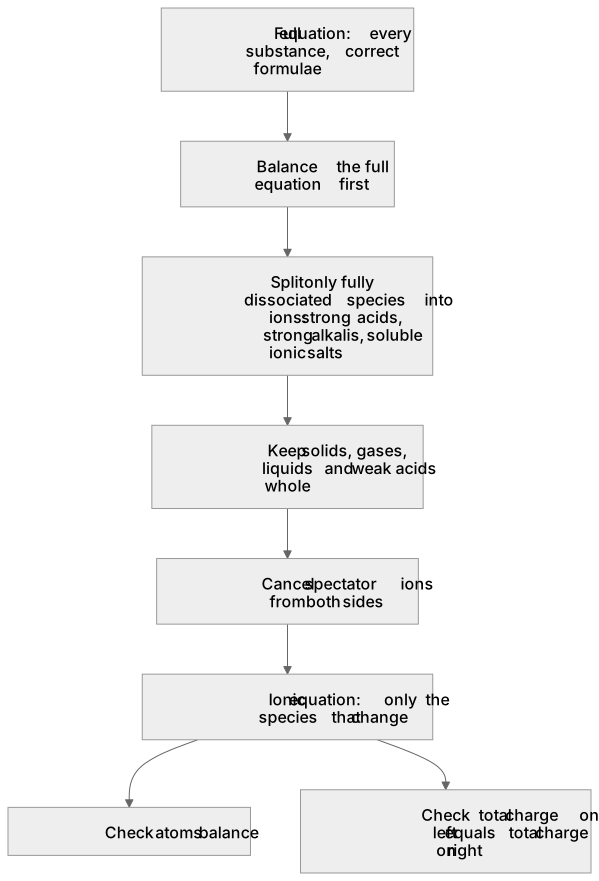
A full equation shows every substance taking part, with correct formulae and, where required, state symbols.
Checked against the AQA 7405 specification (opens in a new tab) on .
- Point 1 of 3
- 3 key terms
Study notes
From the checked teaching notes for this specification point.
The idea
A full equation shows every substance taking part, with correct formulae and, where required, state symbols. An ionic equation shows only the species that actually change, with spectator ions cancelled from both sides: silver nitrate and sodium chloride solutions give Ag⁺(aq) + Cl⁻(aq) → AgCl(s), and any strong acid neutralised by a strong alkali reduces to H⁺(aq) + OH⁻(aq) → H₂O(l). Two conditions must hold in an ionic equation: the atoms must balance and the total charge on the left must equal the total charge on the right. Only substances that are fully dissociated, that is strong acids, strong alkalis and soluble ionic salts, may be split into ions; solids, gases, liquids and weak acids stay whole.
What earns the marks
- Correct formulae for every species in the equation.
- The atoms balanced on both sides.
- The total charge balanced in an ionic equation.
- Spectator ions cancelled so they do not appear in the ionic equation.
- Correct state symbols where the question requires them.
Common mistakes and how to put them right
Changing a subscript inside a formula in order to balance an equation.
Leaving spectator ions such as sodium and nitrate in an ionic equation.
Writing an ionic equation in which the charges do not balance.
Splitting an insoluble solid or a weak acid into separate ions.
Exam tips
- Balance the full equation first, then cancel the spectators; building the ionic equation directly invites errors.
- Add up the charges on each side and write the totals in the margin as a check.
- Only add state symbols when asked, but make them correct when you do.
Try the lesson
The start of the Balanced equations and associated calculations: Equations (full and ionic). lesson, made from checked teaching notes for this specification point.
Have a go first
Which equation is correctly balanced for the reaction of aluminium with dilute sulfuric acid?
Listen
A full equation shows every substance taking part, with correct formulae and, where required, state symbols. An ionic equation shows only the species that actually change, with spectator ions cancelled from both sides: silver nitrate and sodium chloride solutions give Ag⁺(aq) + Cl⁻(aq) → AgCl(s), and any strong acid neutralised by a strong alkali reduces to H⁺(aq) + OH⁻(aq) → H₂O(l). Two conditions must hold in an ionic equation: the atoms must balance and the total charge on the left must equal the total charge on the right. Only substances that are fully dissociated, that is strong acids, strong alkalis and soluble ionic salts, may be split into ions; solids, gases, liquids and weak acids stay whole. A strong answer earns marks for these points. correct formulae for every species in the equation. the atoms balanced on both sides. the total charge balanced in an ionic equation. spectator ions cancelled so they do not appear in the ionic equation. Exam tip: Balance the full equation first, then cancel the spectators; building the ionic equation directly invites errors.
See it
Key words
Say what each word means before you turn the card.
full equations
Try answering aloud or in your head before turning the card.
ionic equations
Try answering aloud or in your head before turning the card.
charge balance
Try answering aloud or in your head before turning the card.
See every definition
- full equations
- Shows every substance taking part, with correct formulae and, where required, state symbols.
- ionic equations
- Shows only the species that actually change, with spectator ions cancelled from both sides.
- charge balance
- In an ionic equation the total charge on the left must equal the total charge on the right.
Label the diagram
Some boxes have lost their names. Pick the right name for each number.
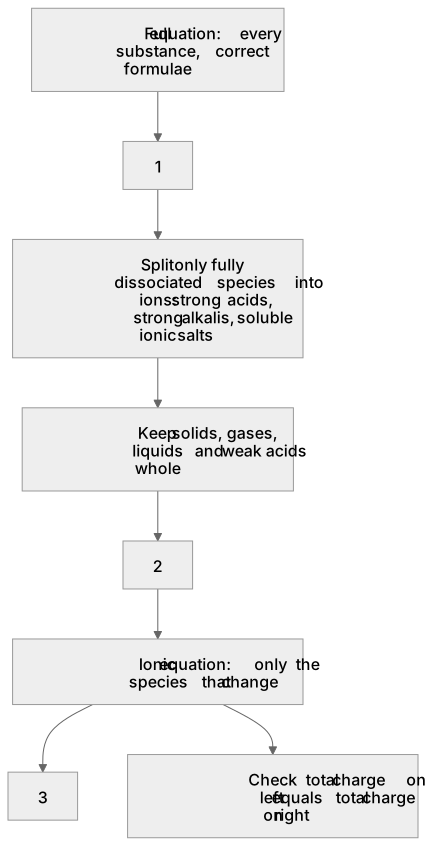
1Box 1
2Box 2
3Box 3
There is more to this lesson
The full lesson goes on to check your understanding and help you earn the marks. Create a free account to carry on, with your progress saved.
A week of Premium from your first lesson · Then the free plan continues · No card, no charge
Test your understanding of Balanced equations and associated calculations: Equations (full and ionic).
Active recall beats re-reading. Take an instant quiz now to test what you’ve learned and lock it into long-term memory.
A week of Premium from your first lesson · Then the free plan continues · No card, no charge