AQA · A-Level · Chemistry
Course version: 7405 · Version from Sept 2016
Required practical 1 Make up a volumetric solution and carry out a simple…
Full specification wording
Balanced equations and associated calculations: Required practical 1 Make up a volumetric solution and carry out a simple acid–base titration.
The practical has two halves.
Checked against the AQA 7405 specification (opens in a new tab) on .
- Point 3 of 3
- 4 key terms
Study notes
From the checked teaching notes for this specification point.
The idea
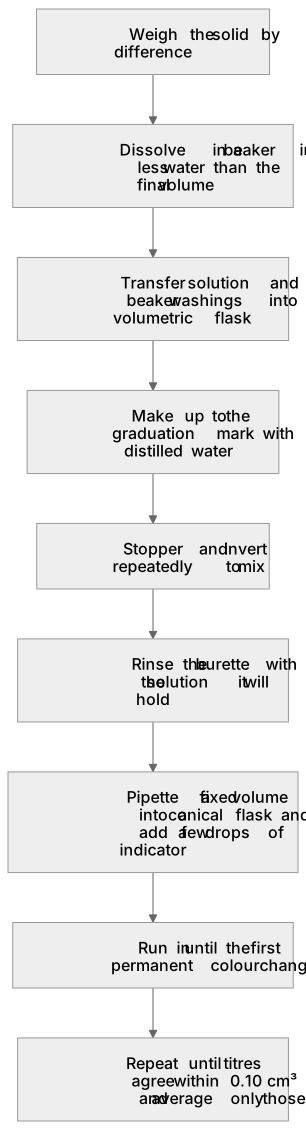
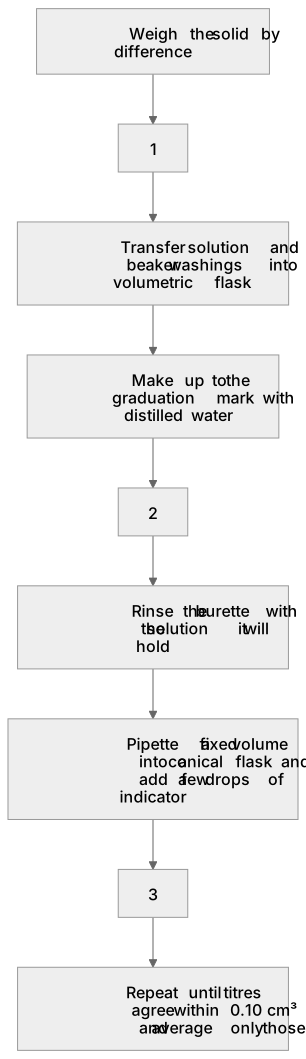
The practical has two halves. Making the standard solution: weigh the solid by difference, dissolve it in a beaker in less water than the final volume, then transfer the solution and the beaker washings into a volumetric flask, make up to the graduation mark with distilled water so the bottom of the meniscus sits on the line at eye level, stopper and invert repeatedly to mix. The washings matter because solute left in the beaker would lower the concentration. Titrating: rinse the burette with the solution it will hold, pipette a fixed volume into a conical flask, add a few drops of indicator, and run in until the first permanent colour change. Repeat until titres agree within 0.10 cm³ and average only those.
What earns the marks
- Transferring the solution together with the beaker washings into a volumetric flask.
- Making the solution up to the graduation mark with distilled water.
- Inverting or shaking the stoppered flask to mix thoroughly.
- Averaging only concordant titres, those within 0.10 cm³ of each other.
- Selecting an indicator with a sharp colour change over the vertical section of the titration curve.
Common mistakes and how to put them right
Rinsing the conical flask with the solution being titrated, which adds extra moles and raises the titre.
Including the rough titre when calculating the mean.
Using an indicator for a weak acid against a weak base, where the pH change is too gradual to judge.
Overshooting the graduation mark and then removing liquid with a pipette.
Reading the top of the meniscus rather than the bottom.
Exam tips
- Quote burette readings to two decimal places ending in 0 or 5, and subtract to give the titre.
- Rinse the burette with the titrant and the pipette with the solution it will deliver, but the conical flask with distilled water only.
- When asked to improve accuracy, name a specific step such as washing the beaker into the flask.
Try the lesson
The start of the Balanced equations and associated calculations: Required practical 1 Make up a volumetric solution and carry out a simple acid–base titration. lesson, made from checked teaching notes for this specification point.
Have a go first
Which piece of apparatus is used to measure the volume of acid added during a titration?
Listen
The practical has two halves. Making the standard solution: weigh the solid by difference, dissolve it in a beaker in less water than the final volume, then transfer the solution and the beaker washings into a volumetric flask, make up to the graduation mark with distilled water so the bottom of the meniscus sits on the line at eye level, stopper and invert repeatedly to mix. The washings matter because solute left in the beaker would lower the concentration. Titrating: rinse the burette with the solution it will hold, pipette a fixed volume into a conical flask, add a few drops of indicator, and run in until the first permanent colour change. Repeat until titres agree within 0.10 cm³ and average only those. A strong answer earns marks for these points. transferring the solution together with the beaker washings into a volumetric flask. making the solution up to the graduation mark with distilled water. inverting or shaking the stoppered flask to mix thoroughly. averaging only concordant titres, those within 0.10 cm³ of each other. Exam tip: Quote burette readings to two decimal places ending in 0 or 5, and subtract to give the titre.
See it
Key words
Say what each word means before you turn the card.
standard solution
Try answering aloud or in your head before turning the card.
volumetric flask technique
Try answering aloud or in your head before turning the card.
concordant titres
Try answering aloud or in your head before turning the card.
indicator choice
Try answering aloud or in your head before turning the card.
See every definition
- standard solution
- A solution made by weighing a solid, dissolving it and making it up to the graduation mark with distilled water so its concentration is accurately known.
- volumetric flask technique
- Transferring the solution and the beaker washings into a volumetric flask, making up to the graduation mark with distilled water, then inverting or shaking the stoppered flask to mix thoroughly.
- concordant titres
- Titres that agree within 0.10 cm³ of each other, which are the only ones averaged when calculating the mean.
- indicator choice
- Selecting an indicator with a sharp colour change over the vertical section of the titration curve.
Label the diagram
Some boxes have lost their names. Pick the right name for each number.
1Box 1
2Box 2
3Box 3
There is more to this lesson
The full lesson goes on to check your understanding and help you earn the marks. Create a free account to carry on, with your progress saved.
A week of Premium from your first lesson · Then the free plan continues · No card, no charge
Test your understanding of Balanced equations and associated calculations: Required practical 1 Make up a volumetric solution and carry out a simple acid–base titration.
Active recall beats re-reading. Take an instant quiz now to test what you’ve learned and lock it into long-term memory.
A week of Premium from your first lesson · Then the free plan continues · No card, no charge