AQA · A-Level · Chemistry
Course version: 7405 · Version from Sept 2016
Polyalkenes are chemically inert and non-biodegradable.
Full specification wording
Biodegradability and disposal of polymers (A-level only): Polyalkenes are chemically inert and non-biodegradable.
An addition polymer made from alkenes has a backbone built only from carbon and hydrogen.
Checked against the AQA 7405 specification (opens in a new tab) on .
- Point 1 of 4
Study notes
From the checked teaching notes for this specification point.
The idea
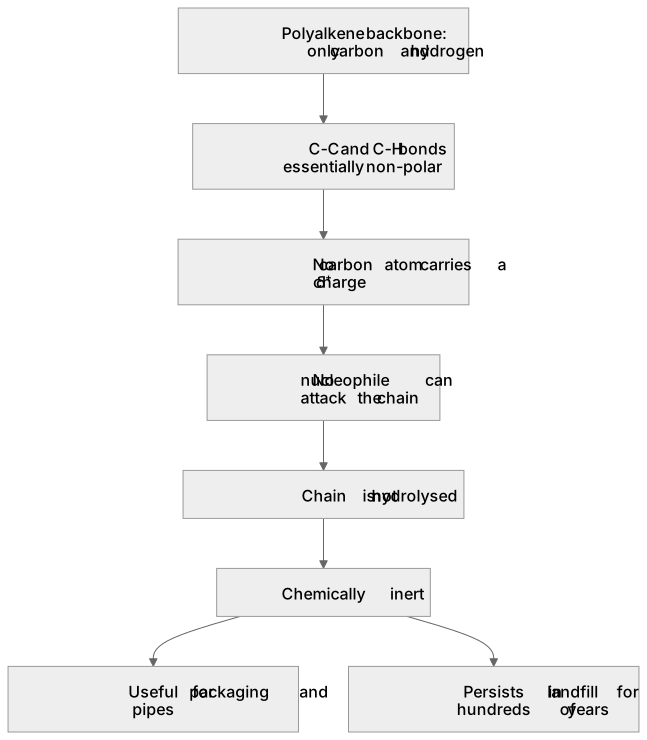
An addition polymer made from alkenes has a backbone built only from carbon and hydrogen. Carbon and hydrogen have almost the same electronegativity, so the C-C and C-H bonds are essentially non-polar and no carbon atom in the chain carries a δ⁺ charge. A nucleophile such as water or a hydroxide ion has nothing to attack, and the C-C bonds are strong, so acids, alkalis, water and the enzymes that micro-organisms use simply leave the chain alone. That inertness is exactly why polyalkenes are useful for packaging and pipes, and exactly why they are a problem afterwards: buried in landfill, a polyalkene article stays essentially unchanged for hundreds of years.
What earns the marks
- The backbone containing only carbon and hydrogen atoms.
- Those bonds being non-polar, so there is no δ⁺ carbon atom.
- Stating that no nucleophile can attack the chain, so it is not hydrolysed.
- Linking that inertness to persistence in landfill.
Common mistakes and how to put them right
Saying polyalkenes are unreactive because they still contain C=C double bonds.
Explaining inertness by chain length rather than by the polarity of the bonds.
Confusing chemical inertness with being insoluble in water.
Claiming that because some plastics break up in sunlight they are therefore biodegradable.
Exam tips
- The word the examiner wants is 'non-polar'. Write it explicitly rather than implying it.
- Break the argument into two halves: no polar site, therefore no nucleophilic attack, therefore no hydrolysis.
Try the lesson
The start of the Biodegradability and disposal of polymers (A-level only): Polyalkenes are chemically inert and non-biodegradable. lesson, made from checked teaching notes for this specification point.
Have a go first
Which property best explains why polyalkenes are described as non-biodegradable?
Listen
An addition polymer made from alkenes has a backbone built only from carbon and hydrogen. Carbon and hydrogen have almost the same electronegativity, so the C-C and C-H bonds are essentially non-polar and no carbon atom in the chain carries a δ⁺ charge. A nucleophile such as water or a hydroxide ion has nothing to attack, and the C-C bonds are strong, so acids, alkalis, water and the enzymes that micro-organisms use simply leave the chain alone. That inertness is exactly why polyalkenes are useful for packaging and pipes, and exactly why they are a problem afterwards: buried in landfill, a polyalkene article stays essentially unchanged for hundreds of years. A strong answer earns marks for these points. the backbone containing only carbon and hydrogen atoms. those bonds being non-polar, so there is no δ⁺ carbon atom. stating that no nucleophile can attack the chain, so it is not hydrolysed. linking that inertness to persistence in landfill. Exam tip: The word the examiner wants is 'non-polar'. Write it explicitly rather than implying it.
See it
Label the diagram
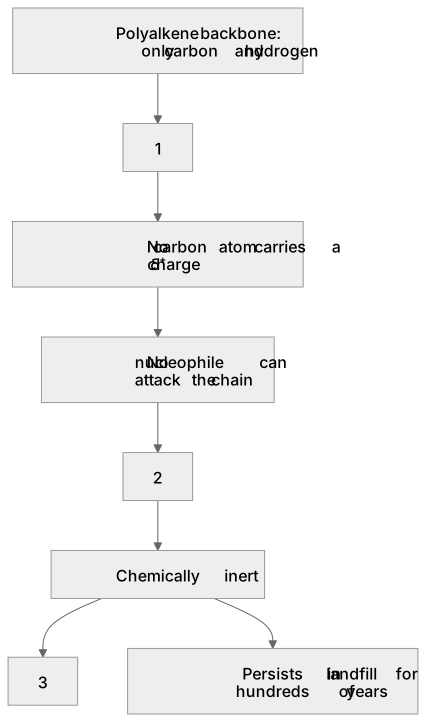
Some boxes have lost their names. Pick the right name for each number.
1Box 1
2Box 2
3Box 3
There is more to this lesson
The full lesson goes on to check your understanding and help you earn the marks. Create a free account to carry on, with your progress saved.
A week of Premium from your first lesson · Then the free plan continues · No card, no charge
Test your understanding of Biodegradability and disposal of polymers (A-level only): Polyalkenes are chemically inert and non-biodegradable.
Active recall beats re-reading. Take an instant quiz now to test what you’ve learned and lock it into long-term memory.
A week of Premium from your first lesson · Then the free plan continues · No card, no charge