AQA · A-Level · Chemistry
Course version: 7405 · Version from Sept 2016
Students should be able to: explain why polyesters and polyamides can be…
Full specification wording
Biodegradability and disposal of polymers (A-level only): Students should be able to: explain why polyesters and polyamides can be hydrolysed but polyalkenes cannot.
The difference is in the backbone, not in how the polymer was made.
Checked against the AQA 7405 specification (opens in a new tab) on .
- Point 4 of 4
Study notes
From the checked teaching notes for this specification point.
The idea
The difference is in the backbone, not in how the polymer was made. A polyester or polyamide chain has a carbonyl carbon at every link, bonded to an oxygen or a nitrogen. Those atoms are more electronegative than carbon, so they draw electron density away and leave that carbon with a δ⁺ charge. A nucleophile, water or a hydroxide ion, is attracted to it, bonds to it and the chain is cut. A polyalkene chain has no such site: every bond in the backbone is C-C or C-H, the electronegativities are almost equal, so the bonds are non-polar and no carbon is electron deficient. With nothing to attract a nucleophile, hydrolysis never starts, whatever the conditions.
What earns the marks
- Identifying the ester or amide link as the polar part of the backbone.
- The carbonyl carbon being δ⁺ because oxygen or nitrogen is more electronegative than carbon.
- A nucleophile attacking that carbon and breaking the chain.
- The polyalkene backbone being non-polar, with no δ⁺ carbon for a nucleophile to attack.
Common mistakes and how to put them right
Saying the polyalkene chain is too strong rather than saying it is non-polar.
Putting the δ⁺ charge on the oxygen and the δ⁻ charge on the carbon.
Describing the attack in a polyester as happening at a C-C bond in the chain.
Answering only that polyalkenes are addition polymers, with no reference to bonding.
Exam tips
- This is a compare-and-contrast answer: make the same point twice, once for each polymer, rather than describing one and stopping.
- Write δ⁺ on the carbon in your diagram; a labelled structure often earns the mark faster than a sentence.
Try the lesson
The start of the Biodegradability and disposal of polymers (A-level only): Students should be able to: explain why polyesters and polyamides can be hydrolysed but polyalkenes cannot. lesson, made from checked teaching notes for this specification point.
Have a go first
Which type of bond in a polyester is broken when the polymer is hydrolysed?
Listen
The difference is in the backbone, not in how the polymer was made. A polyester or polyamide chain has a carbonyl carbon at every link, bonded to an oxygen or a nitrogen. Those atoms are more electronegative than carbon, so they draw electron density away and leave that carbon with a δ⁺ charge. A nucleophile, water or a hydroxide ion, is attracted to it, bonds to it and the chain is cut. A polyalkene chain has no such site: every bond in the backbone is C-C or C-H, the electronegativities are almost equal, so the bonds are non-polar and no carbon is electron deficient. With nothing to attract a nucleophile, hydrolysis never starts, whatever the conditions. A strong answer earns marks for these points. identifying the ester or amide link as the polar part of the backbone. the carbonyl carbon being δ⁺ because oxygen or nitrogen is more electronegative than carbon. a nucleophile attacking that carbon and breaking the chain. the polyalkene backbone being non-polar, with no δ⁺ carbon for a nucleophile to attack. Exam tip: This is a compare-and-contrast answer: make the same point twice, once for each polymer, rather than describing one and stopping.
See it
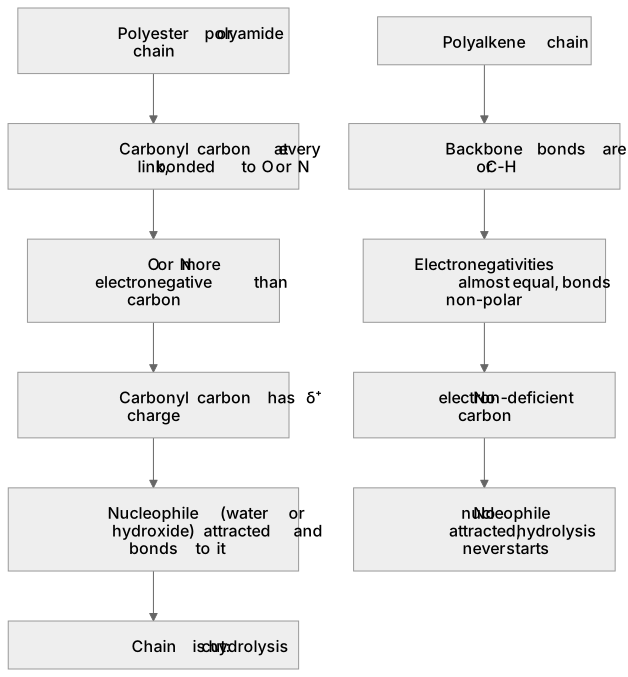
Label the diagram
Some boxes have lost their names. Pick the right name for each number.
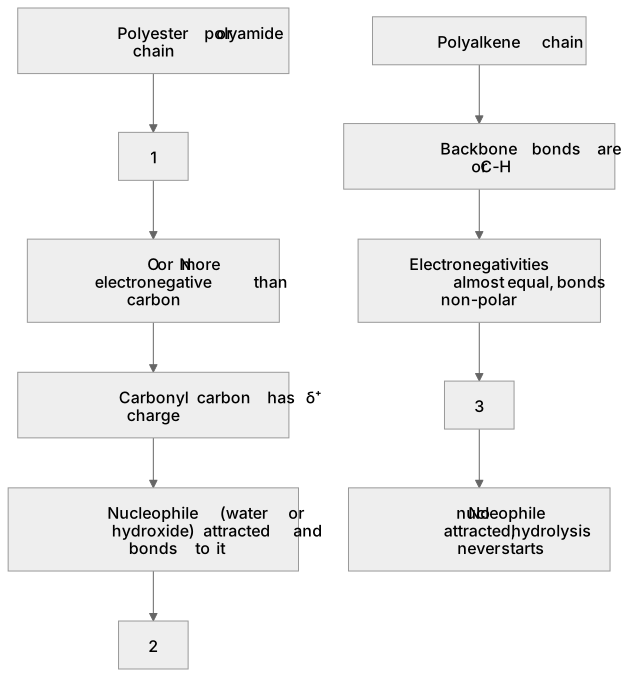
1Box 1
2Box 2
3Box 3
There is more to this lesson
The full lesson goes on to check your understanding and help you earn the marks. Create a free account to carry on, with your progress saved.
A week of Premium from your first lesson · Then the free plan continues · No card, no charge
Test your understanding of Biodegradability and disposal of polymers (A-level only): Students should be able to: explain why polyesters and polyamides can be hydrolysed but polyalkenes cannot.
Active recall beats re-reading. Take an instant quiz now to test what you’ve learned and lock it into long-term memory.
A week of Premium from your first lesson · Then the free plan continues · No card, no charge