AQA · A-Level · Chemistry
Course version: 7405 · Version from Sept 2016
Bond enthalpies: Mean bond enthalpy.
A mean bond enthalpy is the enthalpy change when one mole of a stated covalent bond is broken in the gaseous state, averaged over a range of different compounds containing that bond.
Checked against the AQA 7405 specification (opens in a new tab) on .
- Point 1 of 2
- 4 key terms
Study notes
From the checked teaching notes for this specification point.
The idea
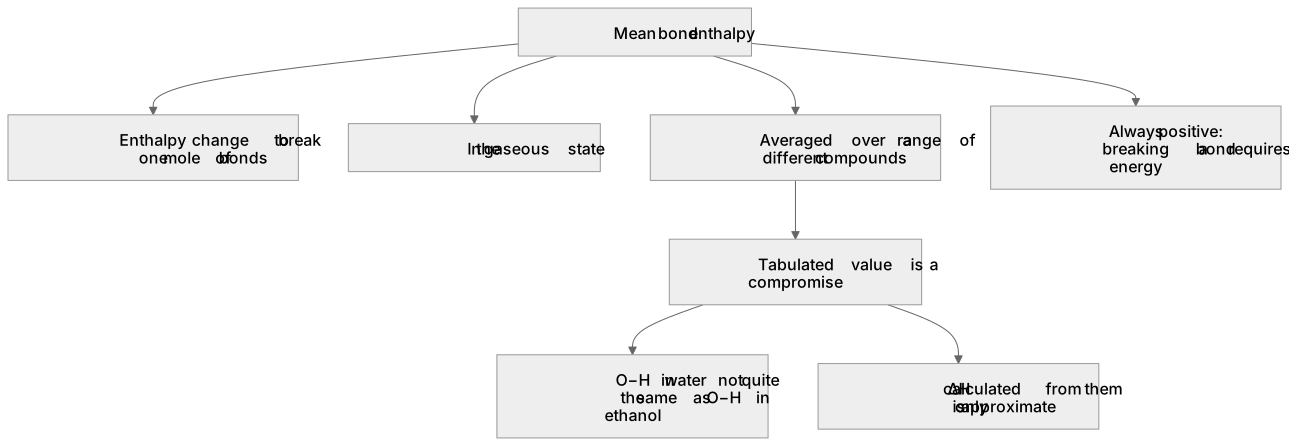
A mean bond enthalpy is the enthalpy change when one mole of a stated covalent bond is broken in the gaseous state, averaged over a range of different compounds containing that bond. The two halves both matter. Gaseous state, because breaking a bond in a liquid would also have to pay for the intermolecular forces. Averaged, because the O−H bond in water is not quite the same strength as the O−H bond in ethanol, so the tabulated value is a compromise that fits neither exactly. Bond breaking always takes energy in, so mean bond enthalpies are always positive and examiners refuse any definition that says energy released. The averaging is also why any ∆H calculated from them is only approximate.
What earns the marks
- Enthalpy change to break one mole of bonds.
- Specifying the gaseous state.
- Averaged over a range of different compounds or molecules.
- Recognising the value as positive, since breaking a bond requires energy.
Common mistakes and how to put them right
Defining it as the energy released when a bond is formed, which examiners explicitly refuse.
Omitting the gaseous state, so the definition would include the energy to vaporise the substance.
Omitting the averaging, which is the point that makes it a mean bond enthalpy rather than a bond dissociation enthalpy.
Writing per mole of molecules rather than per mole of bonds.
Assuming the tabulated value applies exactly to the compound in the question.
Exam tips
- Learn the definition as four chunks: enthalpy change, to break one mole of bonds, in the gaseous state, averaged over different compounds.
- Heat energy change is accepted in place of enthalpy change, but enthalpy released is never accepted.
- If the question names a specific molecule, still say averaged over a range of compounds; the average is the defining feature.
Try the lesson
The start of the Bond enthalpies: Mean bond enthalpy. lesson, made from checked teaching notes for this specification point.
Have a go first
Which statement best describes what is meant by the mean bond enthalpy of a C−H bond?
Listen
A mean bond enthalpy is the enthalpy change when one mole of a stated covalent bond is broken in the gaseous state, averaged over a range of different compounds containing that bond. The two halves both matter. Gaseous state, because breaking a bond in a liquid would also have to pay for the intermolecular forces. Averaged, because the O−H bond in water is not quite the same strength as the O−H bond in ethanol, so the tabulated value is a compromise that fits neither exactly. Bond breaking always takes energy in, so mean bond enthalpies are always positive and examiners refuse any definition that says energy released. The averaging is also why any ∆H calculated from them is only approximate. A strong answer earns marks for these points. enthalpy change to break one mole of bonds. specifying the gaseous state. averaged over a range of different compounds or molecules. recognising the value as positive, since breaking a bond requires energy. Exam tip: Learn the definition as four chunks: enthalpy change, to break one mole of bonds, in the gaseous state, averaged over different compounds.
See it
Key words
Say what each word means before you turn the card.
mean bond enthalpy
Try answering aloud or in your head before turning the card.
gaseous state
Try answering aloud or in your head before turning the card.
averaged over compounds
Try answering aloud or in your head before turning the card.
always endothermic
Try answering aloud or in your head before turning the card.
See every definition
- mean bond enthalpy
- The enthalpy change when one mole of a stated covalent bond is broken in the gaseous state, averaged over a range of different compounds containing that bond.
- gaseous state
- The state specified in the definition because breaking a bond in a liquid would also have to pay for the intermolecular forces.
- averaged over compounds
- The tabulated value is a compromise over a range of different compounds containing that bond, so it fits neither exactly.
- always endothermic
- Bond breaking always takes energy in, so mean bond enthalpies are always positive and any definition saying energy released is refused.
Label the diagram
Some boxes have lost their names. Pick the right name for each number.
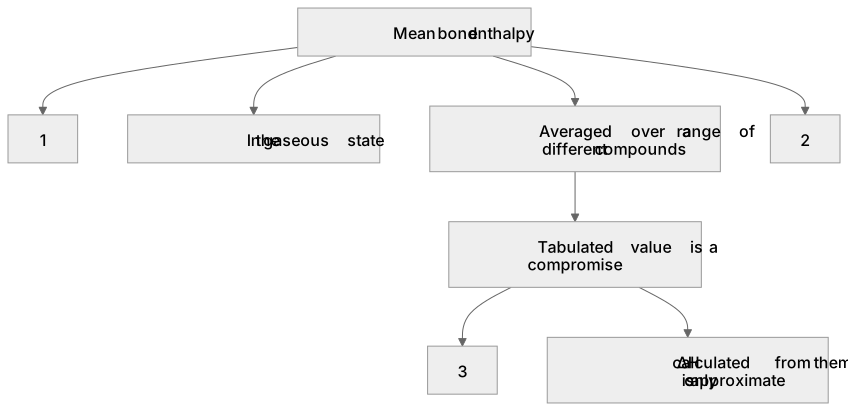
1Box 1
2Box 2
3Box 3
There is more to this lesson
The full lesson goes on to check your understanding and help you earn the marks. Create a free account to carry on, with your progress saved.
A week of Premium from your first lesson · Then the free plan continues · No card, no charge
Test your understanding of Bond enthalpies: Mean bond enthalpy.
Active recall beats re-reading. Take an instant quiz now to test what you’ve learned and lock it into long-term memory.
A week of Premium from your first lesson · Then the free plan continues · No card, no charge