AQA · A-Level · Chemistry
Course version: 7405 · Version from Sept 2016
Electronegativity as the power of an atom to attract the pair of electrons…
Full specification wording
Bond polarity: Electronegativity as the power of an atom to attract the pair of electrons in a covalent bond.
Electronegativity is the power of an atom to attract the pair of electrons in a covalent bond towards itself.
Checked against the AQA 7405 specification (opens in a new tab) on .
- Point 1 of 4
Study notes
From the checked teaching notes for this specification point.
The idea
Electronegativity is the power of an atom to attract the pair of electrons in a covalent bond towards itself. It is measured on the Pauling scale, where fluorine is the highest at 4.0, followed by oxygen at 3.5, then nitrogen and chlorine at 3.0. Across a period it rises because nuclear charge increases while the bonding electrons stay in the same shell with similar shielding, so they are pulled in harder. Down a group it falls because the bonding pair lies in a shell further from the nucleus and is shielded by more inner shells. Only the shared pair is involved; the term says nothing about an atom's attraction for electrons in general.
What earns the marks
- The power or ability of an atom to attract electrons.
- Specifying the pair of electrons in a covalent bond rather than electrons in general.
- Explaining the trend using increasing nuclear charge and decreasing atomic radius.
- Identifying the more electronegative atom correctly from supplied data.
Common mistakes and how to put them right
Defining it as the attraction of an atom for all electrons rather than for a shared pair.
Applying the term to ions instead of to atoms joined by a covalent bond.
Claiming electronegativity increases down a group.
Confusing electronegativity with ionisation energy or electron affinity.
Exam tips
- Include the words bonding pair or pair of electrons in a covalent bond in your definition.
- Use the data booklet values rather than memory when a question asks you to compare atoms.
- Explain trends with nuclear charge, radius and shielding, the same three factors as ionisation energy.
Try the lesson
The start of the Bond polarity: Electronegativity as the power of an atom to attract the pair of electrons in a covalent bond. lesson, made from checked teaching notes for this specification point.
Have a go first
Which statement best defines electronegativity?
Listen
Electronegativity is the power of an atom to attract the pair of electrons in a covalent bond towards itself. It is measured on the Pauling scale, where fluorine is the highest at 4.0, followed by oxygen at 3.5, then nitrogen and chlorine at 3.0. Across a period it rises because nuclear charge increases while the bonding electrons stay in the same shell with similar shielding, so they are pulled in harder. Down a group it falls because the bonding pair lies in a shell further from the nucleus and is shielded by more inner shells. Only the shared pair is involved; the term says nothing about an atom's attraction for electrons in general. A strong answer earns marks for these points. the power or ability of an atom to attract electrons. specifying the pair of electrons in a covalent bond rather than electrons in general. explaining the trend using increasing nuclear charge and decreasing atomic radius. identifying the more electronegative atom correctly from supplied data. Exam tip: Include the words bonding pair or pair of electrons in a covalent bond in your definition.
See it
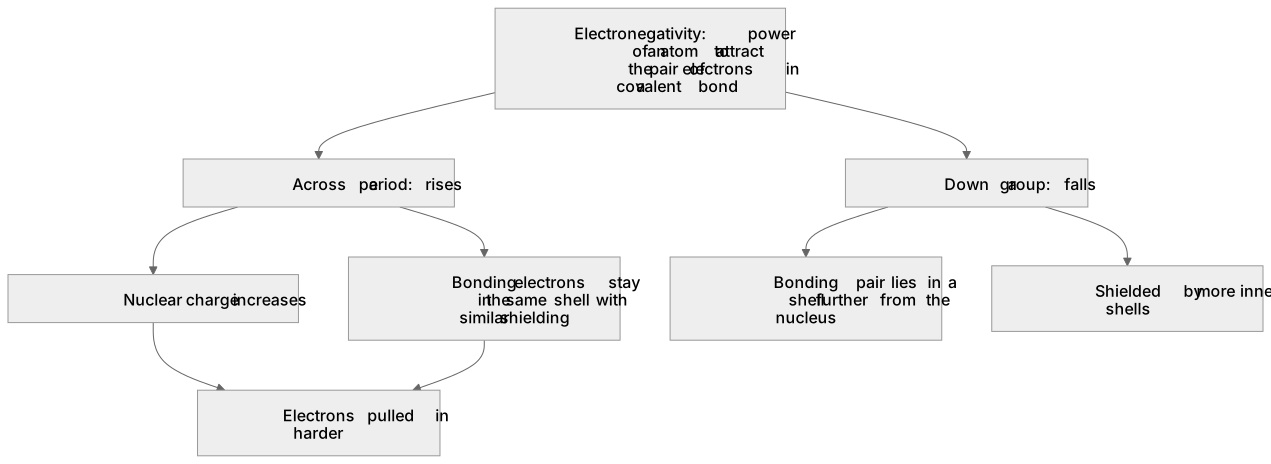
Label the diagram
Some boxes have lost their names. Pick the right name for each number.
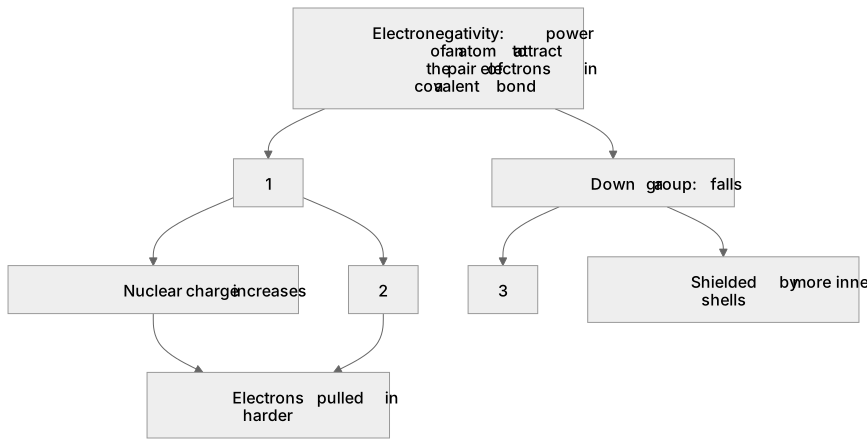
1Box 1
2Box 2
3Box 3
There is more to this lesson
The full lesson goes on to check your understanding and help you earn the marks. Create a free account to carry on, with your progress saved.
A week of Premium from your first lesson · Then the free plan continues · No card, no charge
Test your understanding of Bond polarity: Electronegativity as the power of an atom to attract the pair of electrons in a covalent bond.
Active recall beats re-reading. Take an instant quiz now to test what you’ve learned and lock it into long-term memory.
A week of Premium from your first lesson · Then the free plan continues · No card, no charge