AQA · A-Level · Chemistry
Course version: 7405 · Version from Sept 2016
Students should be able to: use partial charges to show that a bond is…
Full specification wording
Bond polarity: Students should be able to: use partial charges to show that a bond is polar explain why some molecules with polar bonds do not have a permanent dipole.
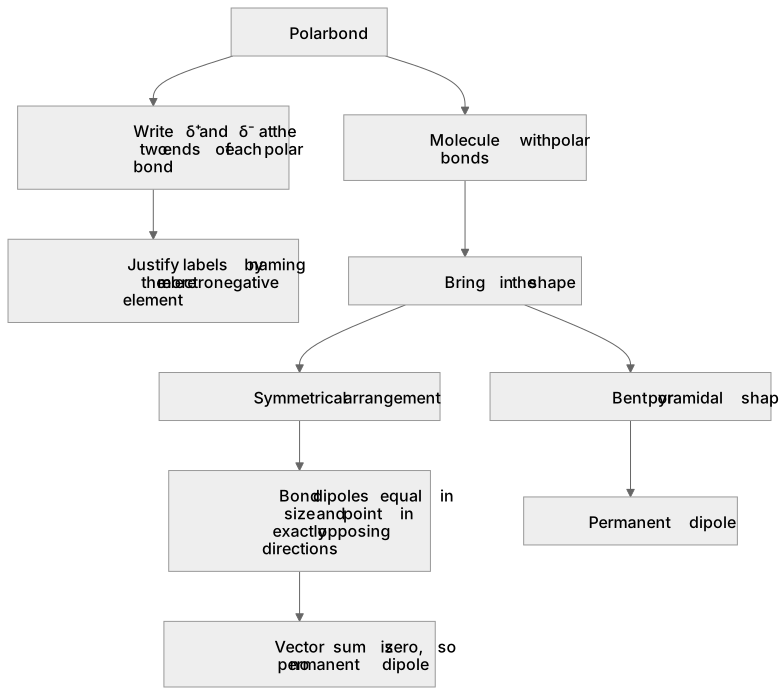
To show a bond is polar, draw the molecule and write δ⁺ and δ⁻ at the two ends of each polar bond, then justify the labels by naming the more electronegative element: oxygen and nitrogen are both…
Checked against the AQA 7405 specification (opens in a new tab) on .
- Point 4 of 4
- 4 key terms
Study notes
From the checked teaching notes for this specification point.
The idea
To show a bond is polar, draw the molecule and write δ⁺ and δ⁻ at the two ends of each polar bond, then justify the labels by naming the more electronegative element: oxygen and nitrogen are both more electronegative than carbon and hydrogen. To explain why a molecule with polar bonds has no permanent dipole, you must bring in the shape. In a symmetrical arrangement the bond dipoles are equal in size and point outwards in directions that exactly oppose one another, so the vector sum is zero. Ethanol and ethylamine are polar because their shapes are bent or pyramidal; methoxymethane is bent too, but its smaller electronegativity differences make it less polar than ethanol.
What earns the marks
- δ⁺ and δ⁻ written on the correct atoms of each polar bond.
- Justifying the labels by naming the more electronegative element.
- Drawing or describing the correct shape of the molecule.
- Stating that the bond dipoles cancel because the molecule is symmetrical, so there is no permanent dipole.
Common mistakes and how to put them right
Labelling the molecule as a whole rather than the atoms at the ends of each bond.
Using full plus and minus signs instead of δ⁺ and δ⁻.
Claiming a molecule is non-polar because its bonds are non-polar when the bonds are in fact polar.
Forgetting that a lone pair on the central atom destroys the symmetry that would allow cancellation.
Exam tips
- A correctly labelled diagram can earn both the polarity marks and the shape mark at once.
- Name the electronegative atom explicitly; diagrams alone without justification often lose a mark.
- When ranking polarity, compare electronegativity differences, not just the presence of polar bonds.
Try the lesson
The start of the Bond polarity: Students should be able to: use partial charges to show that a bond is polar explain why some molecules with polar bonds do not have a permanent dipole. lesson, made from checked teaching notes for this specification point.
Have a go first
Which statement correctly describes the partial charges in a polar covalent bond?
Listen
To show a bond is polar, draw the molecule and write δ⁺ and δ⁻ at the two ends of each polar bond, then justify the labels by naming the more electronegative element: oxygen and nitrogen are both more electronegative than carbon and hydrogen. To explain why a molecule with polar bonds has no permanent dipole, you must bring in the shape. In a symmetrical arrangement the bond dipoles are equal in size and point outwards in directions that exactly oppose one another, so the vector sum is zero. Ethanol and ethylamine are polar because their shapes are bent or pyramidal; methoxymethane is bent too, but its smaller electronegativity differences make it less polar than ethanol. A strong answer earns marks for these points. and δ⁻ written on the correct atoms of each polar bond. justifying the labels by naming the more electronegative element. drawing or describing the correct shape of the molecule. stating that the bond dipoles cancel because the molecule is symmetrical, so there is no permanent dipole. Exam tip: A correctly labelled diagram can earn both the polarity marks and the shape mark at once.
See it
Key words
Say what each word means before you turn the card.
partial charge labelling
Try answering aloud or in your head before turning the card.
justifying with electronegativity
Try answering aloud or in your head before turning the card.
cancelling dipoles
Try answering aloud or in your head before turning the card.
ranking polarity
Try answering aloud or in your head before turning the card.
See every definition
- partial charge labelling
- Writing δ⁺ and δ⁻ at the two ends of each polar bond on a drawn molecule, rather than labelling the molecule as a whole.
- justifying with electronegativity
- Naming the more electronegative element to justify the labels, since oxygen and nitrogen are both more electronegative than carbon and hydrogen.
- cancelling dipoles
- In a symmetrical arrangement the bond dipoles are equal in size and point outwards in directions that exactly oppose one another, so the vector sum is zero.
- ranking polarity
- Comparing electronegativity differences, not just the presence of polar bonds, using both the shapes and the electronegativities of the atoms involved.
Label the diagram
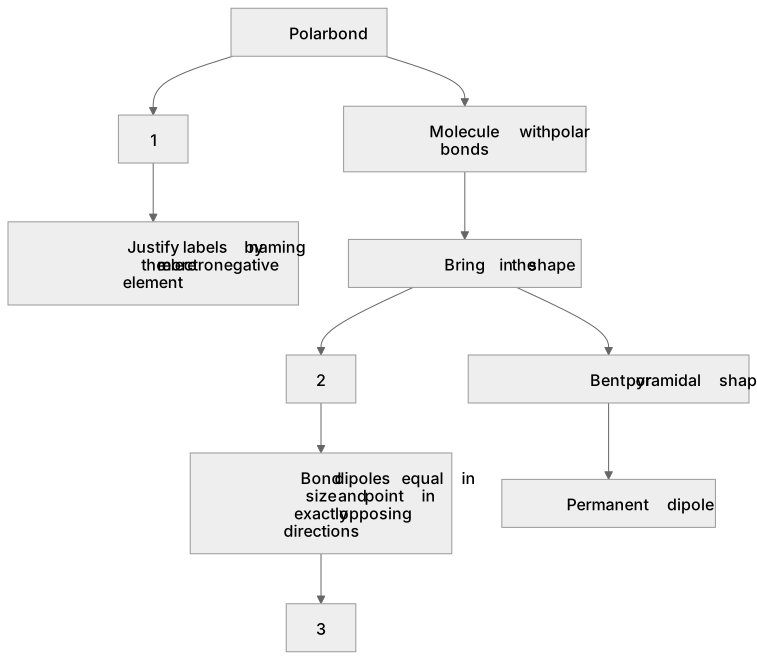
Some boxes have lost their names. Pick the right name for each number.
1Box 1
2Box 2
3Box 3
There is more to this lesson
The full lesson goes on to check your understanding and help you earn the marks. Create a free account to carry on, with your progress saved.
A week of Premium from your first lesson · Then the free plan continues · No card, no charge
Test your understanding of Bond polarity: Students should be able to: use partial charges to show that a bond is polar explain why some molecules with polar bonds do not have a permanent dipole.
Active recall beats re-reading. Take an instant quiz now to test what you’ve learned and lock it into long-term memory.
A week of Premium from your first lesson · Then the free plan continues · No card, no charge