AQA · A-Level · Chemistry
Course version: 7405 · Version from Sept 2016
Acidic buffer solutions contain a weak acid and the salt of that weak acid.
Full specification wording
Buffer action (A-level only): Acidic buffer solutions contain a weak acid and the salt of that weak acid.
An acidic buffer is a weak acid together with the salt of that acid, for example ethanoic acid with sodium or potassium ethanoate.
Checked against the AQA 7405 specification (opens in a new tab) on .
- Point 2 of 5
- 4 key terms
Study notes
From the checked teaching notes for this specification point.
The idea
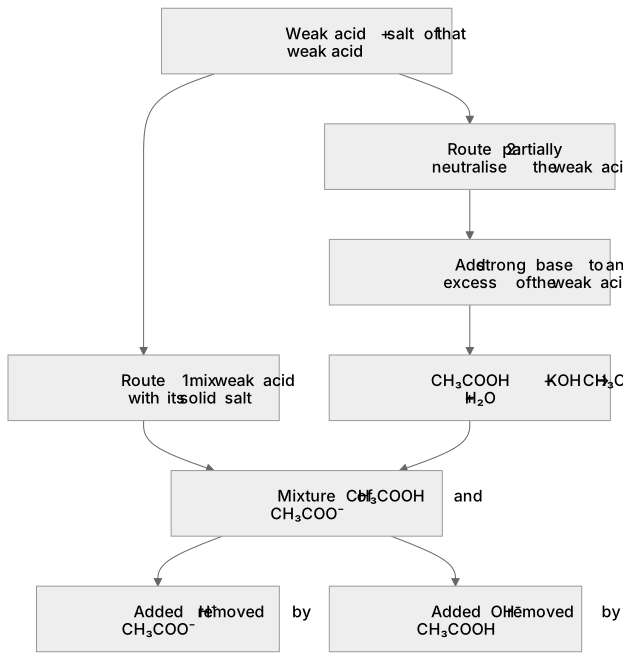
An acidic buffer is a weak acid together with the salt of that acid, for example ethanoic acid with sodium or potassium ethanoate. The salt is fully ionic, so it supplies a large concentration of ethanoate ions, far more than the acid's own slight dissociation could ever provide. There are two ways to make one. Mix the weak acid with its solid salt. Or partially neutralise the weak acid: add the strong base to an excess of the acid, so that CH₃COOH + KOH → CH₃COOK + H₂O converts some of the acid into the salt and leaves the rest unreacted. Both routes finish with the mixture of CH₃COOH and CH₃COO⁻ that buffering requires. Added H⁺ is removed by the ethanoate ion and added OH⁻ by the ethanoic acid molecule, and naming those two species is what earns the marks.
What earns the marks
- Adding an excess of the weak acid to the strong base, so the acid is only partially neutralised.
- Stating that the mixture then contains both the weak acid and its conjugate base.
- The neutralisation equation, for example CH₃COOH + KOH → CH₃COOK + H₂O.
- Stating that CH₃COO⁻ from the salt reacts with the added H⁺.
- Stating that CH₃COOH reacts with the added OH⁻.
Common mistakes and how to put them right
Adding an excess of potassium hydroxide, which destroys all the weak acid and leaves no buffer.
Describing the mixture as a weak acid and a strong base, when the base has been fully consumed.
Writing the salt as CH₃COOHK instead of CH₃COOK or CH₃COO⁻K⁺.
Explaining the action only by saying 'the equilibrium shifts', which examiners ignore unless a species is named.
Choosing a strong acid and its salt, which cannot buffer because the acid is fully dissociated.
Exam tips
- 'Add excess ethanoic acid to the potassium hydroxide' is the phrasing that scores; 'mix them' is not enough.
- Name CH₃COO⁻ and CH₃COOH explicitly in the explanation rather than talking about 'the equilibrium'.
Try the lesson
The start of the Buffer action (A-level only): Acidic buffer solutions contain a weak acid and the salt of that weak acid. lesson, made from checked teaching notes for this specification point.
Have a go first
Which pair of substances could be mixed to make an acidic buffer solution?
Listen
An acidic buffer is a weak acid together with the salt of that acid, for example ethanoic acid with sodium or potassium ethanoate. The salt is fully ionic, so it supplies a large concentration of ethanoate ions, far more than the acid's own slight dissociation could ever provide. There are two ways to make one. Mix the weak acid with its solid salt. Or partially neutralise the weak acid: add the strong base to an excess of the acid, so that CH₃COOH + KOH → CH₃COOK + H₂O converts some of the acid into the salt and leaves the rest unreacted. Both routes finish with the mixture of CH₃COOH and CH₃COO⁻ that buffering requires. Added H⁺ is removed by the ethanoate ion and added OH⁻ by the ethanoic acid molecule, and naming those two species is what earns the marks. A strong answer earns marks for these points. adding an excess of the weak acid to the strong base, so the acid is only partially neutralised. stating that the mixture then contains both the weak acid and its conjugate base. the neutralisation equation, for example CH₃COOH + KOH → CH₃COOK + H₂O. stating that CH₃COO⁻ from the salt reacts with the added H⁺. Exam tip: 'Add excess ethanoic acid to the potassium hydroxide' is the phrasing that scores; 'mix them' is not enough.
See it
Key words
Say what each word means before you turn the card.
acidic buffer
Try answering aloud or in your head before turning the card.
weak acid and its salt
Try answering aloud or in your head before turning the card.
partial neutralisation
Try answering aloud or in your head before turning the card.
named species in buffer action
Try answering aloud or in your head before turning the card.
See every definition
- acidic buffer
- A solution containing a weak acid and the salt of that weak acid.
- weak acid and its salt
- The two components an acidic buffer contains, for example ethanoic acid with sodium or potassium ethanoate.
- partial neutralisation
- Adding the strong base to an excess of the weak acid, so some of the acid is converted into the salt and the rest is left unreacted.
- named species in buffer action
- Added H⁺ is removed by the ethanoate ion and added OH⁻ by the ethanoic acid molecule, and naming those two species earns the marks.
Label the diagram
Some boxes have lost their names. Pick the right name for each number.
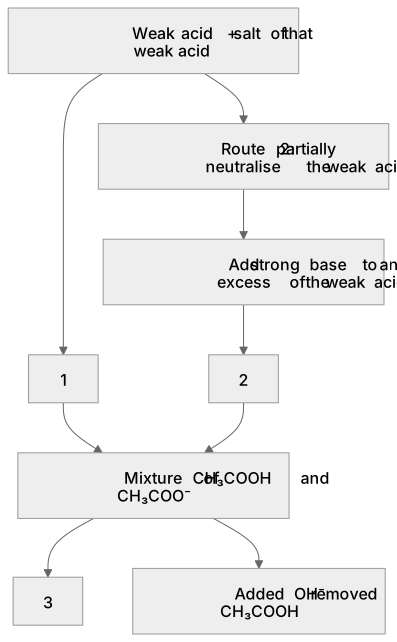
1Box 1
2Box 2
3Box 3
There is more to this lesson
The full lesson goes on to check your understanding and help you earn the marks. Create a free account to carry on, with your progress saved.
A week of Premium from your first lesson · Then the free plan continues · No card, no charge
Test your understanding of Buffer action (A-level only): Acidic buffer solutions contain a weak acid and the salt of that weak acid.
Active recall beats re-reading. Take an instant quiz now to test what you’ve learned and lock it into long-term memory.
A week of Premium from your first lesson · Then the free plan continues · No card, no charge