AQA · A-Level · Chemistry
Course version: 7405 · Version from Sept 2016
Buffer action (A-level only): Applications of buffer solutions.
Blood plasma is the example to know.
Checked against the AQA 7405 specification (opens in a new tab) on .
- Point 4 of 5
- 4 key terms
Study notes
From the checked teaching notes for this specification point.
The idea
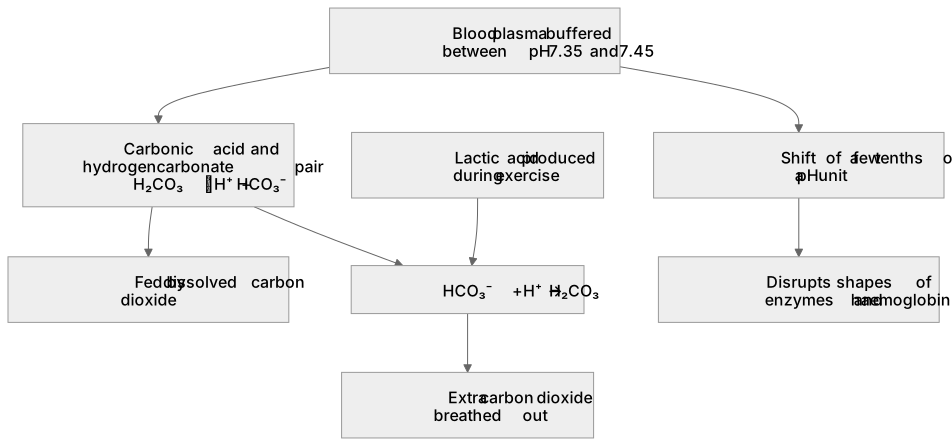
Blood plasma is the example to know. It is held between pH 7.35 and 7.45 by the carbonic acid and hydrogencarbonate pair, H₂CO₃ ⇌ H⁺ + HCO₃⁻, fed by dissolved carbon dioxide. Lactic acid produced during exercise is absorbed by HCO₃⁻ + H⁺ → H₂CO₃, and the extra carbon dioxide is then breathed out, which is part of why the system copes so well. A shift of only a few tenths of a pH unit disrupts the shapes of enzymes and of haemoglobin, so the margin is narrow. Elsewhere, shampoos and skin creams are buffered near pH 5.5 to match skin; foods are buffered with citric acid and a citrate salt to control flavour and inhibit bacteria; and buffer solutions of known pH are what a pH meter is calibrated against before use.
What earns the marks
- Naming a real application, such as blood plasma held near pH 7.4.
- Identifying the conjugate pair responsible, for example H₂CO₃ and HCO₃⁻.
- An equation showing the added H⁺ being removed by HCO₃⁻.
- Stating why the pH must be controlled, such as enzymes losing activity outside a narrow range.
Common mistakes and how to put them right
Naming the blood buffer as carbon dioxide and water rather than the H₂CO₃ and HCO₃⁻ pair.
Stating that blood is buffered at pH 7.0 rather than at about 7.4.
Claiming a buffer can restore the pH after any amount of acid is added.
Describing a shampoo as 'pH balanced' with no named acid and salt.
Exam tips
- Give a number for the pH being maintained; a named application with no value rarely gets full credit.
- Follow every application with the consequence of losing control, such as loss of enzyme activity.
Try the lesson
The start of the Buffer action (A-level only): Applications of buffer solutions. lesson, made from checked teaching notes for this specification point.
Have a go first
Which application relies on a buffer solution maintaining an almost constant pH?
Listen
Blood plasma is the example to know. It is held between pH 7.35 and 7.45 by the carbonic acid and hydrogencarbonate pair, H₂CO₃ ⇌ H⁺ + HCO₃⁻, fed by dissolved carbon dioxide. Lactic acid produced during exercise is absorbed by HCO₃⁻ + H⁺ → H₂CO₃, and the extra carbon dioxide is then breathed out, which is part of why the system copes so well. A shift of only a few tenths of a pH unit disrupts the shapes of enzymes and of haemoglobin, so the margin is narrow. Elsewhere, shampoos and skin creams are buffered near pH 5.5 to match skin; foods are buffered with citric acid and a citrate salt to control flavour and inhibit bacteria; and buffer solutions of known pH are what a pH meter is calibrated against before use. A strong answer earns marks for these points. naming a real application, such as blood plasma held near pH 7.4. identifying the conjugate pair responsible, for example H₂CO₃ and HCO₃⁻. an equation showing the added H⁺ being removed by HCO₃⁻. stating why the pH must be controlled, such as enzymes losing activity outside a narrow range. Exam tip: Give a number for the pH being maintained; a named application with no value rarely gets full credit.
See it
Key words
Say what each word means before you turn the card.
blood plasma buffering
Try answering aloud or in your head before turning the card.
carbonic acid and hydrogencarbonate
Try answering aloud or in your head before turning the card.
enzyme sensitivity to pH
Try answering aloud or in your head before turning the card.
cosmetic and food buffers
Try answering aloud or in your head before turning the card.
See every definition
- blood plasma buffering
- Blood plasma is held between pH 7.35 and 7.45 by the carbonic acid and hydrogencarbonate pair, fed by dissolved carbon dioxide.
- carbonic acid and hydrogencarbonate
- The pair H₂CO₃ ⇌ H⁺ + HCO₃⁻ holds blood plasma in its narrow pH range, and HCO₃⁻ absorbs lactic acid produced during exercise.
- enzyme sensitivity to pH
- A shift of only a few tenths of a pH unit disrupts the shapes of enzymes and of haemoglobin, so the margin is narrow.
- cosmetic and food buffers
- Shampoos and skin creams are buffered near pH 5.5 to match skin, and foods are buffered with citric acid and a citrate salt to control flavour and inhibit bacteria.
Label the diagram
Some boxes have lost their names. Pick the right name for each number.
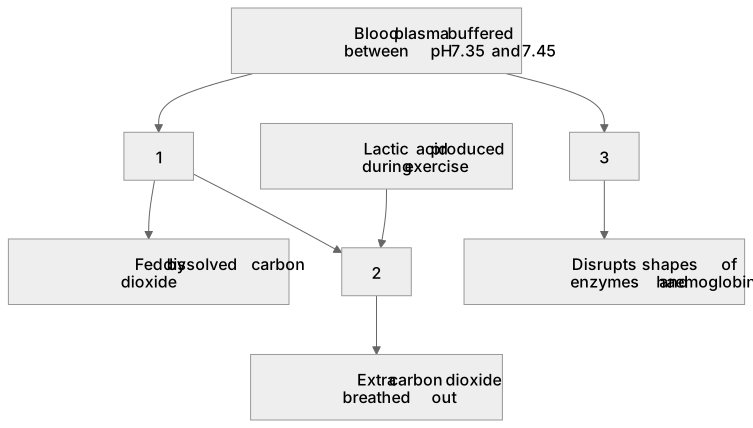
1Box 1
2Box 2
3Box 3
There is more to this lesson
The full lesson goes on to check your understanding and help you earn the marks. Create a free account to carry on, with your progress saved.
A week of Premium from your first lesson · Then the free plan continues · No card, no charge
Test your understanding of Buffer action (A-level only): Applications of buffer solutions.
Active recall beats re-reading. Take an instant quiz now to test what you’ve learned and lock it into long-term memory.
A week of Premium from your first lesson · Then the free plan continues · No card, no charge