AQA · A-Level · Chemistry
Course version: 7405 · Version from Sept 2016
Carboxylic acids and alcohols react, in the presence of an acid catalyst,…
Full specification wording
Carboxylic acids and esters (A-level only): Carboxylic acids and alcohols react, in the presence of an acid catalyst, to give esters.
Esterification is a reversible reaction: an alcohol and a carboxylic acid heated under reflux with a few drops of concentrated sulfuric acid reach an equilibrium mixture, so the yield is always…
Checked against the AQA 7405 specification (opens in a new tab) on .
- Point 2 of 8
- 4 key terms
Study notes
From the checked teaching notes for this specification point.
The idea
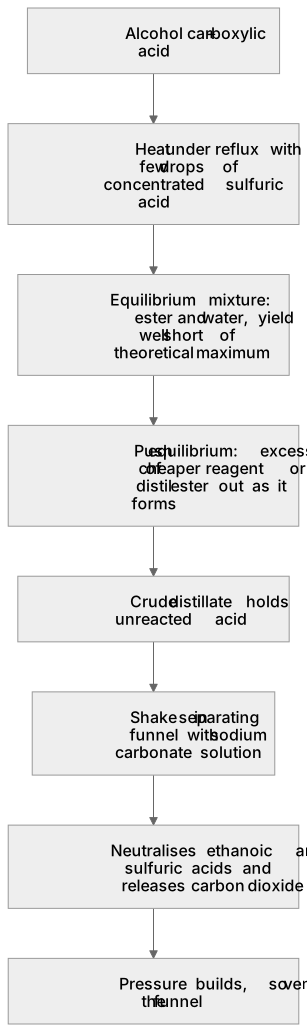
Esterification is a reversible reaction: an alcohol and a carboxylic acid heated under reflux with a few drops of concentrated sulfuric acid reach an equilibrium mixture, so the yield is always well short of the theoretical maximum. Ethanol and ethanoic acid give ethyl ethanoate and water, and the sulfuric acid is a catalyst that is regenerated, not a reactant in the equation. To push the equilibrium over you use an excess of the cheaper reagent or distil the ester out as it forms. The crude distillate still holds unreacted acid, so it is shaken in a separating funnel with sodium carbonate solution; that neutralises the ethanoic and sulfuric acids and releases carbon dioxide, which is why pressure builds and the funnel has to be vented.
What earns the marks
- An equation showing the ester and water as the two products.
- Naming concentrated sulfuric acid as the catalyst and stating that it is not used up.
- The reaction being reversible, so the yield is limited by the position of equilibrium.
- Washing the distillate with sodium carbonate solution to remove the unreacted acid.
- Carbon dioxide being produced, which is what raises the pressure in the separating funnel.
Common mistakes and how to put them right
Leaving water out of the equation, so the equation does not balance.
Swapping the alkyl groups, so ethanol and methanoic acid are written as giving methyl ethanoate.
Saying the sodium carbonate neutralises 'the distillate' or 'the mixture' without naming the acid, which AQA ignores.
Claiming a 100% yield is possible if enough catalyst is added.
Treating the concentrated sulfuric acid as a reagent and putting it into the balanced equation.
Exam tips
- For a percentage yield, find the limiting reagent first by converting both masses or volumes to moles, then work from that.
- Say which acid you are removing when you justify the sodium carbonate wash; 'to act as a base' scores nothing.
- Use ⇌ rather than → whenever you write the esterification equation.
Try the lesson
The start of the Carboxylic acids and esters (A-level only): Carboxylic acids and alcohols react, in the presence of an acid catalyst, to give esters. lesson, made from checked teaching notes for this specification point.
Have a go first
What type of catalyst is used when a carboxylic acid reacts with an alcohol to form an ester?
Listen
Esterification is a reversible reaction: an alcohol and a carboxylic acid heated under reflux with a few drops of concentrated sulfuric acid reach an equilibrium mixture, so the yield is always well short of the theoretical maximum. Ethanol and ethanoic acid give ethyl ethanoate and water, and the sulfuric acid is a catalyst that is regenerated, not a reactant in the equation. To push the equilibrium over you use an excess of the cheaper reagent or distil the ester out as it forms. The crude distillate still holds unreacted acid, so it is shaken in a separating funnel with sodium carbonate solution; that neutralises the ethanoic and sulfuric acids and releases carbon dioxide, which is why pressure builds and the funnel has to be vented. A strong answer earns marks for these points. an equation showing the ester and water as the two products. naming concentrated sulfuric acid as the catalyst and stating that it is not used up. the reaction being reversible, so the yield is limited by the position of equilibrium. washing the distillate with sodium carbonate solution to remove the unreacted acid. Exam tip: For a percentage yield, find the limiting reagent first by converting both masses or volumes to moles, then work from that.
See it
Put it in order
Put these steps in the order they happen.
- 1. Crude distillate holds unreacted acid
- 2. Pressure builds, so vent the funnel
- 3. Shake in separating funnel with sodium carbonate solution
- 4. Alcohol + carboxylic acid
- 5. Heat under reflux with a few drops of concentrated sulfuric acid
- 6. Neutralises ethanoic and sulfuric acids and releases carbon dioxide
- 7. Equilibrium mixture: ester and water, yield well short of theoretical maximum
- 8. Push equilibrium: excess of cheaper reagent or distil ester out as it forms
Key words
Say what each word means before you turn the card.
esterification
Try answering aloud or in your head before turning the card.
acid catalysis
Try answering aloud or in your head before turning the card.
reversible reaction
Try answering aloud or in your head before turning the card.
separating funnel wash
Try answering aloud or in your head before turning the card.
See every definition
- esterification
- A carboxylic acid and an alcohol react, in the presence of an acid catalyst, to give an ester and water.
- acid catalysis
- Concentrated sulfuric acid is used as a catalyst that is regenerated, not a reactant in the equation.
- reversible reaction
- The reaction reaches an equilibrium mixture, so the yield is always well short of the theoretical maximum.
- separating funnel wash
- The crude distillate is shaken in a separating funnel with sodium carbonate solution, which neutralises the unreacted acids and releases carbon dioxide, so the funnel has to be vented.
Label the diagram
Some boxes have lost their names. Pick the right name for each number.
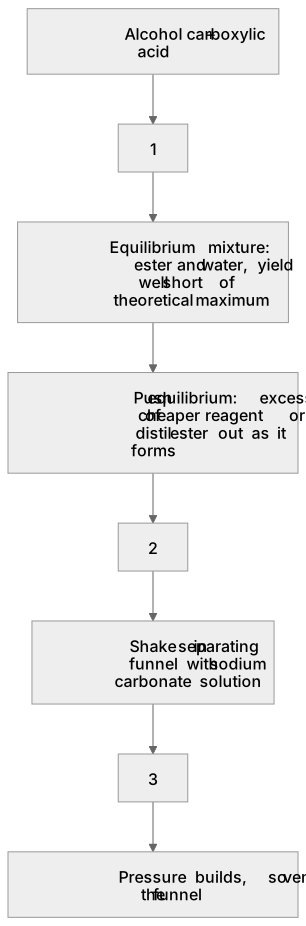
1Box 1
2Box 2
3Box 3
There is more to this lesson
The full lesson goes on to check your understanding and help you earn the marks. Create a free account to carry on, with your progress saved.
A week of Premium from your first lesson · Then the free plan continues · No card, no charge
Test your understanding of Carboxylic acids and esters (A-level only): Carboxylic acids and alcohols react, in the presence of an acid catalyst, to give esters.
Active recall beats re-reading. Take an instant quiz now to test what you’ve learned and lock it into long-term memory.
A week of Premium from your first lesson · Then the free plan continues · No card, no charge