AQA · A-Level · Chemistry
Course version: 7405 · Version from Sept 2016
Vegetable oils and animal fats can be hydrolysed in alkaline conditions to…
Full specification wording
Carboxylic acids and esters (A-level only): Vegetable oils and animal fats can be hydrolysed in alkaline conditions to give soap (salts of long-chain carboxylic acids) and glycerol.
Saponification is alkaline hydrolysis carried out on a triglyceride.
Checked against the AQA 7405 specification (opens in a new tab) on .
- Point 6 of 8
- 4 key terms
Study notes
From the checked teaching notes for this specification point.
The idea
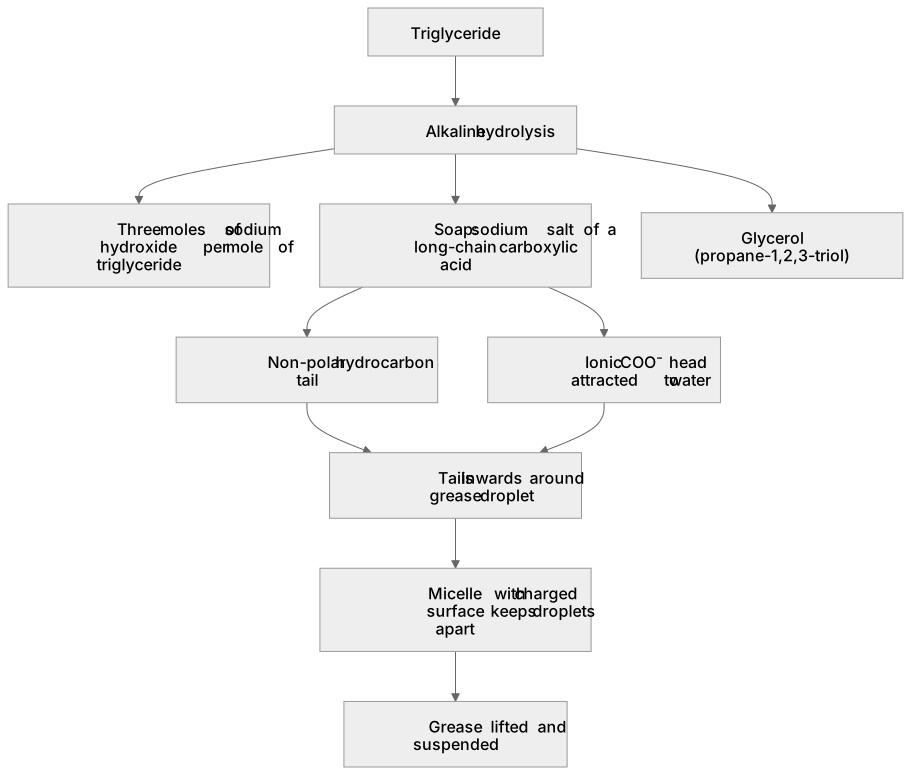
Saponification is alkaline hydrolysis carried out on a triglyceride. Three ester links means three moles of sodium hydroxide per mole of fat, and the products are three molecules of a sodium salt of a long-chain carboxylic acid, RCOO⁻Na⁺, plus one molecule of glycerol. That salt is the soap. It works because it has two incompatible ends: a long non-polar hydrocarbon tail, which mixes with grease, and an ionic COO⁻ head, which is attracted to water. Soap molecules surround a grease droplet with their tails inwards and heads outwards, forming a micelle whose charged surface keeps droplets apart so the grease is lifted and suspended. In hard water the calcium and magnesium salts are insoluble, so scum forms instead.
What earns the marks
- Three moles of sodium hydroxide reacting per mole of triglyceride.
- Glycerol, propane-1,2,3-triol, given as the second product.
- The soap written as the sodium salt of a long-chain carboxylic acid.
- Describing the hydrocarbon tail as non-polar and the COO⁻ head as attracted to water.
Common mistakes and how to put them right
Giving the free long-chain carboxylic acid rather than its sodium salt as the product of the alkali.
Using one mole of sodium hydroxide per triglyceride instead of three.
Naming the alcohol product as ethanol rather than glycerol.
Saying the hydrocarbon tail dissolves in the water and the head in the grease.
Exam tips
- Count the ester links before you balance: three links means three moles of alkali and three moles of soap.
- When explaining how soap cleans, name the two ends and say what each is attracted to; 'it dissolves grease' alone scores nothing.
Try the lesson
The start of the Carboxylic acids and esters (A-level only): Vegetable oils and animal fats can be hydrolysed in alkaline conditions to give soap (salts of long-chain carboxylic acids) and glycerol. lesson, made from checked teaching notes for this specification point.
Have a go first
Which two products are formed when a vegetable oil is hydrolysed with hot aqueous sodium hydroxide?
Listen
Saponification is alkaline hydrolysis carried out on a triglyceride. Three ester links means three moles of sodium hydroxide per mole of fat, and the products are three molecules of a sodium salt of a long-chain carboxylic acid, RCOO⁻Na⁺, plus one molecule of glycerol. That salt is the soap. It works because it has two incompatible ends: a long non-polar hydrocarbon tail, which mixes with grease, and an ionic COO⁻ head, which is attracted to water. Soap molecules surround a grease droplet with their tails inwards and heads outwards, forming a micelle whose charged surface keeps droplets apart so the grease is lifted and suspended. In hard water the calcium and magnesium salts are insoluble, so scum forms instead. A strong answer earns marks for these points. three moles of sodium hydroxide reacting per mole of triglyceride. glycerol, propane-1,2,3-triol, given as the second product. the soap written as the sodium salt of a long-chain carboxylic acid. describing the hydrocarbon tail as non-polar and the COO⁻ head as attracted to water. Exam tip: Count the ester links before you balance: three links means three moles of alkali and three moles of soap.
See it
Key words
Say what each word means before you turn the card.
saponification
Try answering aloud or in your head before turning the card.
soap as a salt
Try answering aloud or in your head before turning the card.
glycerol
Try answering aloud or in your head before turning the card.
hydrophobic tail and ionic head
Try answering aloud or in your head before turning the card.
See every definition
- saponification
- Alkaline hydrolysis carried out on a triglyceride, giving soap and glycerol.
- soap as a salt
- The sodium salt of a long-chain carboxylic acid, RCOO⁻Na⁺, produced along with glycerol.
- glycerol
- Propane-1,2,3-triol, given as the second product of the alkaline hydrolysis.
- hydrophobic tail and ionic head
- A non-polar hydrocarbon tail that mixes with grease and an ionic COO⁻ head that is attracted to water.
Label the diagram
Some boxes have lost their names. Pick the right name for each number.
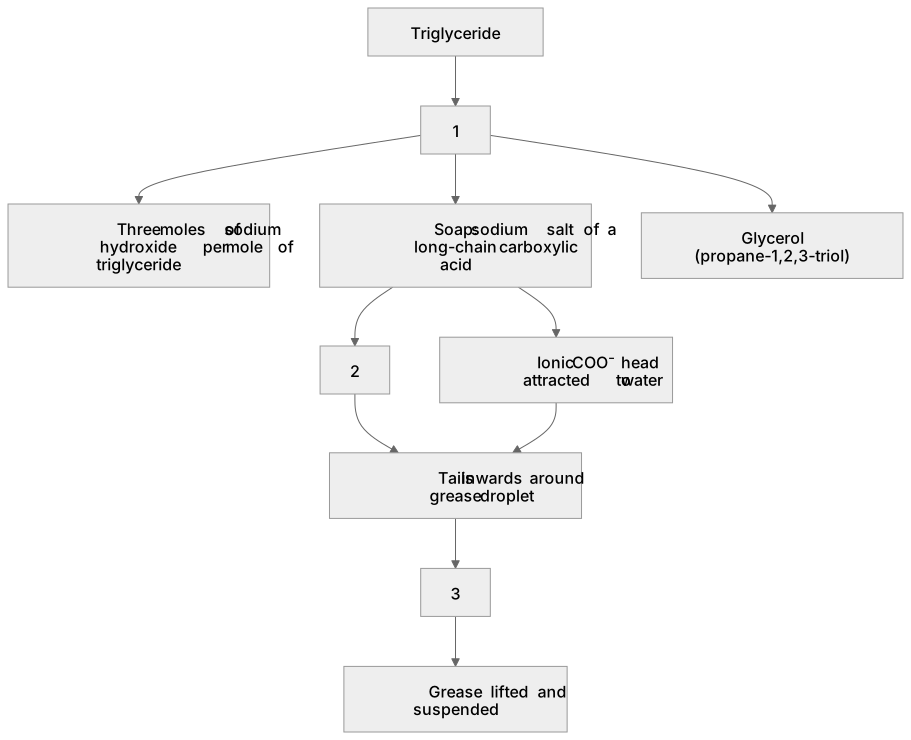
1Box 1
2Box 2
3Box 3
There is more to this lesson
The full lesson goes on to check your understanding and help you earn the marks. Create a free account to carry on, with your progress saved.
A week of Premium from your first lesson · Then the free plan continues · No card, no charge
Test your understanding of Carboxylic acids and esters (A-level only): Vegetable oils and animal fats can be hydrolysed in alkaline conditions to give soap (salts of long-chain carboxylic acids) and glycerol.
Active recall beats re-reading. Take an instant quiz now to test what you’ve learned and lock it into long-term memory.
A week of Premium from your first lesson · Then the free plan continues · No card, no charge