AQA · A-Level · Chemistry
Course version: 7405 · Version from Sept 2016
A heterogeneous catalyst is in a different phase from the reactants and…
Full specification wording
Catalysts (A-level only): A heterogeneous catalyst is in a different phase from the reactants and the reaction occurs at active sites on the surface.
Heterogeneous means the catalyst is in a different phase from the reactants, typically a solid catalyst with gaseous or aqueous reactants.
Checked against the AQA 7405 specification (opens in a new tab) on .
- Point 2 of 7
- 4 key terms
Study notes
From the checked teaching notes for this specification point.
The idea
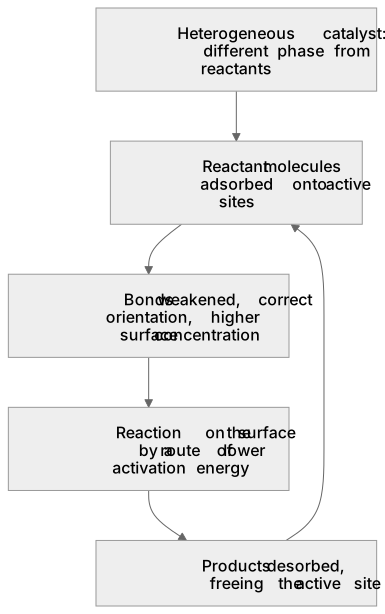
Heterogeneous means the catalyst is in a different phase from the reactants, typically a solid catalyst with gaseous or aqueous reactants. The mark scheme accepts a different phase from the reactants, or from the reactants and products, but not from the products alone. The mechanism has three stages. Reactant molecules are adsorbed onto active sites on the surface, which weakens their bonds, holds them in the right orientation and raises their concentration at the surface. They then react on the surface by a route of lower activation energy. Finally the products are desorbed, freeing the site for more reactant. Adsorption must be of the right strength: too weak and too few molecules stick, too strong and the products never leave.
What earns the marks
- Stating that the catalyst is in a different phase from the reactants.
- Adsorption of reactants onto active sites on the surface.
- Weakening of bonds, correct orientation or increased surface concentration as the reason the rate rises.
- Desorption of the products, which frees the active site.
Common mistakes and how to put them right
Defining heterogeneous as a different phase from the products, which the mark scheme rejects.
Writing absorbed rather than adsorbed, so describing molecules soaking into the bulk solid.
Saying the catalyst dissolves in the reaction mixture, which would make it homogeneous.
Omitting desorption, leaving a surface that would soon be permanently blocked.
Exam tips
- Say different phase from the reactants; adding and products is safe, but products alone is not.
- Spell adsorption with a d and use it consistently throughout the answer.
- Give the three stages in order: adsorption, reaction, desorption.
Try the lesson
The start of the Catalysts (A-level only): A heterogeneous catalyst is in a different phase from the reactants and the reaction occurs at active sites on the surface. lesson, made from checked teaching notes for this specification point.
Have a go first
In a reaction between gaseous reactants and a solid catalyst, which statement describes a heterogeneous catalyst?
Listen
Heterogeneous means the catalyst is in a different phase from the reactants, typically a solid catalyst with gaseous or aqueous reactants. The mark scheme accepts a different phase from the reactants, or from the reactants and products, but not from the products alone. The mechanism has three stages. Reactant molecules are adsorbed onto active sites on the surface, which weakens their bonds, holds them in the right orientation and raises their concentration at the surface. They then react on the surface by a route of lower activation energy. Finally the products are desorbed, freeing the site for more reactant. Adsorption must be of the right strength: too weak and too few molecules stick, too strong and the products never leave. A strong answer earns marks for these points. stating that the catalyst is in a different phase from the reactants. adsorption of reactants onto active sites on the surface. weakening of bonds, correct orientation or increased surface concentration as the reason the rate rises. desorption of the products, which frees the active site. Exam tip: Say different phase from the reactants; adding and products is safe, but products alone is not.
See it
Key words
Say what each word means before you turn the card.
different phase
Try answering aloud or in your head before turning the card.
active sites
Try answering aloud or in your head before turning the card.
adsorption and desorption
Try answering aloud or in your head before turning the card.
strength of adsorption
Try answering aloud or in your head before turning the card.
See every definition
- different phase
- The catalyst is in a different phase from the reactants, typically a solid catalyst with gaseous or aqueous reactants.
- active sites
- Reactant molecules are adsorbed onto these sites on the surface, which weakens their bonds, holds them in the right orientation and raises their concentration at the surface.
- adsorption and desorption
- Reactant molecules are adsorbed onto active sites, and the products are desorbed, freeing the site for more reactant.
- strength of adsorption
- Adsorption must be of the right strength: too weak and too few molecules stick, too strong and the products never leave.
Label the diagram
Some boxes have lost their names. Pick the right name for each number.
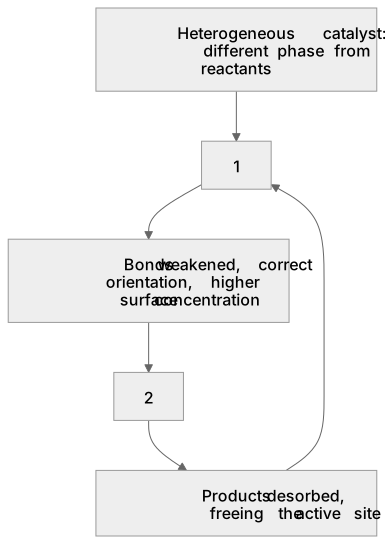
1Box 1
2Box 2
There is more to this lesson
The full lesson goes on to check your understanding and help you earn the marks. Create a free account to carry on, with your progress saved.
A week of Premium from your first lesson · Then the free plan continues · No card, no charge
Test your understanding of Catalysts (A-level only): A heterogeneous catalyst is in a different phase from the reactants and the reaction occurs at active sites on the surface.
Active recall beats re-reading. Take an instant quiz now to test what you’ve learned and lock it into long-term memory.
A week of Premium from your first lesson · Then the free plan continues · No card, no charge