AQA · A-Level · Chemistry
Course version: 7405 · Version from Sept 2016
Many chemical reactions are reversible.
Full specification wording
Chemical equilibria and Le Chatelier's principle: Many chemical reactions are reversible.
In a reversible reaction the products can re-form the reactants, and the equation is written with a double arrow.
Checked against the AQA 7405 specification (opens in a new tab) on .
- Point 1 of 6
- 2 key terms
Study notes
From the checked teaching notes for this specification point.
The idea
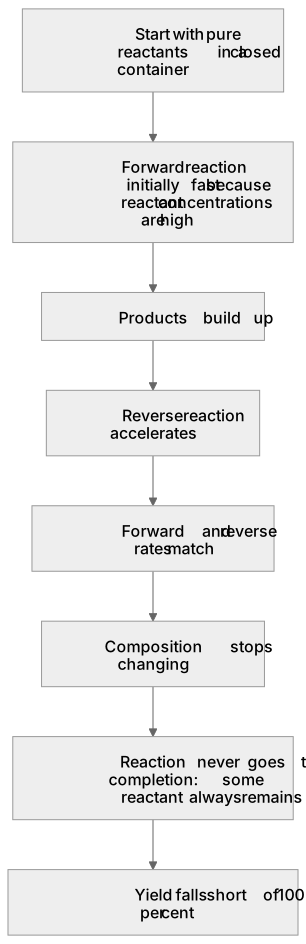
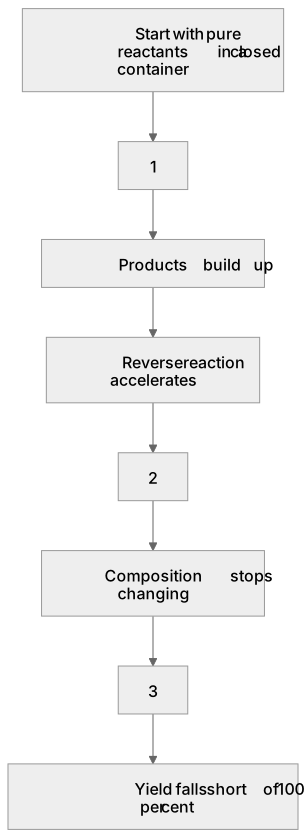
In a reversible reaction the products can re-form the reactants, and the equation is written with a double arrow. Start with pure reactants in a closed container and the forward reaction is initially fast because their concentrations are high; as products build up the reverse reaction accelerates, until the two rates match and the composition stops changing. The consequence is that the reaction never goes to completion: some reactant always remains, and the yield falls short of 100 per cent. Esterification is a familiar case, where ethanol and ethanoic acid reach equilibrium with ethyl ethanoate and water, and the yield can be improved by removing the ester as it forms or by using an excess of one reagent rather than by waiting longer.
What earns the marks
- Stating that the reaction is reversible, so the products re-form the reactants.
- Explaining an incomplete yield by the reaction reaching an equilibrium rather than going to completion.
- Identifying a closed system as a requirement for equilibrium to be established.
- Suggesting a valid way to increase the yield, such as removing a product or using an excess of one reactant.
Common mistakes and how to put them right
Writing a single arrow in an equation for a reaction described as reversible.
Explaining a low yield only as loss during transfer when the reaction itself is an equilibrium.
Assuming a reversible reaction stops when equilibrium is reached.
Claiming that leaving the reaction longer will push it to completion.
Confusing reversibility with a reaction that can be undone by a different reagent.
Exam tips
- If a percentage yield question mentions an ester or an ammonia synthesis, equilibrium is almost always one of the accepted reasons.
- Use the double arrow consistently once you have described a system as reversible.
- Distinguish practical losses, such as transfer and purification, from the chemical limit set by the equilibrium.
Try the lesson
The start of the Chemical equilibria and Le Chatelier's principle: Many chemical reactions are reversible. lesson, made from checked teaching notes for this specification point.
Have a go first
Hydrated copper(II) sulfate is heated in a test tube and a colour change is observed. When a few drops of water are added to the cool residue, the original colour returns. Which conclusion is best supported by these observations?
Listen
In a reversible reaction the products can re-form the reactants, and the equation is written with a double arrow. Start with pure reactants in a closed container and the forward reaction is initially fast because their concentrations are high; as products build up the reverse reaction accelerates, until the two rates match and the composition stops changing. The consequence is that the reaction never goes to completion: some reactant always remains, and the yield falls short of 100 per cent. Esterification is a familiar case, where ethanol and ethanoic acid reach equilibrium with ethyl ethanoate and water, and the yield can be improved by removing the ester as it forms or by using an excess of one reagent rather than by waiting longer. A strong answer earns marks for these points. stating that the reaction is reversible, so the products re-form the reactants. explaining an incomplete yield by the reaction reaching an equilibrium rather than going to completion. identifying a closed system as a requirement for equilibrium to be established. suggesting a valid way to increase the yield, such as removing a product or using an excess of one reactant. Exam tip: If a percentage yield question mentions an ester or an ammonia synthesis, equilibrium is almost always one of the accepted reasons.
See it
Put it in order
Put these steps in the order they happen.
- 1. Forward and reverse rates match
- 2. Yield falls short of 100 per cent
- 3. Composition stops changing
- 4. Start with pure reactants in a closed container
- 5. Forward reaction initially fast because reactant concentrations are high
- 6. Reaction never goes to completion: some reactant always remains
- 7. Products build up
- 8. Reverse reaction accelerates
Key words
Say what each word means before you turn the card.
reversible reactions
Try answering aloud or in your head before turning the card.
double arrow notation
Try answering aloud or in your head before turning the card.
See every definition
- reversible reactions
- Reactions in which the products can re-form the reactants, so the reaction never goes to completion and some reactant always remains.
- double arrow notation
- The way the equation for a reversible reaction is written, showing that the reaction can proceed in both directions.
Label the diagram
Some boxes have lost their names. Pick the right name for each number.
1Box 1
2Box 2
3Box 3
There is more to this lesson
The full lesson goes on to check your understanding and help you earn the marks. Create a free account to carry on, with your progress saved.
A week of Premium from your first lesson · Then the free plan continues · No card, no charge
Test your understanding of Chemical equilibria and Le Chatelier's principle: Many chemical reactions are reversible.
Active recall beats re-reading. Take an instant quiz now to test what you’ve learned and lock it into long-term memory.
A week of Premium from your first lesson · Then the free plan continues · No card, no charge