AQA · A-Level · Chemistry
Course version: 7405 · Version from Sept 2016
Students should be able to: use Le Chatelier’s principle to predict…
Full specification wording
Chemical equilibria and Le Chatelier's principle: Students should be able to: use Le Chatelier’s principle to predict qualitatively the effect of changes in temperature, pressure and concentration on the position of equilibrium explain why, for a reversible reaction used in an industrial process, a compromise temperature and pressure may be used.
Industrial conditions are settled by three competing demands: yield, rate and cost.
Checked against the AQA 7405 specification (opens in a new tab) on .
- Point 6 of 6
- 4 key terms
Study notes
From the checked teaching notes for this specification point.
The idea
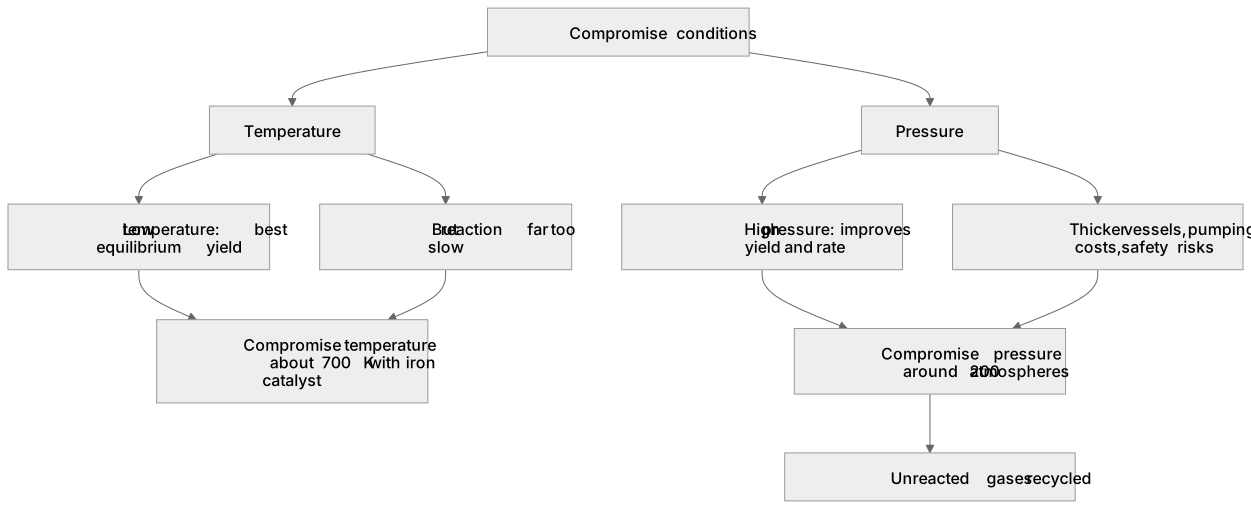
Industrial conditions are settled by three competing demands: yield, rate and cost. In an exothermic synthesis such as ammonia, a low temperature gives the best equilibrium yield but the reaction would be far too slow, so a compromise temperature of about 700 K is used with an iron catalyst, accepting a lower yield in return for reaching it quickly. Pressure works the other way. Fewer moles of gas on the product side means high pressure improves the yield and also the rate, but the thicker vessels, the pumping costs and the safety risks set a practical ceiling, so a compromise pressure around 200 atmospheres is chosen. Unreacted gases are recycled, which recovers much of the yield lost to the compromise.
What earns the marks
- Predicting the direction of shift and the effect on yield for the stated change.
- Identifying the conflict, that the conditions giving the best yield give an unacceptably slow rate.
- Naming the economic or safety limit on pressure, such as the cost of the plant or of compression.
- Stating that the compromise condition balances an acceptable yield against an acceptable rate and cost.
Common mistakes and how to put them right
Arguing only from yield and concluding the plant should run cold, with no mention of rate.
Saying a catalyst is used to improve the yield of the compromise process.
Claiming high pressure is avoided because it reduces the yield.
Forgetting that recycling unreacted gas raises the overall conversion.
Treating the compromise temperature as the one giving the highest yield.
Exam tips
- Structure a compromise answer in three moves: what the equilibrium wants, what the rate wants, what is chosen and why.
- Name the cost or safety factor explicitly for pressure; a general statement about expense rarely scores.
- Quote the sign of ∆H for the forward reaction before you argue about temperature.
Try the lesson
The start of the Chemical equilibria and Le Chatelier's principle: Students should be able to: use Le Chatelier’s principle to predict qualitatively the effect of changes in temperature, pressure and concentration on the position of equilibrium explain why, for a reversible reaction used in an industrial process, a compromise temperature and pressure may be used. lesson, made from checked teaching notes for this specification point.
Have a go first
For the exothermic equilibrium N₂(g) + 3H₂(g) ⇌ 2NH₃(g), which change in conditions will shift the position of equilibrium to the right?
Listen
Industrial conditions are settled by three competing demands: yield, rate and cost. In an exothermic synthesis such as ammonia, a low temperature gives the best equilibrium yield but the reaction would be far too slow, so a compromise temperature of about 700 K is used with an iron catalyst, accepting a lower yield in return for reaching it quickly. Pressure works the other way. Fewer moles of gas on the product side means high pressure improves the yield and also the rate, but the thicker vessels, the pumping costs and the safety risks set a practical ceiling, so a compromise pressure around 200 atmospheres is chosen. Unreacted gases are recycled, which recovers much of the yield lost to the compromise. A strong answer earns marks for these points. predicting the direction of shift and the effect on yield for the stated change. identifying the conflict, that the conditions giving the best yield give an unacceptably slow rate. naming the economic or safety limit on pressure, such as the cost of the plant or of compression. stating that the compromise condition balances an acceptable yield against an acceptable rate and cost. Exam tip: Structure a compromise answer in three moves: what the equilibrium wants, what the rate wants, what is chosen and why.
See it
Key words
Say what each word means before you turn the card.
compromise temperature
Try answering aloud or in your head before turning the card.
compromise pressure
Try answering aloud or in your head before turning the card.
yield against rate
Try answering aloud or in your head before turning the card.
recycling unreacted gases
Try answering aloud or in your head before turning the card.
See every definition
- compromise temperature
- A temperature chosen because the conditions giving the best yield give an unacceptably slow rate, balancing an acceptable yield against an acceptable rate and cost.
- compromise pressure
- A pressure chosen because the cost of the plant or of compression and the safety risks set a practical ceiling, balancing an acceptable yield against an acceptable rate and cost.
- yield against rate
- The conflict in which the conditions giving the best yield give an unacceptably slow rate, so a compromise condition balances an acceptable yield against an acceptable rate and cost.
- recycling unreacted gases
- Recovering much of the yield lost to the compromise, which raises the overall conversion.
Label the diagram
Some boxes have lost their names. Pick the right name for each number.
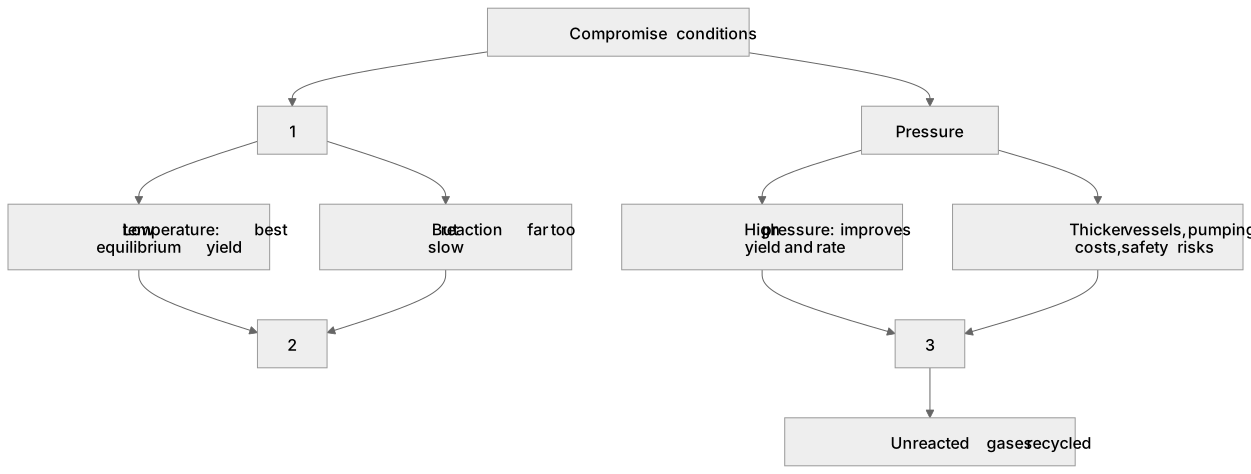
1Box 1
2Box 2
3Box 3
There is more to this lesson
The full lesson goes on to check your understanding and help you earn the marks. Create a free account to carry on, with your progress saved.
A week of Premium from your first lesson · Then the free plan continues · No card, no charge
Test your understanding of Chemical equilibria and Le Chatelier's principle: Students should be able to: use Le Chatelier’s principle to predict qualitatively the effect of changes in temperature, pressure and concentration on the position of equilibrium explain why, for a reversible reaction used in an industrial process, a compromise temperature and pressure may be used.
Active recall beats re-reading. Take an instant quiz now to test what you’ve learned and lock it into long-term memory.
A week of Premium from your first lesson · Then the free plan continues · No card, no charge