AQA · A-Level · Chemistry
Course version: 7405 · Version from Sept 2016
Chlorination of alkanes: The reaction of methane with chlorine.
Methane and chlorine do not react in the dark, but in ultraviolet light they react readily: CH₄ + Cl₂ → CH₃Cl + HCl.
Checked against the AQA 7405 specification (opens in a new tab) on .
- Point 1 of 2
- 4 key terms
Study notes
From the checked teaching notes for this specification point.
The idea
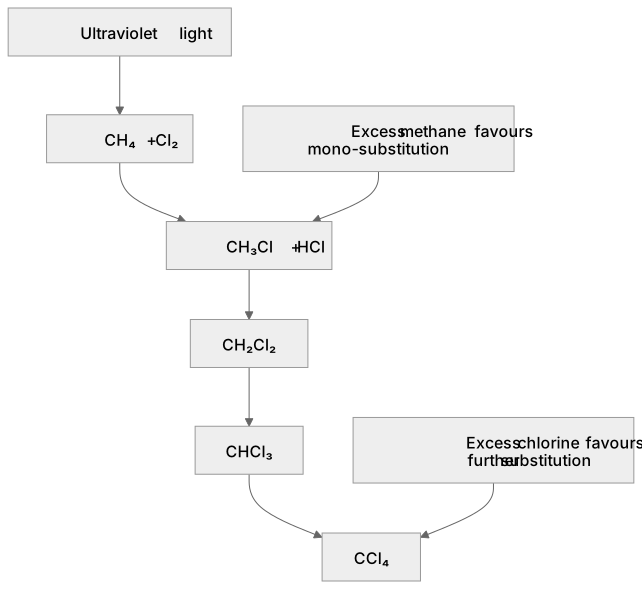
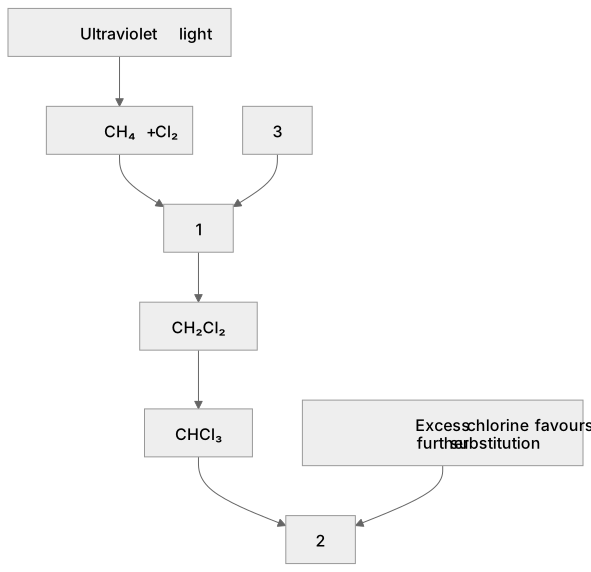
Methane and chlorine do not react in the dark, but in ultraviolet light they react readily: CH₄ + Cl₂ → CH₃Cl + HCl. The chlorine replaces a hydrogen atom, so this is a substitution, not an addition; the hydrogen that leaves is carried away as hydrogen chloride. The reaction does not stop at chloromethane. Any CH₃Cl formed is itself attacked, giving CH₂Cl₂, then CHCl₃ and finally CCl₄, so the product is always a mixture. Using a large excess of methane keeps most molecules at the mono-substituted stage, while an excess of chlorine drives the mixture towards the more highly chlorinated products. That poor selectivity is why this route is a laboratory and industrial nuisance rather than a clean synthesis, and why questions often ask you to predict the full set of products.
What earns the marks
- The balanced equation CH₄ + Cl₂ → CH₃Cl + HCl, with hydrogen chloride shown as the second product.
- Ultraviolet light (sunlight) as the essential condition.
- Naming further substitution products such as CH₂Cl₂, CHCl₃ or CCl₄.
- Saying an excess of methane favours mono-substitution while an excess of chlorine favours further substitution.
Common mistakes and how to put them right
Writing the reaction as an addition, giving a product such as CH₄Cl₂, when an alkane is saturated and can only substitute.
Leaving HCl out of the equation, so the hydrogen atoms do not balance.
Saying a catalyst is needed rather than ultraviolet light.
Claiming chloromethane is the only product, when a mixture of all four chloromethanes is formed.
Exam tips
- Write the condition as ultraviolet light every time; "light" alone is often not enough for the mark.
- If asked for all products, work upwards one chlorine at a time so you do not miss CHCl₃.
- Check your equation balances for hydrogen before chlorine; a missing HCl is the usual cause of failure.
Try the lesson
The start of the Chlorination of alkanes: The reaction of methane with chlorine. lesson, made from checked teaching notes for this specification point.
Have a go first
Which type of reaction occurs when methane reacts with chlorine in the presence of ultraviolet light?
Listen
Methane and chlorine do not react in the dark, but in ultraviolet light they react readily: CH₄ + Cl₂ → CH₃Cl + HCl. The chlorine replaces a hydrogen atom, so this is a substitution, not an addition; the hydrogen that leaves is carried away as hydrogen chloride. The reaction does not stop at chloromethane. Any CH₃Cl formed is itself attacked, giving CH₂Cl₂, then CHCl₃ and finally CCl₄, so the product is always a mixture. Using a large excess of methane keeps most molecules at the mono-substituted stage, while an excess of chlorine drives the mixture towards the more highly chlorinated products. That poor selectivity is why this route is a laboratory and industrial nuisance rather than a clean synthesis, and why questions often ask you to predict the full set of products. A strong answer earns marks for these points. the balanced equation CH₄ + Cl₂ → CH₃Cl + HCl, with hydrogen chloride shown as the second product. ultraviolet light (sunlight) as the essential condition. naming further substitution products such as CH₂Cl₂, CHCl₃ or CCl₄. saying an excess of methane favours mono-substitution while an excess of chlorine favours further substitution. Exam tip: Write the condition as ultraviolet light every time; "light" alone is often not enough for the mark.
See it
Key words
Say what each word means before you turn the card.
ultraviolet light
Try answering aloud or in your head before turning the card.
substitution
Try answering aloud or in your head before turning the card.
further substitution
Try answering aloud or in your head before turning the card.
excess of one reagent
Try answering aloud or in your head before turning the card.
See every definition
- ultraviolet light
- Methane and chlorine do not react in the dark, but in this condition they react readily, and it is the essential condition for the reaction.
- substitution
- The chlorine replaces a hydrogen atom, and the hydrogen that leaves is carried away as hydrogen chloride.
- further substitution
- Any CH₃Cl formed is itself attacked, giving CH₂Cl₂, then CHCl₃ and finally CCl₄, so the product is always a mixture.
- excess of one reagent
- A large excess of methane keeps most molecules at the mono-substituted stage, while an excess of chlorine drives the mixture towards the more highly chlorinated products.
Label the diagram
Some boxes have lost their names. Pick the right name for each number.
1Box 1
2Box 2
3Box 3
There is more to this lesson
The full lesson goes on to check your understanding and help you earn the marks. Create a free account to carry on, with your progress saved.
A week of Premium from your first lesson · Then the free plan continues · No card, no charge
Test your understanding of Chlorination of alkanes: The reaction of methane with chlorine.
Active recall beats re-reading. Take an instant quiz now to test what you’ve learned and lock it into long-term memory.
A week of Premium from your first lesson · Then the free plan continues · No card, no charge