AQA · A-Level · Chemistry
Course version: 7405 · Version from Sept 2016
Required practical 12 Separation of species by thin-layer chromatography.
Full specification wording
Chromatography (A-level only): Required practical 12 Separation of species by thin-layer chromatography.
Rule the baseline in pencil about a centimetre from the bottom of the plate, because ink would dissolve and travel with the solvent.
Checked against the AQA 7405 specification (opens in a new tab) on .
- Point 5 of 5
- 4 key terms
Study notes
From the checked teaching notes for this specification point.
The idea
Rule the baseline in pencil about a centimetre from the bottom of the plate, because ink would dissolve and travel with the solvent. Spot the samples with a capillary tube, keeping each spot small and letting it dry before respotting so the sample stays concentrated. Stand the plate in a tank with the solvent below the baseline, never above it, or the spots dissolve into the solvent instead of climbing. The lid matters: it saturates the atmosphere with solvent vapour and stops solvent evaporating off the plate, which would otherwise distort the chromatogram. When the solvent front nears the top, remove the plate and mark the front at once, before it dries. Colourless spots are revealed under ultraviolet light or with a locating agent such as ninhydrin.
What earns the marks
- A pencil baseline, with the reason that ink would dissolve and run.
- The solvent starting below the baseline so that the spots are not washed off.
- A lid on the tank, because it saturates the atmosphere with solvent vapour and reduces evaporation from the plate.
- Marking the solvent front as soon as the plate is removed.
- Locating colourless spots under ultraviolet light or with a locating agent.
Common mistakes and how to put them right
Ruling the baseline in pen, so the ink separates alongside the sample.
Filling the tank so that the solvent covers the spots.
Leaving the tank uncovered, so solvent evaporates from the plate and the front becomes uneven.
Letting the plate dry before the solvent front has been marked, so the distance cannot be measured.
Measuring from the bottom edge of the plate rather than from the baseline.
Exam tips
- Measure both distances from the baseline, one to the centre of the spot and one to the solvent front, and show that in your working.
- When asked what is wrong with an apparatus diagram, check the solvent level, the lid and the baseline first; those are usually the faults.
- Give a reason with every precaution, because the mark is almost always for the reason rather than the instruction.
Try the lesson
The start of the Chromatography (A-level only): Required practical 12 Separation of species by thin-layer chromatography. lesson, made from checked teaching notes for this specification point.
Have a go first
In thin-layer chromatography, which liquid is used to carry the dissolved species up the stationary phase?
Listen
Rule the baseline in pencil about a centimetre from the bottom of the plate, because ink would dissolve and travel with the solvent. Spot the samples with a capillary tube, keeping each spot small and letting it dry before respotting so the sample stays concentrated. Stand the plate in a tank with the solvent below the baseline, never above it, or the spots dissolve into the solvent instead of climbing. The lid matters: it saturates the atmosphere with solvent vapour and stops solvent evaporating off the plate, which would otherwise distort the chromatogram. When the solvent front nears the top, remove the plate and mark the front at once, before it dries. Colourless spots are revealed under ultraviolet light or with a locating agent such as ninhydrin. A strong answer earns marks for these points. a pencil baseline, with the reason that ink would dissolve and run. the solvent starting below the baseline so that the spots are not washed off. a lid on the tank, because it saturates the atmosphere with solvent vapour and reduces evaporation from the plate. marking the solvent front as soon as the plate is removed. Exam tip: Measure both distances from the baseline, one to the centre of the spot and one to the solvent front, and show that in your working.
See it
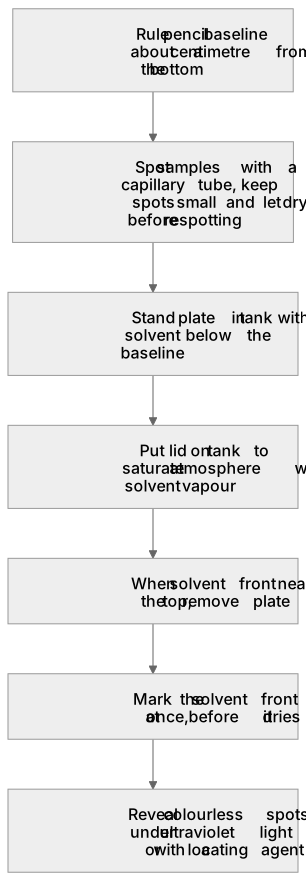
Put it in order
Put these steps in the order they happen.
- 1. Reveal colourless spots under ultraviolet light or with a locating agent
- 2. Mark the solvent front at once, before it dries
- 3. Stand plate in tank with solvent below the baseline
- 4. When solvent front nears the top, remove plate
- 5. Rule pencil baseline about a centimetre from the bottom
- 6. Spot samples with a capillary tube, keep spots small and let dry before respotting
- 7. Put lid on tank to saturate atmosphere with solvent vapour
Key words
Say what each word means before you turn the card.
pencil baseline
Try answering aloud or in your head before turning the card.
solvent below the spots
Try answering aloud or in your head before turning the card.
lid and saturated vapour
Try answering aloud or in your head before turning the card.
marking the solvent front
Try answering aloud or in your head before turning the card.
See every definition
- pencil baseline
- A line ruled in pencil about a centimetre from the bottom of the plate, because ink would dissolve and travel with the solvent.
- solvent below the spots
- The plate stands in a tank with the solvent below the baseline, never above it, or the spots dissolve into the solvent instead of climbing.
- lid and saturated vapour
- The lid saturates the atmosphere with solvent vapour and stops solvent evaporating off the plate, which would otherwise distort the chromatogram.
- marking the solvent front
- When the solvent front nears the top, the plate is removed and the front marked at once, before it dries.
Label the diagram
Some boxes have lost their names. Pick the right name for each number.
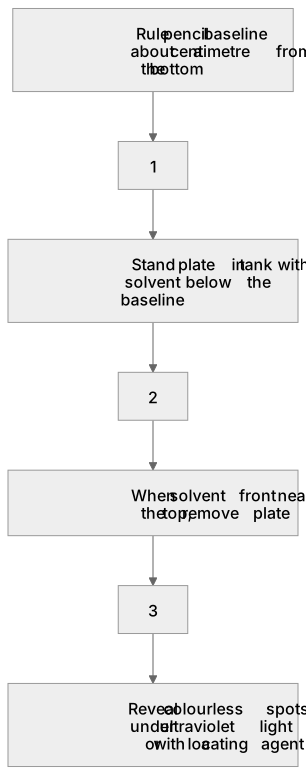
1Box 1
2Box 2
3Box 3
There is more to this lesson
The full lesson goes on to check your understanding and help you earn the marks. Create a free account to carry on, with your progress saved.
A week of Premium from your first lesson · Then the free plan continues · No card, no charge
Test your understanding of Chromatography (A-level only): Required practical 12 Separation of species by thin-layer chromatography.
Active recall beats re-reading. Take an instant quiz now to test what you’ve learned and lock it into long-term memory.
A week of Premium from your first lesson · Then the free plan continues · No card, no charge