AQA · A-Level · Chemistry
Course version: 7405 · Version from Sept 2016
The concentration of hydrogen ions in aqueous solution covers a very wide…
Full specification wording
Definition and determination of pH (A-level only): The concentration of hydrogen ions in aqueous solution covers a very wide range.
Hydrogen ion concentrations in aqueous solution span an enormous range.
Checked against the AQA 7405 specification (opens in a new tab) on .
- Point 1 of 3
- 2 key terms
Study notes
From the checked teaching notes for this specification point.
The idea
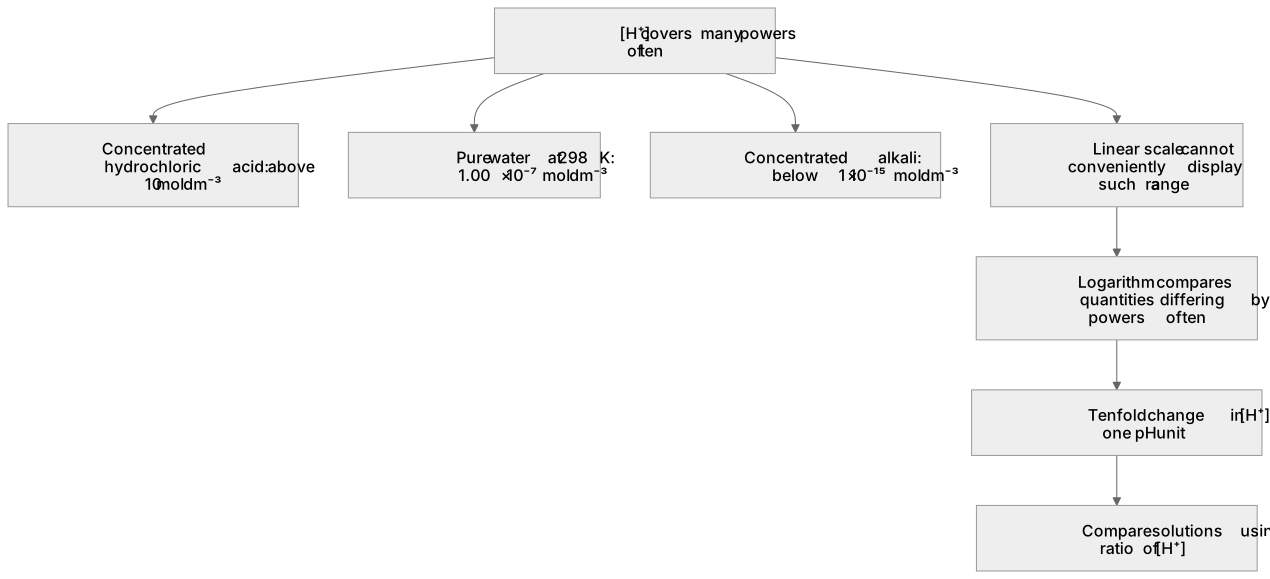
Hydrogen ion concentrations in aqueous solution span an enormous range. Concentrated hydrochloric acid can exceed 10 mol dm⁻³; pure water at 298 K is 1.00 × 10⁻⁷ mol dm⁻³; a concentrated alkali can be below 1 × 10⁻¹⁵ mol dm⁻³. That is sixteen powers of ten, and no linear axis can show it. On a scale where 1 mol dm⁻³ is drawn a metre long, pure water would be a ten-millionth of a metre. The differences matter even between similar solutions: dissolve SO₂ in water and you reach pH 2 to 3, dissolve SO₃ and you reach pH 0 to 1, a hundredfold difference in [H⁺] from two oxides of the same element. Comparing quantities that differ by powers of ten is exactly the job a logarithm does.
What earns the marks
- Stating that [H⁺] covers many powers of ten, roughly 10 to 10⁻¹⁵ mol dm⁻³.
- Explaining that a linear scale cannot conveniently display such a range.
- Relating a tenfold change in [H⁺] to a change of one pH unit.
- Comparing two solutions using the ratio of their hydrogen ion concentrations.
Common mistakes and how to put them right
Saying a solution at pH 1 is twice as acidic as one at pH 2 rather than ten times.
Believing pH cannot fall below 0 or rise above 14.
Comparing a concentration in mol dm⁻³ with a pH value without converting one to the other.
Assuming a strong acid and a weak acid of equal concentration have the same [H⁺].
Exam tips
- Whenever a question compares acidity, convert everything to [H⁺] or everything to pH before you compare.
- A difference of n pH units is a factor of 10ⁿ in hydrogen ion concentration.
Try the lesson
The start of the Definition and determination of pH (A-level only): The concentration of hydrogen ions in aqueous solution covers a very wide range. lesson, made from checked teaching notes for this specification point.
Have a go first
Which expression defines pH?
Listen
Hydrogen ion concentrations in aqueous solution span an enormous range. Concentrated hydrochloric acid can exceed 10 mol dm⁻³; pure water at 298 K is 1.00 × 10⁻⁷ mol dm⁻³; a concentrated alkali can be below 1 × 10⁻¹⁵ mol dm⁻³. That is sixteen powers of ten, and no linear axis can show it. On a scale where 1 mol dm⁻³ is drawn a metre long, pure water would be a ten-millionth of a metre. The differences matter even between similar solutions: dissolve SO₂ in water and you reach pH 2 to 3, dissolve SO₃ and you reach pH 0 to 1, a hundredfold difference in [H⁺] from two oxides of the same element. Comparing quantities that differ by powers of ten is exactly the job a logarithm does. A strong answer earns marks for these points. stating that [H⁺] covers many powers of ten, roughly 10 to 10⁻¹⁵ mol dm⁻³. explaining that a linear scale cannot conveniently display such a range. relating a tenfold change in [H⁺] to a change of one pH unit. comparing two solutions using the ratio of their hydrogen ion concentrations. Exam tip: Whenever a question compares acidity, convert everything to [H⁺] or everything to pH before you compare.
See it
Key words
Say what each word means before you turn the card.
range of hydrogen ion concentration
Try answering aloud or in your head before turning the card.
need for a log scale
Try answering aloud or in your head before turning the card.
See every definition
- range of hydrogen ion concentration
- The concentration of hydrogen ions in aqueous solution covers a very wide range, roughly 10 to 10⁻¹⁵ mol dm⁻³.
- need for a log scale
- A linear scale cannot conveniently display such a range, so a logarithm is used.
Label the diagram
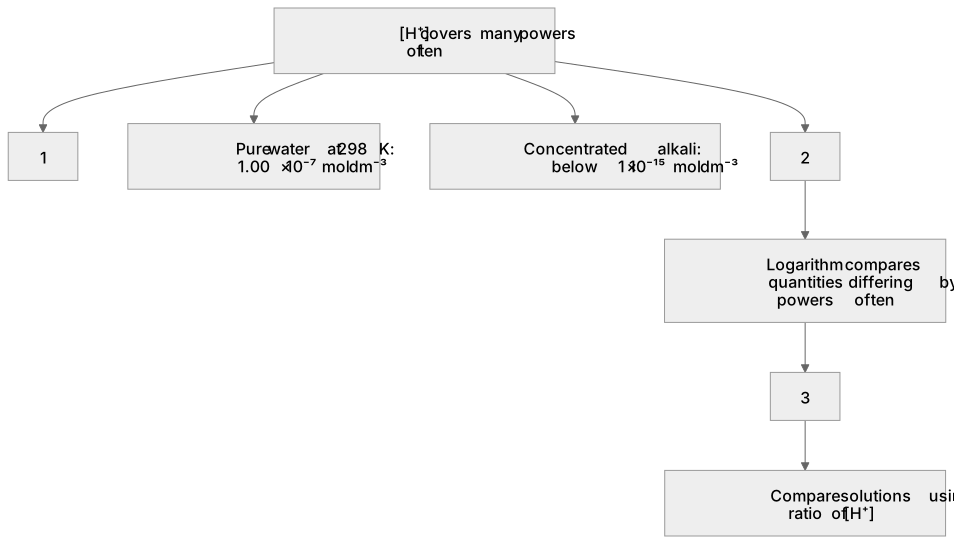
Some boxes have lost their names. Pick the right name for each number.
1Box 1
2Box 2
3Box 3
There is more to this lesson
The full lesson goes on to check your understanding and help you earn the marks. Create a free account to carry on, with your progress saved.
A week of Premium from your first lesson · Then the free plan continues · No card, no charge
Test your understanding of Definition and determination of pH (A-level only): The concentration of hydrogen ions in aqueous solution covers a very wide range.
Active recall beats re-reading. Take an instant quiz now to test what you’ve learned and lock it into long-term memory.
A week of Premium from your first lesson · Then the free plan continues · No card, no charge