AQA · A-Level · Chemistry
Course version: 7405 · Version from Sept 2016
The rate equation is an experimentally determined relationship.
Full specification wording
Determination of rate equation (A-level only): The rate equation is an experimentally determined relationship.
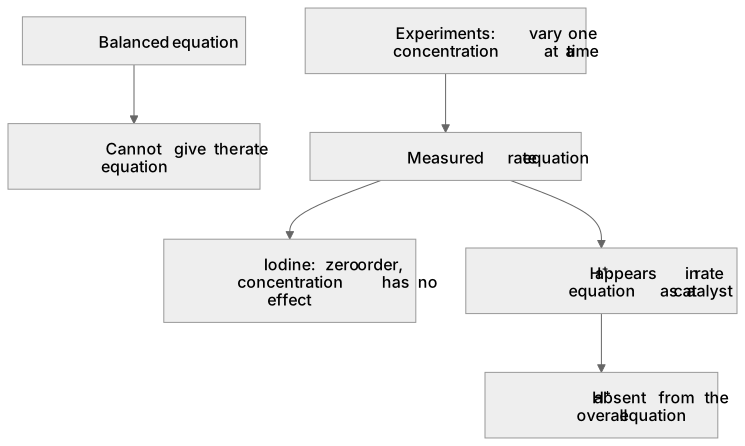
The rate equation cannot be written from the balanced equation; it has to be measured.
Checked against the AQA 7405 specification (opens in a new tab) on .
- Point 1 of 4
- 4 key terms
Study notes
From the checked teaching notes for this specification point.
The idea
The rate equation cannot be written from the balanced equation; it has to be measured. The stoichiometric equation counts what is consumed overall, whereas the rate equation reflects only the species involved up to and including the slowest step. The acid catalysed iodination of a ketone makes the point sharply: iodine is a reactant in the overall equation, yet the measured rate equation is rate = k[CH₃CH₂COCH₃][H⁺], so iodine is zero order and its concentration has no effect on the rate. Meanwhile H⁺ appears in the rate equation although, as a catalyst, it does not appear in the overall equation at all. Only experiments that vary one concentration at a time can establish these orders.
What earns the marks
- Stating that orders are determined experimentally and cannot be deduced from the equation.
- Identifying a species as zero order because changing its concentration leaves the rate unchanged.
- Recognising that a catalyst can appear in the rate equation while being absent from the overall equation.
- Describing a procedure in which one concentration is varied while the others are held constant.
Common mistakes and how to put them right
Reading the orders off the balancing numbers of the chemical equation.
Assuming every reactant must appear in the rate equation.
Assuming a species absent from the overall equation cannot appear in the rate equation.
Varying two concentrations between experiments and then attributing the rate change to one of them.
Describing a zero order reactant as one that is not consumed during the reaction.
Exam tips
- Compare pairs of experiments in which only one concentration differs; that comparison is the whole method.
- If doubling a concentration leaves the rate unchanged, state that the order is zero and say so explicitly.
- Never justify an order by pointing at the stoichiometry, however well the numbers seem to fit.
Try the lesson
The start of the Determination of rate equation (A-level only): The rate equation is an experimentally determined relationship. lesson, made from checked teaching notes for this specification point.
Have a go first
A student attempts to deduce the rate equation for a reaction directly from its overall balanced chemical equation. Why is this approach invalid?
Listen
The rate equation cannot be written from the balanced equation; it has to be measured. The stoichiometric equation counts what is consumed overall, whereas the rate equation reflects only the species involved up to and including the slowest step. The acid catalysed iodination of a ketone makes the point sharply: iodine is a reactant in the overall equation, yet the measured rate equation is rate = k[CH₃CH₂COCH₃][H⁺], so iodine is zero order and its concentration has no effect on the rate. Meanwhile H⁺ appears in the rate equation although, as a catalyst, it does not appear in the overall equation at all. Only experiments that vary one concentration at a time can establish these orders. A strong answer earns marks for these points. stating that orders are determined experimentally and cannot be deduced from the equation. identifying a species as zero order because changing its concentration leaves the rate unchanged. recognising that a catalyst can appear in the rate equation while being absent from the overall equation. describing a procedure in which one concentration is varied while the others are held constant. Exam tip: Compare pairs of experiments in which only one concentration differs; that comparison is the whole method.
See it
Key words
Say what each word means before you turn the card.
orders are experimental
Try answering aloud or in your head before turning the card.
stoichiometry is not the rate equation
Try answering aloud or in your head before turning the card.
zero order reactants
Try answering aloud or in your head before turning the card.
catalysts in the rate equation
Try answering aloud or in your head before turning the card.
See every definition
- orders are experimental
- They are determined experimentally and cannot be deduced from the equation, so the rate equation has to be measured.
- stoichiometry is not the rate equation
- The stoichiometric equation counts what is consumed overall, whereas the rate equation reflects only the species involved up to and including the slowest step.
- zero order reactants
- Changing the concentration of such a species leaves the rate unchanged, so its concentration has no effect on the rate.
- catalysts in the rate equation
- A catalyst can appear in the rate equation while being absent from the overall equation.
Label the diagram
Some boxes have lost their names. Pick the right name for each number.
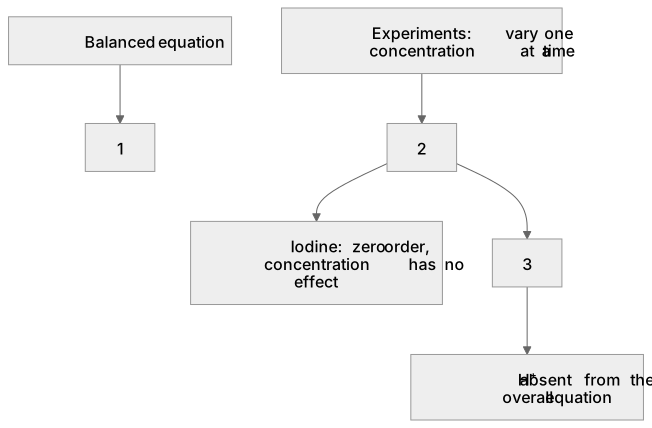
1Box 1
2Box 2
3Box 3
There is more to this lesson
The full lesson goes on to check your understanding and help you earn the marks. Create a free account to carry on, with your progress saved.
A week of Premium from your first lesson · Then the free plan continues · No card, no charge
Test your understanding of Determination of rate equation (A-level only): The rate equation is an experimentally determined relationship.
Active recall beats re-reading. Take an instant quiz now to test what you’ve learned and lock it into long-term memory.
A week of Premium from your first lesson · Then the free plan continues · No card, no charge