AQA · A-Level · Chemistry
Course version: 7405 · Version from Sept 2016
The structures of the phosphate ion, 2-deoxyribose (a pentose sugar) and…
Full specification wording
DNA (A-level only): The structures of the phosphate ion, 2-deoxyribose (a pentose sugar) and the four bases adenine, cytosine, guanine and thymine are given in the Chemistry Data Booklet.
You are not asked to memorise these shapes, you are asked to read them off the booklet and use them, so practise with it open.
Checked against the AQA 7405 specification (opens in a new tab) on .
- Point 1 of 5
- 4 key terms
Study notes
From the checked teaching notes for this specification point.
The idea
You are not asked to memorise these shapes, you are asked to read them off the booklet and use them, so practise with it open. The phosphate ion is PO₄³⁻, drawn with phosphorus bonded to four oxygens and carrying the negative charge. 2-deoxyribose is a pentose: a five-membered ring of four carbons and one oxygen, with an OH on carbon one, an OH on carbon three and a CH₂OH side group on carbon four. The missing OH on carbon two is what deoxy means, and it is the only difference from the ribose of RNA. Adenine and guanine are purines, built from two fused rings; cytosine and thymine are pyrimidines, with one ring. Every base carries an N-H that becomes the link to the sugar, and guanine keeps a ring nitrogen with a spare lone pair that cisplatin later attacks.
What earns the marks
- 2-deoxyribose drawn correctly, with no OH group on carbon two.
- The phosphate ion drawn with phosphorus bonded to four oxygens and the negative charge shown.
- Identifying adenine and guanine as the two-ring purines and cytosine and thymine as the one-ring pyrimidines.
- Showing a nitrogen atom of the base as the atom that bonds to the sugar.
Common mistakes and how to put them right
Drawing ribose, with an OH on carbon two, when the booklet gives 2-deoxyribose.
Copying uracil from a biology textbook in place of thymine, which is the base this specification lists.
Drawing phosphoric acid rather than the phosphate ion the booklet shows.
Redrawing a base from memory and losing a ring nitrogen, which makes the link to the sugar impossible to show.
Treating the booklet structures as material to learn, then spending exam time reproducing them instead of reading them.
Exam tips
- Open the Data Booklet at the DNA structures before you start the question; the marks are for using them, not recalling them.
- Mark the OH groups and the N-H you are going to react before you draw anything, so the bond you form is the one being credited.
- Draw large. A displayed formula must show every bond and every atom, and an examiner cannot credit a link they cannot see.
Try the lesson
The start of the DNA (A-level only): The structures of the phosphate ion, 2-deoxyribose (a pentose sugar) and the four bases adenine, cytosine, guanine and thymine are given in the Chemistry Data Booklet. lesson, made from checked teaching notes for this specification point.
Have a go first
Using the Chemistry Data Booklet, which sugar unit is present in the DNA nucleotide structure?
Listen
You are not asked to memorise these shapes, you are asked to read them off the booklet and use them, so practise with it open. The phosphate ion is PO₄³⁻, drawn with phosphorus bonded to four oxygens and carrying the negative charge. 2-deoxyribose is a pentose: a five-membered ring of four carbons and one oxygen, with an OH on carbon one, an OH on carbon three and a CH₂OH side group on carbon four. The missing OH on carbon two is what deoxy means, and it is the only difference from the ribose of RNA. Adenine and guanine are purines, built from two fused rings; cytosine and thymine are pyrimidines, with one ring. Every base carries an N-H that becomes the link to the sugar, and guanine keeps a ring nitrogen with a spare lone pair that cisplatin later attacks. A strong answer earns marks for these points. 2-deoxyribose drawn correctly, with no OH group on carbon two. the phosphate ion drawn with phosphorus bonded to four oxygens and the negative charge shown. identifying adenine and guanine as the two-ring purines and cytosine and thymine as the one-ring pyrimidines. showing a nitrogen atom of the base as the atom that bonds to the sugar. Exam tip: Open the Data Booklet at the DNA structures before you start the question; the marks are for using them, not recalling them.
See it
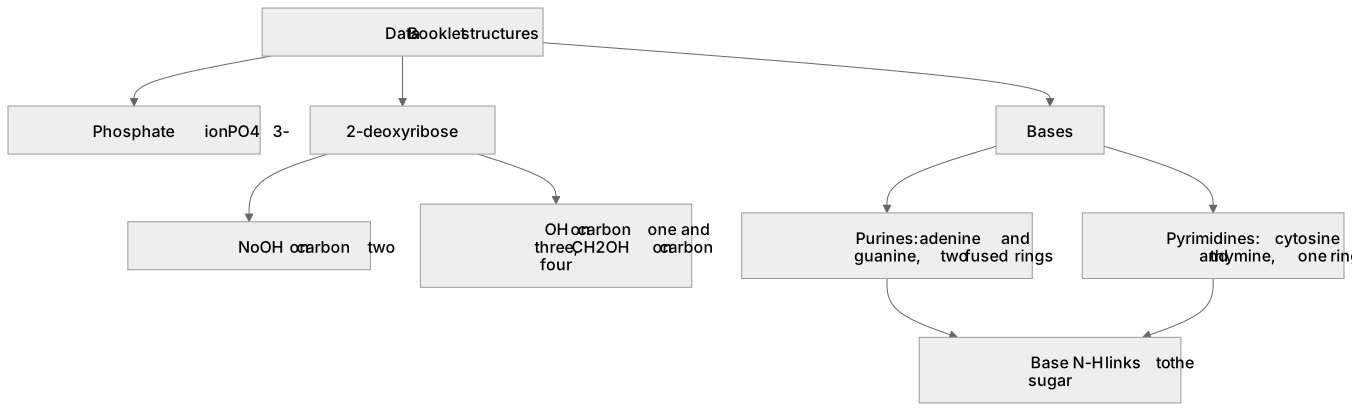
Key words
Say what each word means before you turn the card.
phosphate ion
Try answering aloud or in your head before turning the card.
2-deoxyribose
Try answering aloud or in your head before turning the card.
purines
Try answering aloud or in your head before turning the card.
pyrimidines
Try answering aloud or in your head before turning the card.
See every definition
- phosphate ion
- Drawn with phosphorus bonded to four oxygens and carrying the negative charge, and given in the Chemistry Data Booklet.
- 2-deoxyribose
- A pentose: a five-membered ring of four carbons and one oxygen, with an OH on carbon one, an OH on carbon three and a CH₂OH side group on carbon four.
- purines
- Adenine and guanine, built from two fused rings, as given in the Chemistry Data Booklet.
- pyrimidines
- Cytosine and thymine, with one ring, as given in the Chemistry Data Booklet.
Label the diagram
Some boxes have lost their names. Pick the right name for each number.
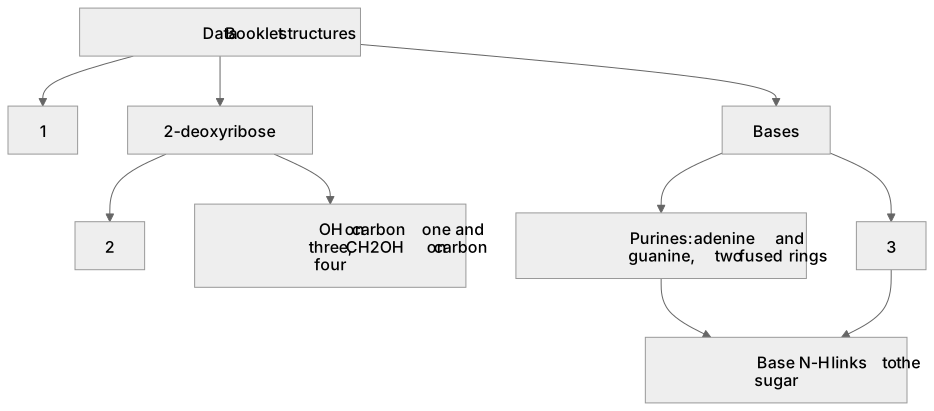
1Box 1
2Box 2
3Box 3
There is more to this lesson
The full lesson goes on to check your understanding and help you earn the marks. Create a free account to carry on, with your progress saved.
A week of Premium from your first lesson · Then the free plan continues · No card, no charge
Test your understanding of DNA (A-level only): The structures of the phosphate ion, 2-deoxyribose (a pentose sugar) and the four bases adenine, cytosine, guanine and thymine are given in the Chemistry Data Booklet.
Active recall beats re-reading. Take an instant quiz now to test what you’ve learned and lock it into long-term memory.
A week of Premium from your first lesson · Then the free plan continues · No card, no charge