AQA · A-Level · Chemistry
Course version: 7405 · Version from Sept 2016
The qualitative effect of temperature changes on the rate of reaction.
Full specification wording
Effect of temperature on reaction rate: The qualitative effect of temperature changes on the rate of reaction.
Raising the temperature makes a reaction faster, and usually much faster: as a rough guide a 10 K rise roughly doubles the rate of many reactions near room temperature.
Checked against the AQA 7405 specification (opens in a new tab) on .
- Point 2 of 4
- 4 key terms
Study notes
From the checked teaching notes for this specification point.
The idea
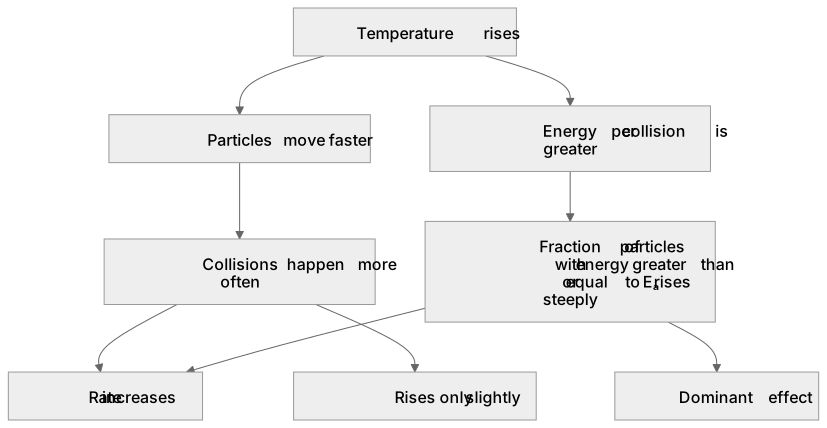
Raising the temperature makes a reaction faster, and usually much faster: as a rough guide a 10 K rise roughly doubles the rate of many reactions near room temperature. A plot of rate against temperature is not a straight line but a curve that steepens, an exponential rise. Two things change when a gas or solution is heated. The particles move faster, so collisions happen more often, and their energy per collision is greater. The second effect dominates by far. The collision frequency rises only slightly, roughly with the square root of the absolute temperature, while the fraction of particles with energy greater than or equal to Eₐ rises steeply, and it is this fraction that multiplies up the number of successful collisions.
What earns the marks
- Stating that rate increases as temperature increases.
- Describing the increase as exponential, or as rising by an ever greater factor.
- Stating that many more particles have energy greater than or equal to the activation energy.
- Identifying the increase in the energy of the particles, rather than the increase in collision frequency, as the dominant effect.
Common mistakes and how to put them right
Explaining the increase only as more frequent collisions, which the mark scheme refuses on its own.
Writing more successful collisions with no reference to energy or the activation energy, which is also refused alone.
Describing the rate against temperature graph as a straight line of positive gradient.
Saying the activation energy falls when the temperature rises.
Claiming the particles gain activation energy rather than gaining kinetic energy.
Exam tips
- Always pair the two ideas: particles have more energy, so a greater proportion of collisions exceed Eₐ.
- Say many more particles exceed Eₐ; the word many is what conveys the exponential effect.
- When describing a curve, name the shape, then explain it; description and explanation carry separate marks.
Try the lesson
The start of the Effect of temperature on reaction rate: The qualitative effect of temperature changes on the rate of reaction. lesson, made from checked teaching notes for this specification point.
Have a go first
Which statement best describes the qualitative effect of a temperature decrease on the rate of a chemical reaction?
Listen
Raising the temperature makes a reaction faster, and usually much faster: as a rough guide a 10 K rise roughly doubles the rate of many reactions near room temperature. A plot of rate against temperature is not a straight line but a curve that steepens, an exponential rise. Two things change when a gas or solution is heated. The particles move faster, so collisions happen more often, and their energy per collision is greater. The second effect dominates by far. The collision frequency rises only slightly, roughly with the square root of the absolute temperature, while the fraction of particles with energy greater than or equal to Eₐ rises steeply, and it is this fraction that multiplies up the number of successful collisions. A strong answer earns marks for these points. stating that rate increases as temperature increases. describing the increase as exponential, or as rising by an ever greater factor. stating that many more particles have energy greater than or equal to the activation energy. identifying the increase in the energy of the particles, rather than the increase in collision frequency, as the dominant effect. Exam tip: Always pair the two ideas: particles have more energy, so a greater proportion of collisions exceed Eₐ.
See it
Key words
Say what each word means before you turn the card.
temperature and rate
Try answering aloud or in your head before turning the card.
exponential increase
Try answering aloud or in your head before turning the card.
kinetic energy of particles
Try answering aloud or in your head before turning the card.
proportion exceeding Eₐ
Try answering aloud or in your head before turning the card.
See every definition
- temperature and rate
- Raising the temperature makes a reaction faster, and usually much faster, with a plot of rate against temperature being a curve that steepens.
- exponential increase
- A plot of rate against temperature is not a straight line but a curve that steepens, an exponential rise.
- kinetic energy of particles
- When a gas or solution is heated the particles move faster, so collisions happen more often, and their energy per collision is greater.
- proportion exceeding Eₐ
- The fraction of particles with energy greater than or equal to Eₐ rises steeply, and it is this fraction that multiplies up the number of successful collisions.
Label the diagram
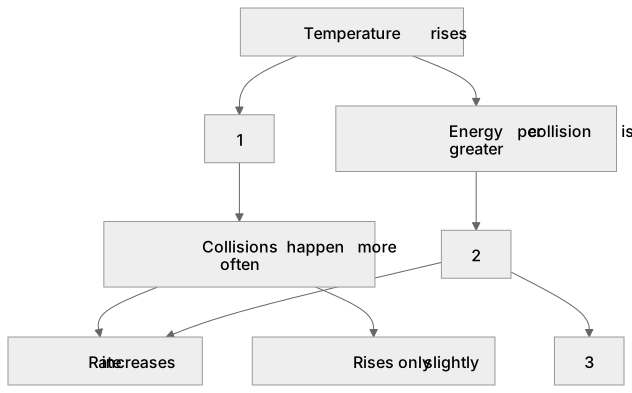
Some boxes have lost their names. Pick the right name for each number.
1Box 1
2Box 2
3Box 3
There is more to this lesson
The full lesson goes on to check your understanding and help you earn the marks. Create a free account to carry on, with your progress saved.
A week of Premium from your first lesson · Then the free plan continues · No card, no charge
Test your understanding of Effect of temperature on reaction rate: The qualitative effect of temperature changes on the rate of reaction.
Active recall beats re-reading. Take an instant quiz now to test what you’ve learned and lock it into long-term memory.
A week of Premium from your first lesson · Then the free plan continues · No card, no charge