AQA · A-Level · Chemistry
Course version: 7405 · Version from Sept 2016
Required practical 8 Measuring the EMF of an electrochemical cell.
Full specification wording
Electrode potentials and cells (A-level only): Required practical 8 Measuring the EMF of an electrochemical cell.
In Required practical 8 you build two half-cells and measure the potential difference between them.
Checked against the AQA 7405 specification (opens in a new tab) on .
- Point 7 of 7
- 4 key terms
Study notes
From the checked teaching notes for this specification point.
The idea
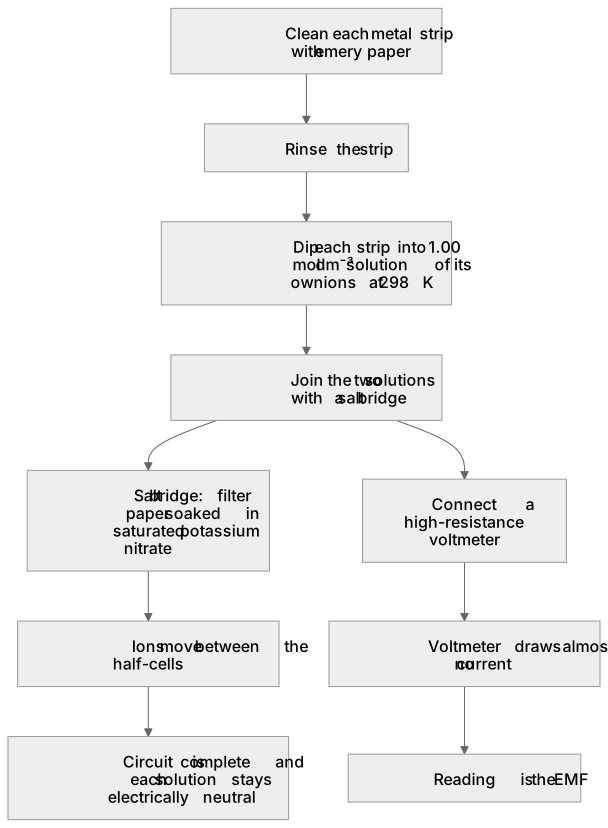
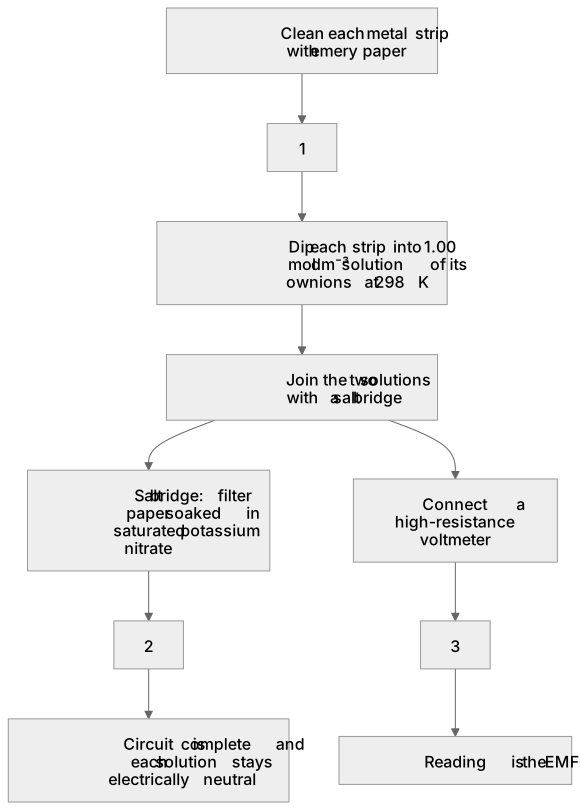
In Required practical 8 you build two half-cells and measure the potential difference between them. Each metal strip is cleaned with emery paper to remove the oxide layer, rinsed, and dipped into a 1.00 mol dm⁻³ solution of its own ions at 298 K. The two solutions are joined by a salt bridge, usually filter paper soaked in saturated potassium nitrate, which completes the circuit by letting ions move between the half-cells and keeps each solution electrically neutral. It does not let electrons through, and answers that say it does gain no credit. Potassium nitrate is chosen because neither K⁺ nor NO₃⁻ reacts with or precipitates the ions present, whereas potassium chloride would ruin a silver half-cell. A high-resistance voltmeter draws almost no current, so the reading is the EMF.
What earns the marks
- Stating that the salt bridge completes the circuit by allowing ions to move between the half-cells.
- Naming a soluble salt such as potassium nitrate that does not react with the ions in either half-cell.
- Cleaning the metal electrodes with emery paper before use.
- Using a high-resistance voltmeter so that negligible current is drawn.
- Using 1.00 mol dm⁻³ solutions at 298 K so the value may be quoted as standard.
Common mistakes and how to put them right
Writing that the salt bridge lets electrons flow between the half-cells, which examiners do not credit.
Choosing potassium chloride when the cell contains a silver half-cell, because silver chloride precipitates.
Replacing the salt bridge with a metal wire.
Leaving an oxide layer on the metal strip, so the reading drifts and reads low.
Describing the salt bridge as 'maintaining electrical neutrality' only, with no mention of ion movement.
Exam tips
- Learn one complete sentence for the salt bridge: it allows ions to move so the circuit is complete and each solution stays electrically neutral.
- If a measured EMF is lower than the calculated value, non-standard concentration or temperature is the expected explanation.
Try the lesson
The start of the Electrode potentials and cells (A-level only): Required practical 8 Measuring the EMF of an electrochemical cell. lesson, made from checked teaching notes for this specification point.
Have a go first
In Required practical 8, a student sets up a zinc/copper cell and measures its EMF. Which piece of apparatus is most appropriate to measure the EMF of the cell?
Listen
In Required practical 8 you build two half-cells and measure the potential difference between them. Each metal strip is cleaned with emery paper to remove the oxide layer, rinsed, and dipped into a 1.00 mol dm⁻³ solution of its own ions at 298 K. The two solutions are joined by a salt bridge, usually filter paper soaked in saturated potassium nitrate, which completes the circuit by letting ions move between the half-cells and keeps each solution electrically neutral. It does not let electrons through, and answers that say it does gain no credit. Potassium nitrate is chosen because neither K⁺ nor NO₃⁻ reacts with or precipitates the ions present, whereas potassium chloride would ruin a silver half-cell. A high-resistance voltmeter draws almost no current, so the reading is the EMF. A strong answer earns marks for these points. stating that the salt bridge completes the circuit by allowing ions to move between the half-cells. naming a soluble salt such as potassium nitrate that does not react with the ions in either half-cell. cleaning the metal electrodes with emery paper before use. using a high-resistance voltmeter so that negligible current is drawn. Exam tip: Learn one complete sentence for the salt bridge: it allows ions to move so the circuit is complete and each solution stays electrically neutral.
See it
Key words
Say what each word means before you turn the card.
Required practical 8
Try answering aloud or in your head before turning the card.
salt bridge
Try answering aloud or in your head before turning the card.
high-resistance voltmeter
Try answering aloud or in your head before turning the card.
standard conditions
Try answering aloud or in your head before turning the card.
See every definition
- Required practical 8
- Building two half-cells and measuring the potential difference between them to measure the EMF of an electrochemical cell.
- salt bridge
- Usually filter paper soaked in saturated potassium nitrate, joining the two solutions and completing the circuit by letting ions move between the half-cells.
- high-resistance voltmeter
- A meter that draws almost no current, so the reading is the EMF.
- standard conditions
- Using 1.00 mol dm⁻³ solutions at 298 K so the value may be quoted as standard.
Label the diagram
Some boxes have lost their names. Pick the right name for each number.
1Box 1
2Box 2
3Box 3
There is more to this lesson
The full lesson goes on to check your understanding and help you earn the marks. Create a free account to carry on, with your progress saved.
A week of Premium from your first lesson · Then the free plan continues · No card, no charge
Test your understanding of Electrode potentials and cells (A-level only): Required practical 8 Measuring the EMF of an electrochemical cell.
Active recall beats re-reading. Take an instant quiz now to test what you’ve learned and lock it into long-term memory.
A week of Premium from your first lesson · Then the free plan continues · No card, no charge