AQA · A-Level · Chemistry
Course version: 7405 · Version from Sept 2016
The importance of the conditions when measuring the electrode potential, E…
Full specification wording
Electrode potentials and cells (A-level only): The importance of the conditions when measuring the electrode potential, E (Nernst equation not required).
An electrode potential is the position of an equilibrium, so anything that shifts that equilibrium changes E. Standard values are quoted at 298 K with every solution at 1.00 mol dm⁻³ and every gas…
Checked against the AQA 7405 specification (opens in a new tab) on .
- Point 4 of 7
- 4 key terms
Study notes
From the checked teaching notes for this specification point.
The idea
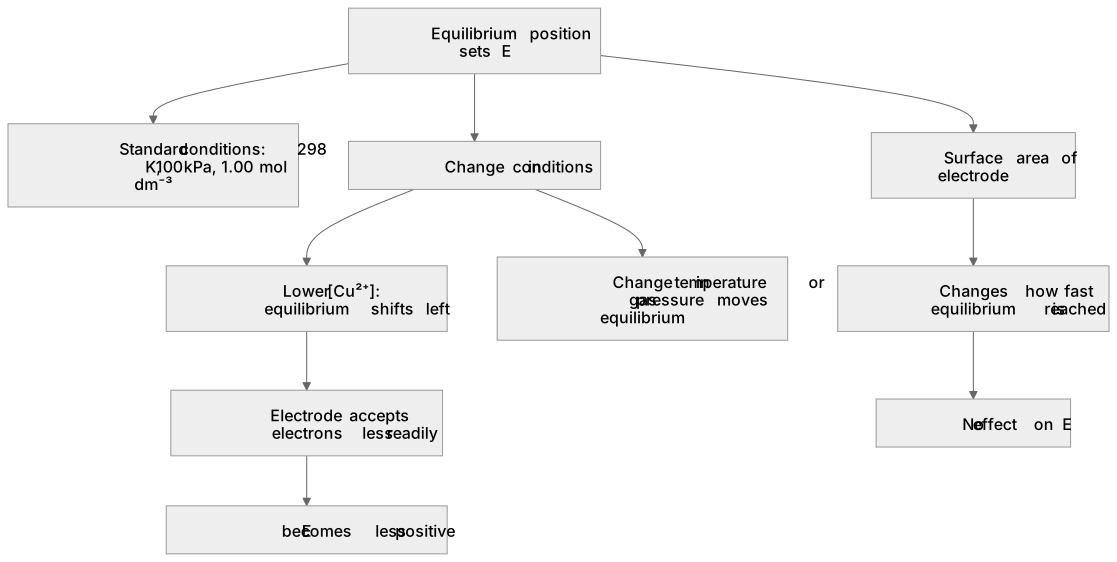
An electrode potential is the position of an equilibrium, so anything that shifts that equilibrium changes E. Standard values are quoted at 298 K with every solution at 1.00 mol dm⁻³ and every gas at 100 kPa. Lowering [Cu²⁺] in Cu²⁺(aq) + 2e⁻ ⇌ Cu(s) pulls the equilibrium to the left, so the electrode accepts electrons less readily and E becomes less positive. Changing the temperature or the pressure of a gaseous reactant moves the equilibrium too. What does not change E is the surface area of the electrode: a larger platinum surface lets the equilibrium be reached faster but does not alter where that equilibrium lies. Rate and position are separate ideas, and only the position sets the potential.
What earns the marks
- Stating the standard conditions of 298 K, 100 kPa and 1.00 mol dm⁻³ solutions.
- Explaining the effect of a concentration change using the position of the half-cell equilibrium.
- Stating that the surface area of the electrode has no effect on the electrode potential.
- Deducing whether E becomes more or less positive from the direction the equilibrium shifts.
Common mistakes and how to put them right
Claiming that increasing the surface area of the platinum electrode makes the potential more positive, when it only changes how fast equilibrium is reached.
Saying temperature has no effect because E⦵ is a constant.
Treating E as a fixed property of the half-cell whatever the concentrations are.
Quoting 273 K or 100 °C as the standard temperature instead of 298 K.
Exam tips
- Treat every half-equation as an equilibrium and apply Le Chatelier's principle to it; that answers almost every 'effect of' question here.
- Watch for distractors about electrode size, shape or surface area; these change rate, not potential.
Try the lesson
The start of the Electrode potentials and cells (A-level only): The importance of the conditions when measuring the electrode potential, E (Nernst equation not required). lesson, made from checked teaching notes for this specification point.
Have a go first
Which set of conditions is used when measuring a standard electrode potential?
Listen
An electrode potential is the position of an equilibrium, so anything that shifts that equilibrium changes E. Standard values are quoted at 298 K with every solution at 1.00 mol dm⁻³ and every gas at 100 kPa. Lowering [Cu²⁺] in Cu²⁺(aq) + 2e⁻ ⇌ Cu(s) pulls the equilibrium to the left, so the electrode accepts electrons less readily and E becomes less positive. Changing the temperature or the pressure of a gaseous reactant moves the equilibrium too. What does not change E is the surface area of the electrode: a larger platinum surface lets the equilibrium be reached faster but does not alter where that equilibrium lies. Rate and position are separate ideas, and only the position sets the potential. A strong answer earns marks for these points. stating the standard conditions of 298 K, 100 kPa and 1.00 mol dm⁻³ solutions. explaining the effect of a concentration change using the position of the half-cell equilibrium. stating that the surface area of the electrode has no effect on the electrode potential. deducing whether E becomes more or less positive from the direction the equilibrium shifts. Exam tip: Treat every half-equation as an equilibrium and apply Le Chatelier's principle to it; that answers almost every 'effect of' question here.
See it
Key words
Say what each word means before you turn the card.
standard conditions
Try answering aloud or in your head before turning the card.
equilibrium position
Try answering aloud or in your head before turning the card.
effect of concentration
Try answering aloud or in your head before turning the card.
rate versus position
Try answering aloud or in your head before turning the card.
See every definition
- standard conditions
- Values are quoted at 298 K with every solution at 1.00 mol dm⁻³ and every gas at 100 kPa.
- equilibrium position
- An electrode potential is the position of an equilibrium, so anything that shifts that equilibrium changes E.
- effect of concentration
- Lowering [Cu²⁺] pulls the equilibrium to the left, so the electrode accepts electrons less readily and E becomes less positive.
- rate versus position
- Rate and position are separate ideas, and only the position sets the potential.
Label the diagram
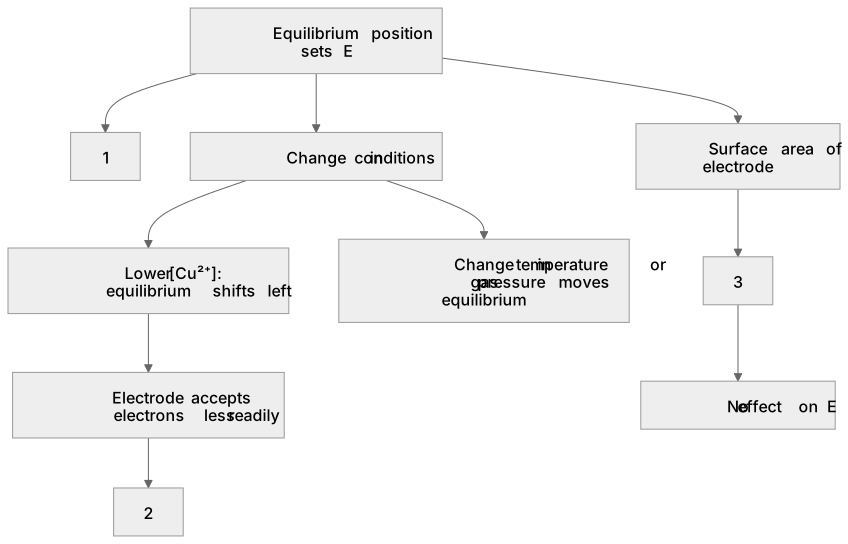
Some boxes have lost their names. Pick the right name for each number.
1Box 1
2Box 2
3Box 3
There is more to this lesson
The full lesson goes on to check your understanding and help you earn the marks. Create a free account to carry on, with your progress saved.
A week of Premium from your first lesson · Then the free plan continues · No card, no charge
Test your understanding of Electrode potentials and cells (A-level only): The importance of the conditions when measuring the electrode potential, E (Nernst equation not required).
Active recall beats re-reading. Take an instant quiz now to test what you’ve learned and lock it into long-term memory.
A week of Premium from your first lesson · Then the free plan continues · No card, no charge