AQA · A-Level · Chemistry
Course version: 7405 · Version from Sept 2016
Molecular formula is the actual number of atoms of each element in a…
Full specification wording
Empirical and molecular formula: Molecular formula is the actual number of atoms of each element in a compound.
The molecular formula states how many atoms of each element are actually present in one molecule.
Checked against the AQA 7405 specification (opens in a new tab) on .
- Point 2 of 4
- 2 key terms
Study notes
From the checked teaching notes for this specification point.
The idea
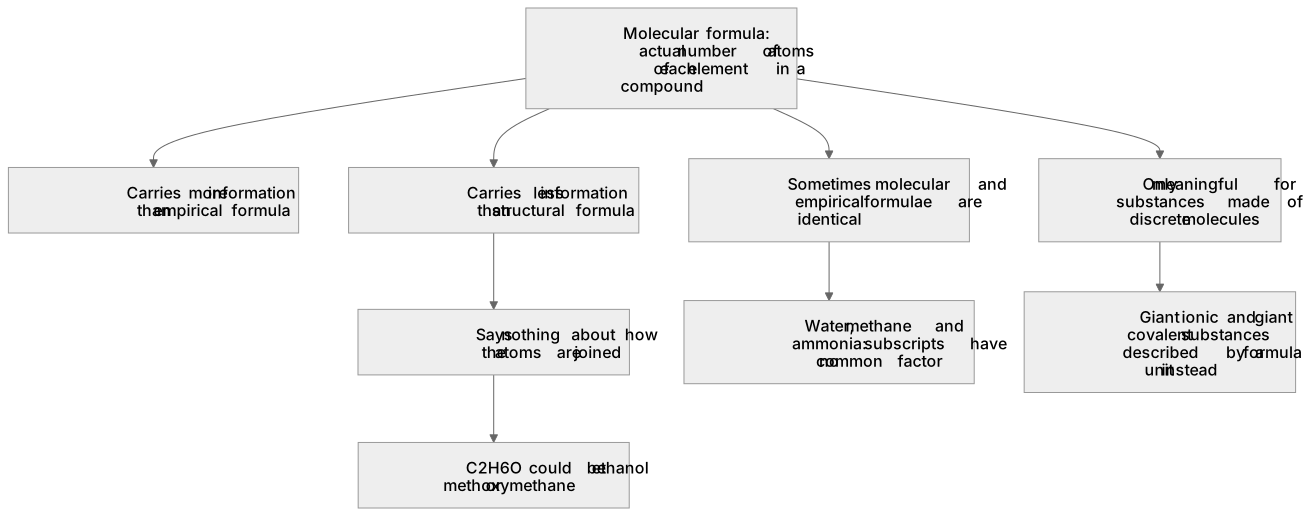
The molecular formula states how many atoms of each element are actually present in one molecule. Ethanoic acid is C₂H₄O₂, benzene is C₆H₆, glucose is C₆H₁₂O₆. It carries more information than the empirical formula but less than a structural formula, since it says nothing about how the atoms are joined: C₂H₆O could be ethanol or methoxymethane. Sometimes the molecular and empirical formulae are identical, as in water, methane and ammonia, because the subscripts already have no common factor. Molecular formulae are only meaningful for substances made of discrete molecules; giant ionic and giant covalent substances are described by a formula unit instead.
What earns the marks
- The actual number of atoms of each element in one molecule.
- Recognising when the molecular formula and empirical formula are the same.
- Showing the molecular formula as a whole-number multiple of the empirical formula.
- Distinguishing a molecular formula from a structural formula.
Common mistakes and how to put them right
Giving the empirical formula when the molecular formula was requested.
Assuming the two formulae must always differ, so doubling an already simplest formula.
Miscounting hydrogen atoms when reading a skeletal or displayed structure.
Quoting a molecular formula for an ionic compound such as sodium chloride.
Exam tips
- Count atoms from a displayed formula systematically, element by element, rather than by eye.
- State whether the question wants empirical, molecular or structural before you write anything.
- Remember that isomers share a molecular formula, so a molecular formula alone never identifies a compound.
Try the lesson
The start of the Empirical and molecular formula: Molecular formula is the actual number of atoms of each element in a compound. lesson, made from checked teaching notes for this specification point.
Have a go first
A compound has the structural formula HOOCCH₂CH₂COOH. What is the molecular formula of this compound?
Listen
The molecular formula states how many atoms of each element are actually present in one molecule. Ethanoic acid is C₂H₄O₂, benzene is C₆H₆, glucose is C₆H₁₂O₆. It carries more information than the empirical formula but less than a structural formula, since it says nothing about how the atoms are joined: C₂H₆O could be ethanol or methoxymethane. Sometimes the molecular and empirical formulae are identical, as in water, methane and ammonia, because the subscripts already have no common factor. Molecular formulae are only meaningful for substances made of discrete molecules; giant ionic and giant covalent substances are described by a formula unit instead. A strong answer earns marks for these points. the actual number of atoms of each element in one molecule. recognising when the molecular formula and empirical formula are the same. showing the molecular formula as a whole-number multiple of the empirical formula. distinguishing a molecular formula from a structural formula. Exam tip: Count atoms from a displayed formula systematically, element by element, rather than by eye.
See it
Key words
Say what each word means before you turn the card.
molecular formula
Try answering aloud or in your head before turning the card.
isomers
Try answering aloud or in your head before turning the card.
See every definition
- molecular formula
- The actual number of atoms of each element in a compound, stating how many atoms of each element are actually present in one molecule.
- isomers
- Compounds that share a molecular formula, so a molecular formula alone never identifies a compound.
Label the diagram
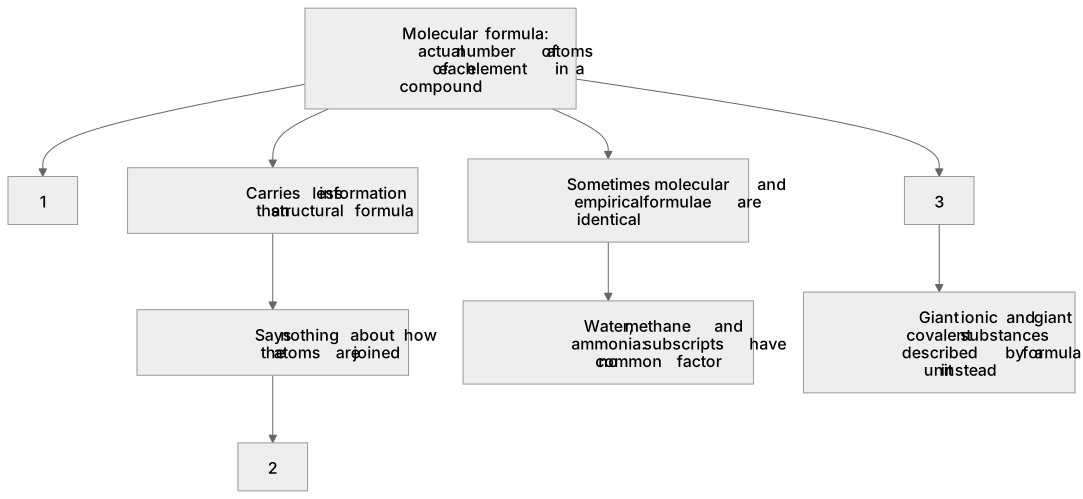
Some boxes have lost their names. Pick the right name for each number.
1Box 1
2Box 2
3Box 3
There is more to this lesson
The full lesson goes on to check your understanding and help you earn the marks. Create a free account to carry on, with your progress saved.
A week of Premium from your first lesson · Then the free plan continues · No card, no charge
Test your understanding of Empirical and molecular formula: Molecular formula is the actual number of atoms of each element in a compound.
Active recall beats re-reading. Take an instant quiz now to test what you’ve learned and lock it into long-term memory.
A week of Premium from your first lesson · Then the free plan continues · No card, no charge