AQA · A-Level · Chemistry
Course version: 7405 · Version from Sept 2016
Students should be able to: calculate empirical formula from data giving…
Full specification wording
Empirical and molecular formula: Students should be able to: calculate empirical formula from data giving composition by mass or percentage by mass calculate molecular formula from the empirical formula and relative molecular mass.
This is the full two-part calculation.
Checked against the AQA 7405 specification (opens in a new tab) on .
- Point 4 of 4
- 4 key terms
Study notes
From the checked teaching notes for this specification point.
The idea
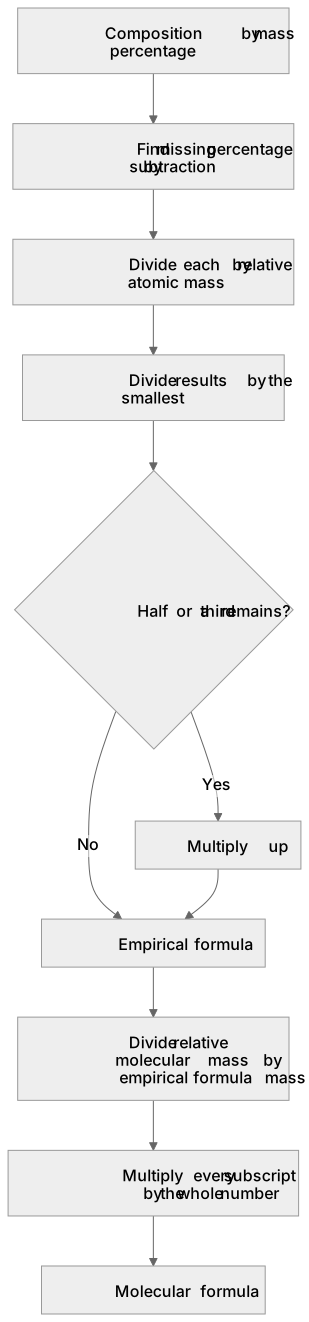
This is the full two-part calculation. Part one: convert composition to an empirical formula. Find any missing percentage by subtraction, divide each mass or percentage by the relative atomic mass, divide the results by the smallest, and multiply up if a half or a third remains. A sample of 37.08 per cent carbon, 5.15 per cent hydrogen, 24.72 per cent oxygen and the rest sulfur gives relative amounts of 3.09, 5.15, 1.55 and 1.03, which reduce to 3, 5, 1.5, 1 and then double to C₆H₁₀O₃S₂. Part two: divide the relative molecular mass by the empirical formula mass and multiply every subscript by the whole number obtained.
What earns the marks
- The percentage of the element described as the remainder.
- Dividing each percentage by the relative atomic mass to obtain relative amounts.
- The ratio divided by the smallest value and expressed as the empirical formula.
- The multiplier found from relative molecular mass divided by empirical formula mass.
- The molecular formula obtained by scaling every subscript.
Common mistakes and how to put them right
Not calculating the percentage of the element given only as the rest of the sample.
Dividing by the largest relative amount instead of the smallest.
Leaving the ratio as decimals such as 3.
Put it right: 5 : 1.5 : 1 without doubling.
Stopping at the empirical formula when the question also asked for the molecular formula.
Exam tips
- Use a four-row table: percentage, divided by relative atomic mass, divided by the smallest, multiplied up.
- Carry at least three significant figures until the final ratio so that 1.5 is not mistaken for 1 or 2.
- Read the final line of the question again; empirical and molecular are often both required.
Try the lesson
The start of the Empirical and molecular formula: Students should be able to: calculate empirical formula from data giving composition by mass or percentage by mass calculate molecular formula from the empirical formula and relative molecular mass. lesson, made from checked teaching notes for this specification point.
Have a go first
A compound contains 24.0 g of carbon and 64.0 g of oxygen only. What is its empirical formula?
Listen
This is the full two-part calculation. Part one: convert composition to an empirical formula. Find any missing percentage by subtraction, divide each mass or percentage by the relative atomic mass, divide the results by the smallest, and multiply up if a half or a third remains. A sample of 37.08 per cent carbon, 5.15 per cent hydrogen, 24.72 per cent oxygen and the rest sulfur gives relative amounts of 3.09, 5.15, 1.55 and 1.03, which reduce to 3, 5, 1.5, 1 and then double to C₆H₁₀O₃S₂. Part two: divide the relative molecular mass by the empirical formula mass and multiply every subscript by the whole number obtained. A strong answer earns marks for these points. the percentage of the element described as the remainder. dividing each percentage by the relative atomic mass to obtain relative amounts. the ratio divided by the smallest value and expressed as the empirical formula. the multiplier found from relative molecular mass divided by empirical formula mass. Exam tip: Use a four-row table: percentage, divided by relative atomic mass, divided by the smallest, multiplied up.
See it
Key words
Say what each word means before you turn the card.
percentage composition
Try answering aloud or in your head before turning the card.
relative amounts
Try answering aloud or in your head before turning the card.
simplest ratio
Try answering aloud or in your head before turning the card.
multiplier from relative molecular mass
Try answering aloud or in your head before turning the card.
See every definition
- percentage composition
- Data giving composition by mass or percentage by mass, where any missing percentage is found by subtraction.
- relative amounts
- The result of dividing each mass or percentage by the relative atomic mass.
- simplest ratio
- The relative amounts divided by the smallest value, multiplied up if a half or a third remains.
- multiplier from relative molecular mass
- The relative molecular mass divided by the empirical formula mass, by which every subscript is multiplied.
Label the diagram
Some boxes have lost their names. Pick the right name for each number.
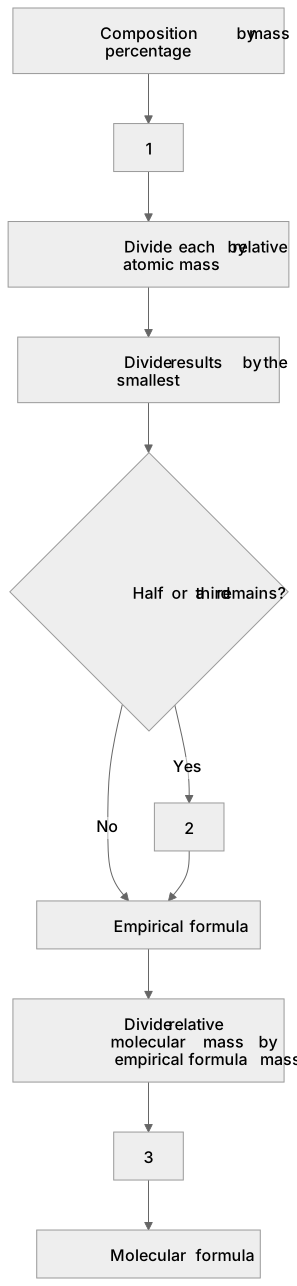
1Box 1
2Box 2
3Box 3
There is more to this lesson
The full lesson goes on to check your understanding and help you earn the marks. Create a free account to carry on, with your progress saved.
A week of Premium from your first lesson · Then the free plan continues · No card, no charge
Test your understanding of Empirical and molecular formula: Students should be able to: calculate empirical formula from data giving composition by mass or percentage by mass calculate molecular formula from the empirical formula and relative molecular mass.
Active recall beats re-reading. Take an instant quiz now to test what you’ve learned and lock it into long-term memory.
A week of Premium from your first lesson · Then the free plan continues · No card, no charge