AQA · A-Level · Chemistry
Course version: 7405 · Version from Sept 2016
The principle of a drug acting as an enzyme inhibitor by blocking the…
Full specification wording
Enzymes (A-level only): The principle of a drug acting as an enzyme inhibitor by blocking the active site.
A competitive inhibitor is a molecule similar enough in shape to the substrate to enter the active site, but which either does not react once there or binds much more tightly than the substrate does.
Checked against the AQA 7405 specification (opens in a new tab) on .
- Point 3 of 5
Study notes
From the checked teaching notes for this specification point.
The idea
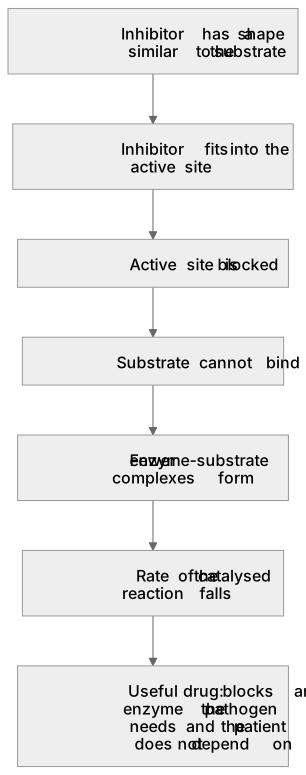
A competitive inhibitor is a molecule similar enough in shape to the substrate to enter the active site, but which either does not react once there or binds much more tightly than the substrate does. While it sits in the site, substrate molecules cannot bind, so fewer enzyme-substrate complexes form and the rate of the catalysed reaction falls. If the binding is reversible, raising the substrate concentration wins the competition back; if it is irreversible, that enzyme molecule is out of action permanently. Many drugs work this way, and the value of one depends on selectivity: a useful antibacterial blocks an enzyme the bacterium needs to survive and that human cells either do not have or do not depend on.
What earns the marks
- The inhibitor having a shape similar to the substrate so it fits the active site.
- The active site being blocked so the substrate cannot bind.
- The rate of the catalysed reaction being reduced as a result.
- Selectivity, that a useful drug blocks an enzyme needed by the pathogen and not by the patient.
Common mistakes and how to put them right
Saying the inhibitor destroys or denatures the enzyme rather than occupying its site.
Saying the drug binds to the substrate instead of to the enzyme.
Omitting the requirement that the inhibitor must resemble the substrate in shape.
Assuming any large molecule will act as an inhibitor.
Exam tips
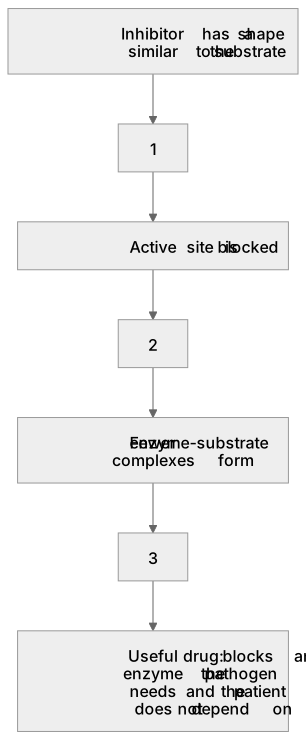
- Answer in three steps: similar shape, site blocked, rate falls. Missing the first step loses the explanation mark.
- If the question mentions a drug, add the selectivity point; that is usually the fourth mark.
Try the lesson
The start of the Enzymes (A-level only): The principle of a drug acting as an enzyme inhibitor by blocking the active site. lesson, made from checked teaching notes for this specification point.
Have a go first
A drug molecule has a shape that fits into the active site of an enzyme. What is the direct effect of the drug binding in this way?
Listen
A competitive inhibitor is a molecule similar enough in shape to the substrate to enter the active site, but which either does not react once there or binds much more tightly than the substrate does. While it sits in the site, substrate molecules cannot bind, so fewer enzyme-substrate complexes form and the rate of the catalysed reaction falls. If the binding is reversible, raising the substrate concentration wins the competition back; if it is irreversible, that enzyme molecule is out of action permanently. Many drugs work this way, and the value of one depends on selectivity: a useful antibacterial blocks an enzyme the bacterium needs to survive and that human cells either do not have or do not depend on. A strong answer earns marks for these points. the inhibitor having a shape similar to the substrate so it fits the active site. the active site being blocked so the substrate cannot bind. the rate of the catalysed reaction being reduced as a result. selectivity, that a useful drug blocks an enzyme needed by the pathogen and not by the patient. Exam tip: Answer in three steps: similar shape, site blocked, rate falls. Missing the first step loses the explanation mark.
See it
Put it in order
Put these steps in the order they happen.
- 1. Useful drug: blocks an enzyme the pathogen needs and the patient does not depend on
- 2. Rate of the catalysed reaction falls
- 3. Active site is blocked
- 4. Fewer enzyme-substrate complexes form
- 5. Inhibitor has a shape similar to the substrate
- 6. Inhibitor fits into the active site
- 7. Substrate cannot bind
Label the diagram
Some boxes have lost their names. Pick the right name for each number.
1Box 1
2Box 2
3Box 3
There is more to this lesson
The full lesson goes on to check your understanding and help you earn the marks. Create a free account to carry on, with your progress saved.
A week of Premium from your first lesson · Then the free plan continues · No card, no charge
Test your understanding of Enzymes (A-level only): The principle of a drug acting as an enzyme inhibitor by blocking the active site.
Active recall beats re-reading. Take an instant quiz now to test what you’ve learned and lock it into long-term memory.
A week of Premium from your first lesson · Then the free plan continues · No card, no charge