Study Notes
Overview
Welcome to section 3.1.10 of the A-Level Chemistry specification: the equilibrium constant Kp for homogeneous systems. 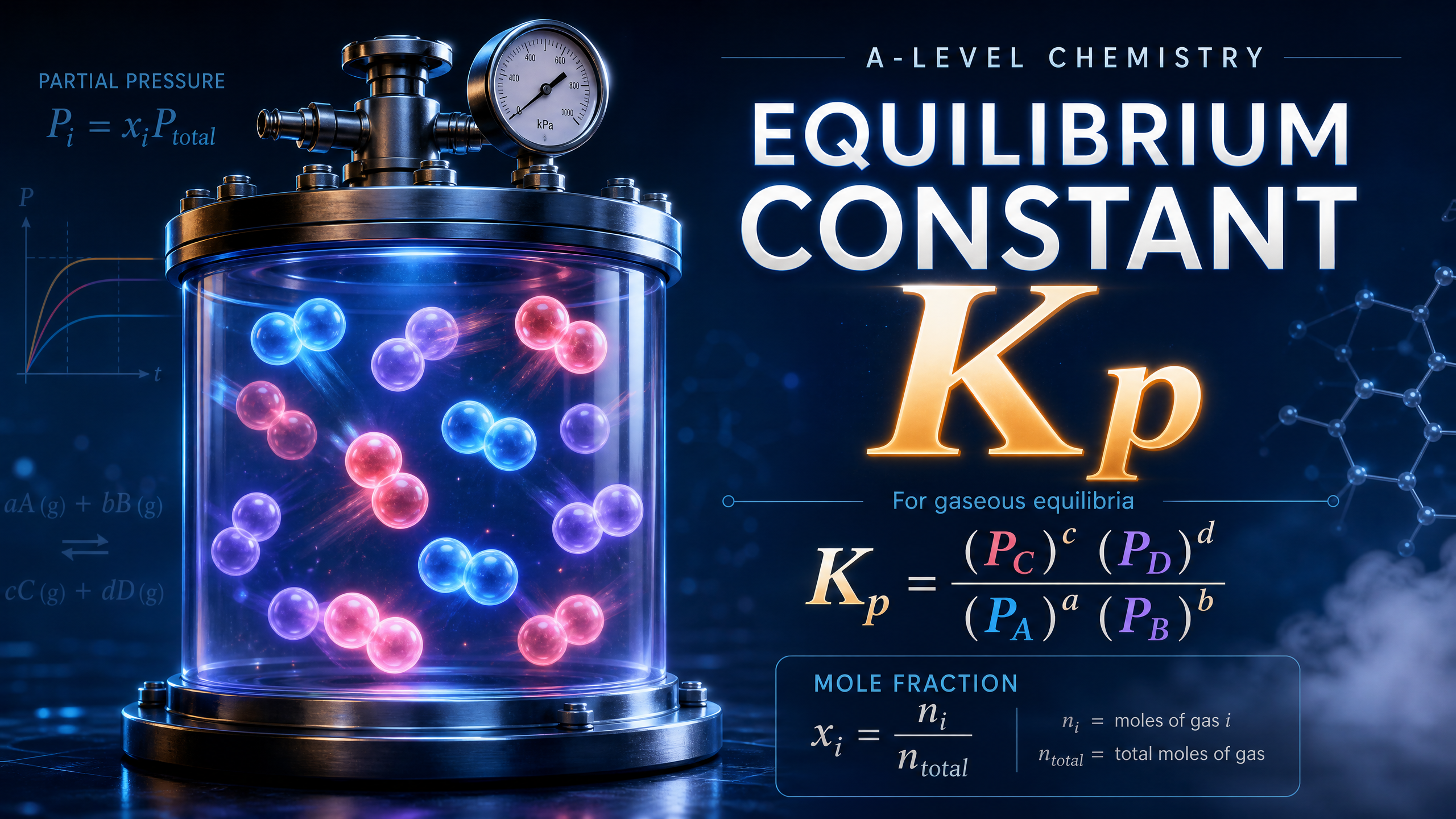
While you are likely familiar with Kc (the equilibrium constant in terms of concentration), Kp is its gaseous counterpart. It is a fundamental concept in physical chemistry that allows us to quantify the position of equilibrium in a reversible reaction where all reactants and products are gases. Understanding Kp is not just an academic exercise; it is crucial for industrial applications, such as optimizing the yield of ammonia in the Haber process or sulfur trioxide in the Contact process.
In your exams, this topic frequently appears as a high-tariff calculation question (often worth 5-7 marks) or as a challenging evaluative question requiring you to apply Le Chatelier's principle. You will need to synthesize your knowledge of mole calculations, algebraic rearrangement, and thermodynamics to succeed.
Key Concepts
Concept 1: Partial Pressure and Mole Fractions
In a mixture of gases, each individual gas exerts its own pressure, independent of the others. This is known as its partial pressure. Dalton's Law states that the total pressure of a gas mixture is the sum of all the individual partial pressures.
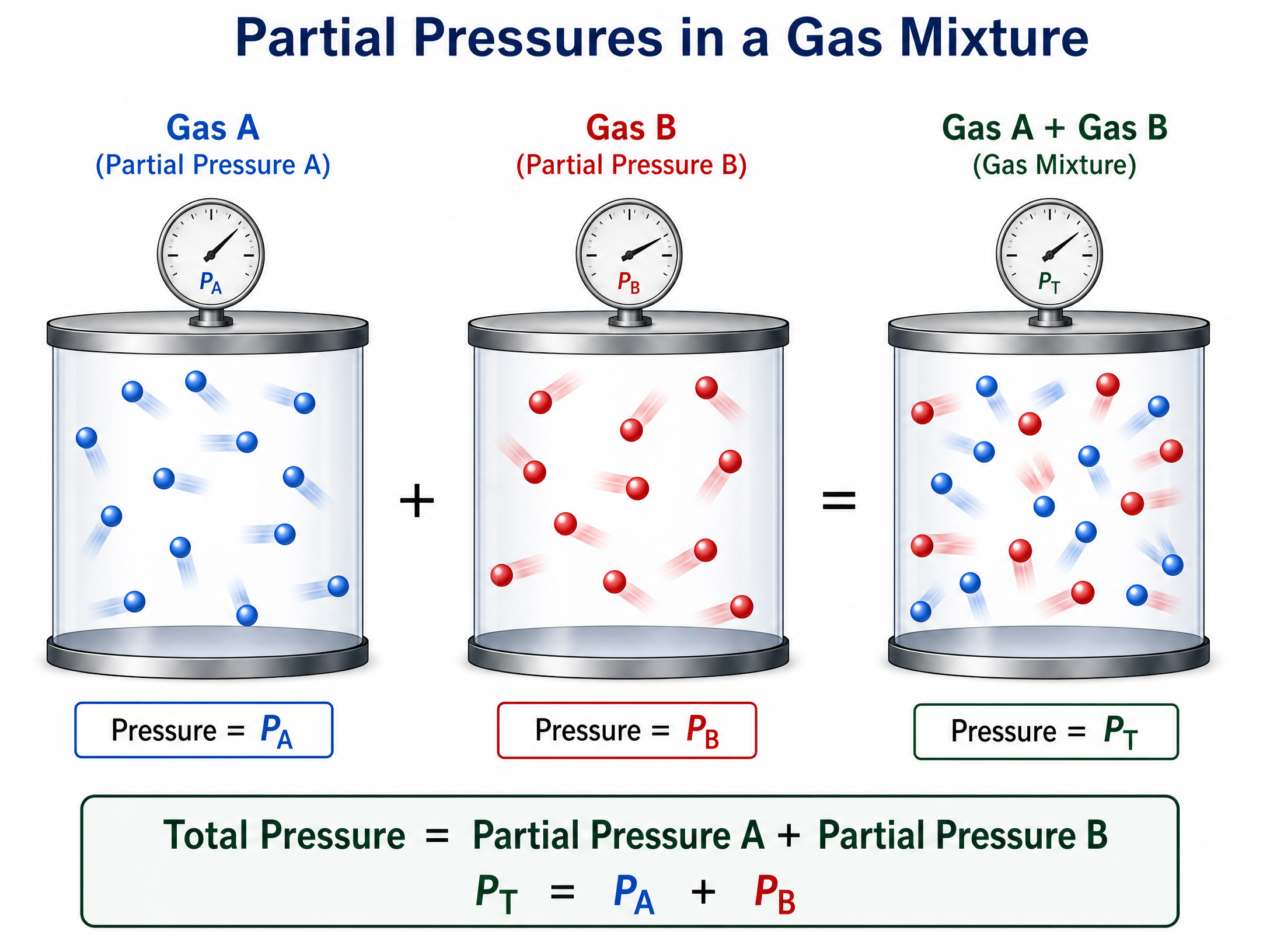
To calculate the partial pressure of a specific gas, you must first find its mole fraction. Think of the mole fraction as the proportion of the total gas mixture that belongs to that specific gas.
Why does this work? Because at a constant temperature and volume, the pressure a gas exerts is directly proportional to the number of moles present (as per the ideal gas equation, pV = nRT).
Concept 2: Constructing the Kp Expression
The Kp expression is constructed similarly to Kc, but using partial pressures instead of concentrations.
- Place the partial pressures of the products in the numerator (top).
- Place the partial pressures of the reactants in the denominator (bottom).
- Raise each partial pressure to the power of its balancing number (stoichiometric coefficient) from the balanced chemical equation.
CRITICAL RULE: You MUST use round brackets () for partial pressures, typically with a capital 'P' and a subscript for the gas (e.g., P_{NH_3}). Do NOT use square brackets [], as these strictly denote concentration and will lose you marks.
Concept 3: The Effect of Changing Conditions
This is a major testing point. You must distinguish between changes to the position of equilibrium and changes to the value of Kp.
- Temperature: This is the ONLY factor that changes the value of Kp.
- For an exothermic reaction (forward direction), increasing temperature shifts the equilibrium to the left (endothermic direction) to oppose the change. The partial pressures of the products decrease, and reactants increase, causing the value of Kp to decrease.
- For an endothermic reaction, increasing temperature shifts the equilibrium to the right, causing the value of Kp to increase.
- Total Pressure: Changing the total pressure may shift the position of equilibrium (according to Le Chatelier's principle), but it does not change the value of Kp. The system adjusts the individual partial pressures until the ratio matches the constant Kp value again.
- Catalysts: Catalysts speed up the rate of both the forward and reverse reactions equally. They help the system reach equilibrium faster but have no effect on the position of equilibrium or the value of Kp.
Mathematical/Scientific Relationships
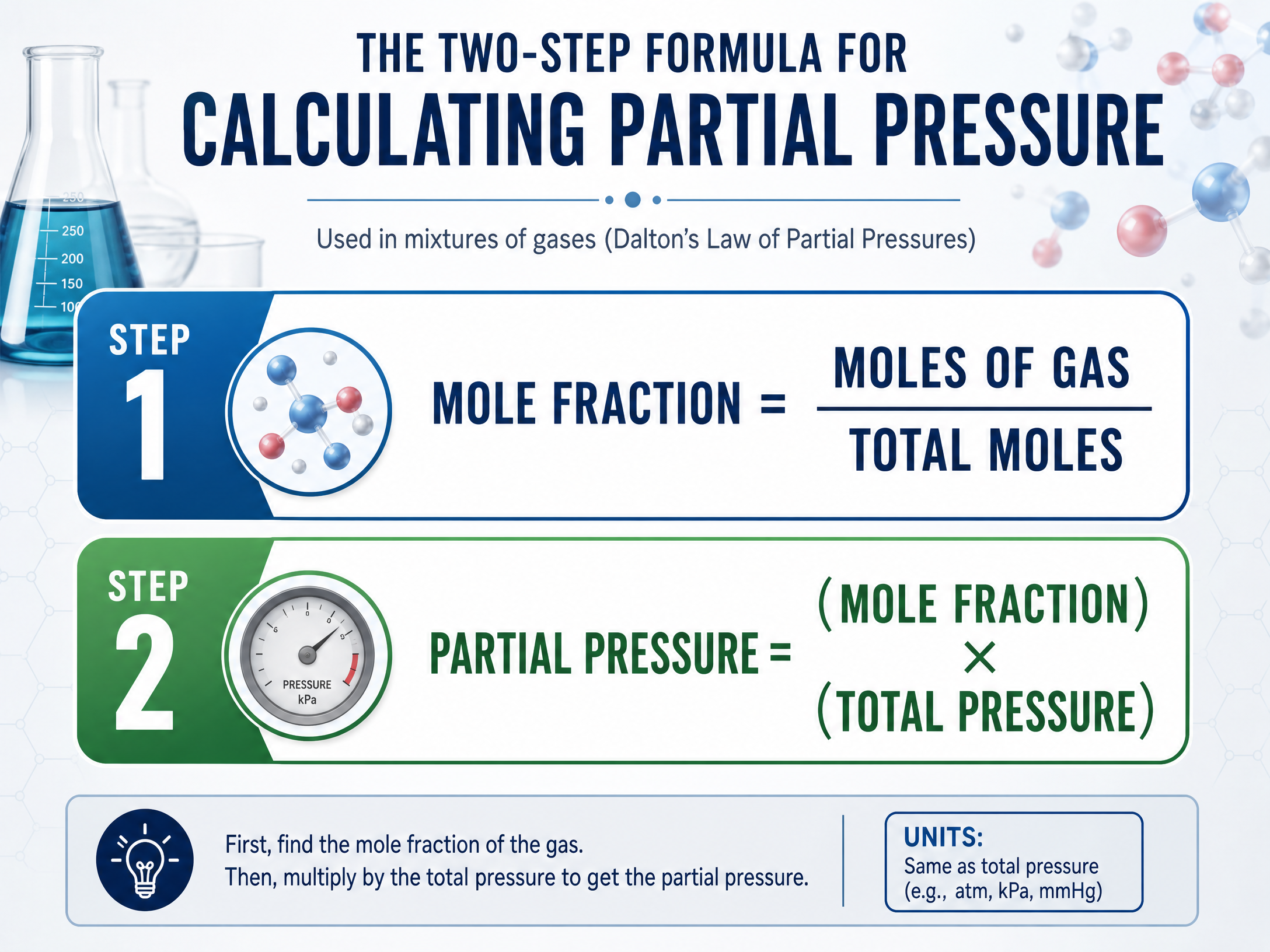
1. Mole Fraction (x_A)
x_A = \frac{\text{moles of gas A}}{\text{total moles of all gases}}
2. Partial Pressure (P_A)
P_A = x_A \times P_{total}
3. The Kp ExpressionFor a general reaction: aA_{(g)} + bB_{(g)} \rightleftharpoons cC_{(g)} + dD_{(g)}
K_p = \frac{(P_C)^c \times (P_D)^d}{(P_A)^a \times (P_B)^b}
Practical Applications
Understanding Kp is vital in chemical engineering. In the Haber Process (N_{2(g)} + 3H_{2(g)} \rightleftharpoons 2NH_{3(g)}), the forward reaction is exothermic. A low temperature would give a high value of Kp and a high yield of ammonia, but the rate of reaction would be too slow to be economically viable. Therefore, a compromise temperature of around 450°C is used, alongside an iron catalyst to speed up the attainment of equilibrium. High pressure is used to push the equilibrium to the right (fewer moles of gas), increasing the yield.
Podcast Revision
Listen to our comprehensive 10-minute audio guide covering all these concepts, common pitfalls, and a quick-fire quiz!
Visual Resources
2 diagrams and illustrations
Interactive Diagrams
2 interactive diagrams to visualise key concepts
Conceptual Flow Outline
Flowchart for solving Kp calculation questions
Conceptual Flow Outline
How temperature affects the value of Kp
Worked Examples
3 detailed examples with solutions and examiner commentary
Practice Questions
Test your understanding — click to reveal model answers
Write the Kp expression for the following reaction and deduce its units: 2SO_{2(g)} + O_{2(g)} \rightleftharpoons 2SO_{3(g)}
Hint: Remember to use round brackets and raise the pressures to the power of their balancing numbers.
A system contains 0.50 mol of gas A, 0.30 mol of gas B, and 0.20 mol of gas C at equilibrium. The total pressure is 150 kPa. Calculate the partial pressure of gas B.
Hint: First find the total number of moles, then the mole fraction of B.
For the reaction N_{2(g)} + 3H_{2(g)} \rightleftharpoons 2NH_{3(g)}, the forward reaction is exothermic. State and explain the effect of increasing the temperature on the value of Kp.
Hint: Link Le Chatelier's principle to the numerator and denominator of the Kp expression.
A catalyst is added to a gaseous equilibrium mixture. State the effect on the position of equilibrium and the value of Kp.
Hint: Think about what a catalyst actually does to the forward and reverse reaction rates.
In an experiment, 2.00 mol of SO_2 and 1.00 mol of O_2 were placed in a flask. At equilibrium, 1.50 mol of SO_3 had formed. The total pressure was 300 kPa. Calculate Kp for the reaction 2SO_{2(g)} + O_{2(g)} \rightleftharpoons 2SO_{3(g)}.
Hint: You are given INITIAL moles. You must use an ICE table to find the equilibrium moles of SO2 and O2 before calculating mole fractions.