AQA · A-Level · Chemistry
Course version: 7405 · Version from Sept 2016
Students should be able to: explain the existence of these forces between…
Full specification wording
Forces between molecules: Students should be able to: explain the existence of these forces between familiar and unfamiliar molecules explain how melting and boiling points are influenced by these intermolecular forces.
For an unfamiliar molecule, work from the structure.
Checked against the AQA 7405 specification (opens in a new tab) on .
- Point 4 of 4
- 2 key terms
Study notes
From the checked teaching notes for this specification point.
The idea
For an unfamiliar molecule, work from the structure. Induced dipole-dipole forces are always present, so start there and judge their size from the number of electrons and the shape. Then look for a permanent dipole: polar bonds in an unsymmetrical arrangement. Finally check for a hydrogen atom bonded directly to nitrogen, oxygen or fluorine, which allows hydrogen bonding to a lone pair on a neighbouring molecule. Boiling point then follows from the strongest force present. Ethanol and ethylamine both hydrogen bond, so both boil above methoxymethane, which has only permanent dipole-dipole and induced dipole forces; ethanol beats ethylamine because oxygen is more electronegative than nitrogen.
What earns the marks
- Naming every intermolecular force acting in each molecule, not only the strongest.
- Justifying hydrogen bonding by identifying a hydrogen bonded to nitrogen, oxygen or fluorine and a lone pair to accept it.
- Identifying which force is strongest in each substance.
- The comparison of boiling points with a reason based on those forces.
Common mistakes and how to put them right
Naming only one force when several act at once.
Ignoring induced dipole-dipole forces in a polar or hydrogen bonded molecule.
Using bond enthalpy data to argue about boiling points, which concern intermolecular forces.
Referring to breaking covalent bonds anywhere in an answer about boiling.
Exam tips
- Annotate each structure with its polar bonds and any hydrogen attached to nitrogen, oxygen or fluorine before writing.
- Compare like with like: molecules of similar electron count isolate the effect of the stronger force.
- When two molecules both hydrogen bond, decide between them on electronegativity.
Try the lesson
The start of the Forces between molecules: Students should be able to: explain the existence of these forces between familiar and unfamiliar molecules explain how melting and boiling points are influenced by these intermolecular forces. lesson, made from checked teaching notes for this specification point.
Have a go first
Which intermolecular force exists between all simple covalent molecules, whether polar or non-polar?
Listen
For an unfamiliar molecule, work from the structure. Induced dipole-dipole forces are always present, so start there and judge their size from the number of electrons and the shape. Then look for a permanent dipole: polar bonds in an unsymmetrical arrangement. Finally check for a hydrogen atom bonded directly to nitrogen, oxygen or fluorine, which allows hydrogen bonding to a lone pair on a neighbouring molecule. Boiling point then follows from the strongest force present. Ethanol and ethylamine both hydrogen bond, so both boil above methoxymethane, which has only permanent dipole-dipole and induced dipole forces; ethanol beats ethylamine because oxygen is more electronegative than nitrogen. A strong answer earns marks for these points. naming every intermolecular force acting in each molecule, not only the strongest. justifying hydrogen bonding by identifying a hydrogen bonded to nitrogen, oxygen or fluorine and a lone pair to accept it. identifying which force is strongest in each substance. the comparison of boiling points with a reason based on those forces. Exam tip: Annotate each structure with its polar bonds and any hydrogen attached to nitrogen, oxygen or fluorine before writing.
See it
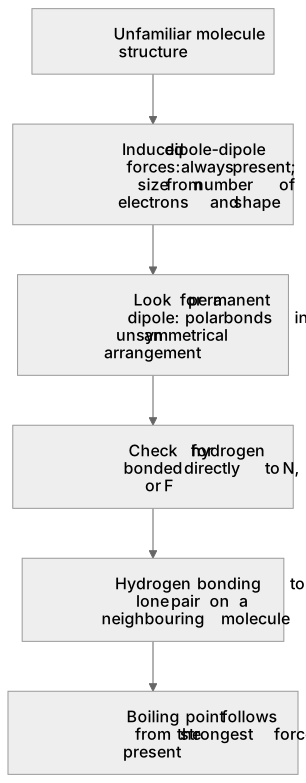
Put it in order
Put these steps in the order they happen.
- 1. Look for a permanent dipole: polar bonds in an unsymmetrical arrangement
- 2. Induced dipole-dipole forces: always present; size from number of electrons and shape
- 3. Unfamiliar molecule structure
- 4. Boiling point follows from the strongest force present
- 5. Hydrogen bonding to a lone pair on a neighbouring molecule
- 6. Check for hydrogen bonded directly to N, O or F
Key words
Say what each word means before you turn the card.
unfamiliar molecules
Try answering aloud or in your head before turning the card.
electronegativity of the donor atom
Try answering aloud or in your head before turning the card.
See every definition
- unfamiliar molecules
- For a molecule that is not familiar, work from the structure to judge the size of the induced dipole-dipole forces from the number of electrons and the shape.
- electronegativity of the donor atom
- When two molecules both hydrogen bond, the one with the more electronegative donor atom has the higher boiling point, so ethanol beats ethylamine because oxygen is more electronegative than nitrogen.
Label the diagram
Some boxes have lost their names. Pick the right name for each number.
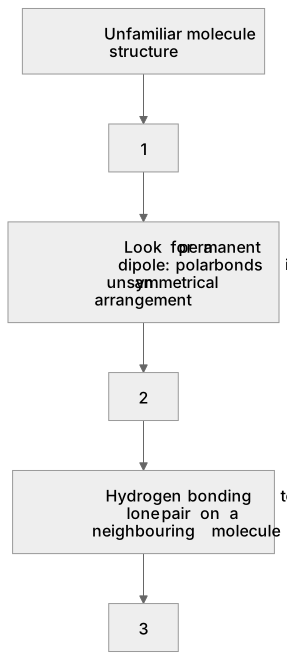
1Box 1
2Box 2
3Box 3
There is more to this lesson
The full lesson goes on to check your understanding and help you earn the marks. Create a free account to carry on, with your progress saved.
A week of Premium from your first lesson · Then the free plan continues · No card, no charge
Test your understanding of Forces between molecules: Students should be able to: explain the existence of these forces between familiar and unfamiliar molecules explain how melting and boiling points are influenced by these intermolecular forces.
Active recall beats re-reading. Take an instant quiz now to test what you’ve learned and lock it into long-term memory.
A week of Premium from your first lesson · Then the free plan continues · No card, no charge