AQA · A-Level · Chemistry
Course version: 7405 · Version from Sept 2016
The melting and boiling points of molecular substances are influenced by…
Full specification wording
Forces between molecules: The melting and boiling points of molecular substances are influenced by the strength of these intermolecular forces.
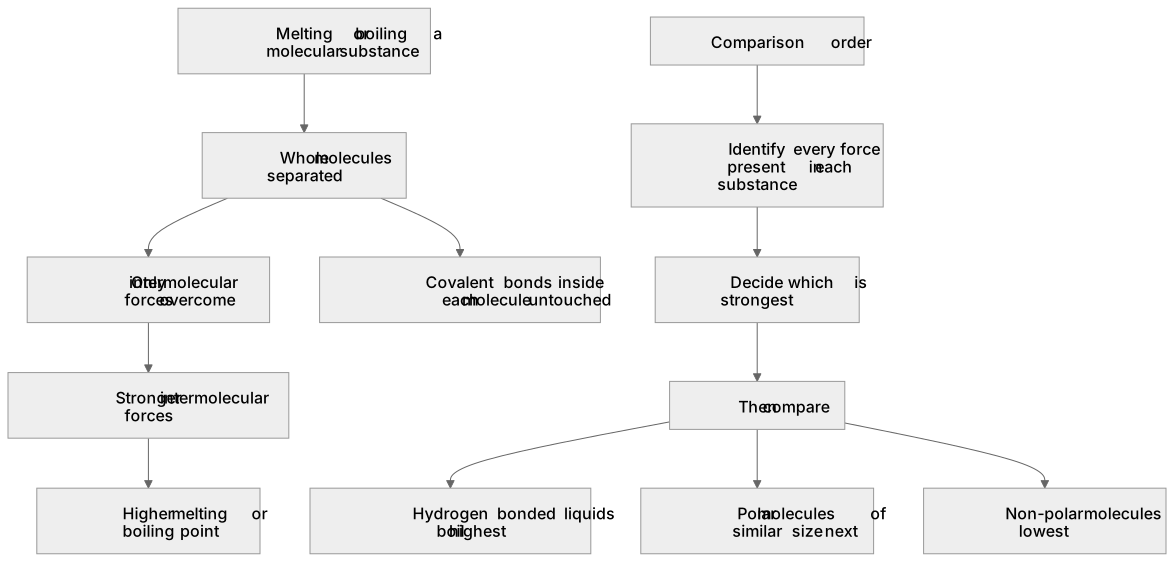
Melting and boiling a molecular substance separates whole molecules, so only the intermolecular forces are overcome; the covalent bonds inside each molecule are untouched.
Checked against the AQA 7405 specification (opens in a new tab) on .
- Point 2 of 4
- 4 key terms
Study notes
From the checked teaching notes for this specification point.
The idea
Melting and boiling a molecular substance separates whole molecules, so only the intermolecular forces are overcome; the covalent bonds inside each molecule are untouched. Stronger intermolecular forces therefore mean a higher melting or boiling point. Comparisons follow a fixed order: identify every force present in each substance, decide which is strongest, and only then compare. Hydrogen bonded liquids boil highest, polar molecules of similar size come next, and non-polar molecules lowest. Where the same force operates in both substances, compare the number of electrons and the surface area in contact, so a longer unbranched chain boils higher than a shorter or more branched isomer with the same formula.
What earns the marks
- Stating that only intermolecular forces are overcome on melting or boiling.
- Naming the strongest intermolecular force present in each substance.
- Comparing the number of electrons or surface contact where induced dipole forces dominate.
- The conclusion about which substance has the higher melting or boiling point, with a reason.
Common mistakes and how to put them right
Writing that covalent bonds break, which is explicitly refused by the mark scheme.
Claiming a branched isomer boils higher than its straight-chain isomer.
Comparing relative molecular masses rather than electron count and contact area.
Ignoring hydrogen bonding when it is present and arguing only from molecular size.
Exam tips
- Open the answer with the words intermolecular forces are overcome; it protects you from the covalent bond error.
- Name the forces in both substances before comparing; a one-sided answer rarely scores full marks.
- If the only difference is chain shape, argue from surface contact between molecules.
Try the lesson
The start of the Forces between molecules: The melting and boiling points of molecular substances are influenced by the strength of these intermolecular forces. lesson, made from checked teaching notes for this specification point.
Have a go first
Which statement explains why iodine, I₂, has a higher boiling point than bromine, Br₂?
Listen
Melting and boiling a molecular substance separates whole molecules, so only the intermolecular forces are overcome; the covalent bonds inside each molecule are untouched. Stronger intermolecular forces therefore mean a higher melting or boiling point. Comparisons follow a fixed order: identify every force present in each substance, decide which is strongest, and only then compare. Hydrogen bonded liquids boil highest, polar molecules of similar size come next, and non-polar molecules lowest. Where the same force operates in both substances, compare the number of electrons and the surface area in contact, so a longer unbranched chain boils higher than a shorter or more branched isomer with the same formula. A strong answer earns marks for these points. stating that only intermolecular forces are overcome on melting or boiling. naming the strongest intermolecular force present in each substance. comparing the number of electrons or surface contact where induced dipole forces dominate. the conclusion about which substance has the higher melting or boiling point, with a reason. Exam tip: Open the answer with the words intermolecular forces are overcome; it protects you from the covalent bond error.
See it
Key words
Say what each word means before you turn the card.
overcoming intermolecular forces
Try answering aloud or in your head before turning the card.
covalent bonds unbroken
Try answering aloud or in your head before turning the card.
comparing force strengths
Try answering aloud or in your head before turning the card.
branching and contact area
Try answering aloud or in your head before turning the card.
See every definition
- overcoming intermolecular forces
- Melting or boiling a molecular substance separates whole molecules, so only the intermolecular forces are overcome.
- covalent bonds unbroken
- When a molecular substance melts or boils, the covalent bonds inside each molecule are untouched.
- comparing force strengths
- Comparisons follow a fixed order: identify every force present in each substance, decide which is strongest, and only then compare.
- branching and contact area
- Where the same force operates in both substances, compare the surface area in contact, so a longer unbranched chain boils higher than a shorter or more branched isomer with the same formula.
Label the diagram
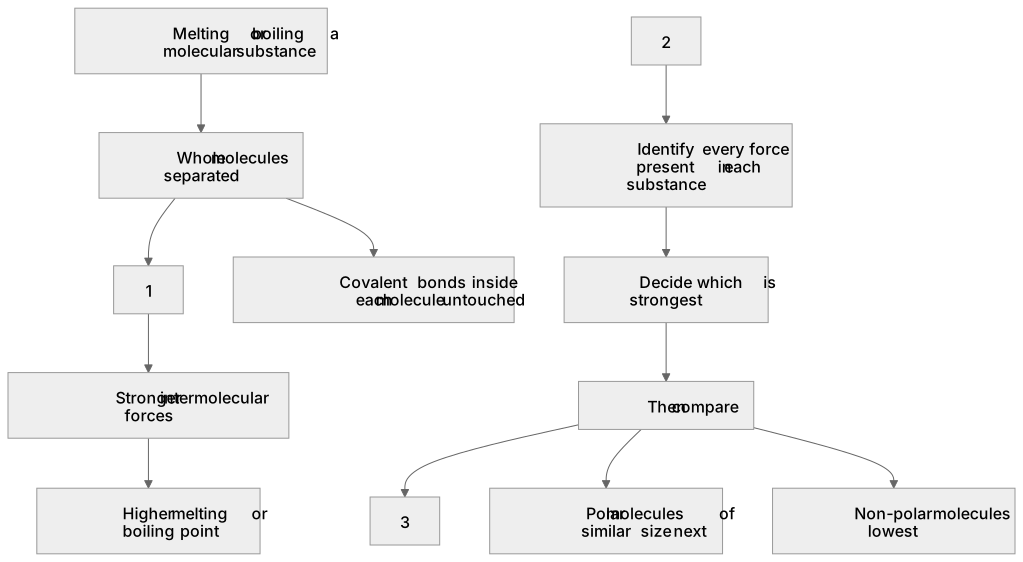
Some boxes have lost their names. Pick the right name for each number.
1Box 1
2Box 2
3Box 3
There is more to this lesson
The full lesson goes on to check your understanding and help you earn the marks. Create a free account to carry on, with your progress saved.
A week of Premium from your first lesson · Then the free plan continues · No card, no charge
Test your understanding of Forces between molecules: The melting and boiling points of molecular substances are influenced by the strength of these intermolecular forces.
Active recall beats re-reading. Take an instant quiz now to test what you’ve learned and lock it into long-term memory.
A week of Premium from your first lesson · Then the free plan continues · No card, no charge