AQA · A-Level · Chemistry
Course version: 7405 · Version from Sept 2016
A simple colorimeter can be used to determine the concentration of…
Full specification wording
Formation of coloured ions (A-level only): A simple colorimeter can be used to determine the concentration of coloured ions in solution.
The routine is fixed.
Checked against the AQA 7405 specification (opens in a new tab) on .
- Point 6 of 6
- 4 key terms
Study notes
From the checked teaching notes for this specification point.
The idea
The routine is fixed. Select the filter that transmits the light the solution absorbs most strongly, the complementary colour. Zero the colorimeter with a blank of pure solvent so that the cell and the water contribute nothing. Make up a set of standard solutions of known concentration by accurate dilution of a stock solution, measure the absorbance of each, and plot a calibration curve of absorbance against concentration, which should be a straight line through the origin. Then measure the absorbance of the unknown under identical conditions and read its concentration from the graph. If the ion is too faintly coloured, add a ligand first to convert it into a more intensely coloured complex. Every solution must be measured with the same filter and the same cell.
What earns the marks
- Choosing a filter of the colour complementary to the solution.
- Zeroing the instrument with a blank containing solvent only.
- Preparing standard solutions of known concentration and plotting a calibration curve.
- Reading the unknown concentration from the calibration curve using its measured absorbance.
Common mistakes and how to put them right
Plotting the calibration graph with concentration on the vertical axis and then reading it incorrectly.
Using a different filter or a different cell for the unknown than for the standards.
Forgetting to zero with a blank, so that every absorbance reading is offset.
Extrapolating far beyond the most concentrated standard, where absorbance is no longer proportional to concentration.
Exam tips
- Name the blank you would use, because distilled water or the solvent is what scores.
- Describe the calibration curve as absorbance against concentration, in that order.
- State that all measurements use the same filter and cell when asked how to make the comparison valid.
Try the lesson
The start of the Formation of coloured ions (A-level only): A simple colorimeter can be used to determine the concentration of coloured ions in solution. lesson, made from checked teaching notes for this specification point.
Have a go first
What does a simple colorimeter directly measure when used to determine the concentration of coloured ions in a solution?
Listen
The routine is fixed. Select the filter that transmits the light the solution absorbs most strongly, the complementary colour. Zero the colorimeter with a blank of pure solvent so that the cell and the water contribute nothing. Make up a set of standard solutions of known concentration by accurate dilution of a stock solution, measure the absorbance of each, and plot a calibration curve of absorbance against concentration, which should be a straight line through the origin. Then measure the absorbance of the unknown under identical conditions and read its concentration from the graph. If the ion is too faintly coloured, add a ligand first to convert it into a more intensely coloured complex. Every solution must be measured with the same filter and the same cell. A strong answer earns marks for these points. choosing a filter of the colour complementary to the solution. zeroing the instrument with a blank containing solvent only. preparing standard solutions of known concentration and plotting a calibration curve. reading the unknown concentration from the calibration curve using its measured absorbance. Exam tip: Name the blank you would use, because distilled water or the solvent is what scores.
See it
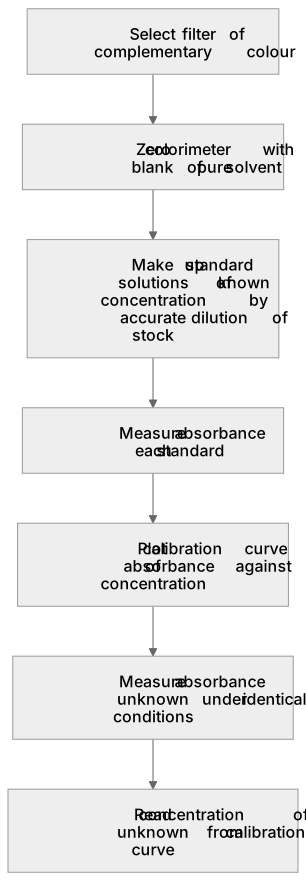
Put it in order
Put these steps in the order they happen.
- 1. Read concentration of unknown from calibration curve
- 2. Measure absorbance of unknown under identical conditions
- 3. Make up standard solutions of known concentration by accurate dilution of stock
- 4. Plot calibration curve of absorbance against concentration
- 5. Select filter of complementary colour
- 6. Zero colorimeter with blank of pure solvent
- 7. Measure absorbance of each standard
Key words
Say what each word means before you turn the card.
complementary filter
Try answering aloud or in your head before turning the card.
calibration curve
Try answering aloud or in your head before turning the card.
standard solutions
Try answering aloud or in your head before turning the card.
blank
Try answering aloud or in your head before turning the card.
See every definition
- complementary filter
- The filter that transmits the light the solution absorbs most strongly, being the complementary colour.
- calibration curve
- A plot of absorbance against concentration, made from standard solutions of known concentration, which should be a straight line through the origin.
- standard solutions
- Solutions of known concentration made up by accurate dilution of a stock solution, whose absorbance is measured to plot the calibration curve.
- blank
- A blank of pure solvent used to zero the colorimeter so that the cell and the water contribute nothing.
Label the diagram
Some boxes have lost their names. Pick the right name for each number.
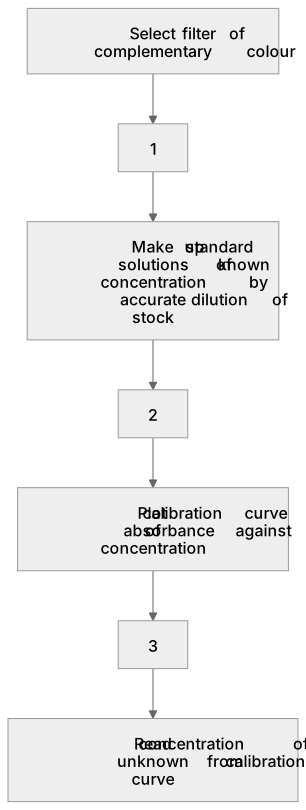
1Box 1
2Box 2
3Box 3
There is more to this lesson
The full lesson goes on to check your understanding and help you earn the marks. Create a free account to carry on, with your progress saved.
A week of Premium from your first lesson · Then the free plan continues · No card, no charge
Test your understanding of Formation of coloured ions (A-level only): A simple colorimeter can be used to determine the concentration of coloured ions in solution.
Active recall beats re-reading. Take an instant quiz now to test what you’ve learned and lock it into long-term memory.
A week of Premium from your first lesson · Then the free plan continues · No card, no charge