AQA · A-Level · Chemistry
Course version: 7405 · Version from Sept 2016
The energy difference between the ground state and the excited state of…
Full specification wording
Formation of coloured ions (A-level only): The energy difference between the ground state and the excited state of the d electrons is given by: ∆E = hν = hc/λ Changes in oxidation state, co-ordination number and ligand alter ∆E and this leads to a change in colour.
ΔE = hν = hc/λ ties the size of the d orbital gap to the light absorbed.
Checked against the AQA 7405 specification (opens in a new tab) on .
- Point 4 of 6
- 3 key terms
Study notes
From the checked teaching notes for this specification point.
The idea
ΔE = hν = hc/λ ties the size of the d orbital gap to the light absorbed. Use h = 6.63 × 10⁻³⁴ J s and c = 3.00 × 10⁸ m s⁻¹, and remember that λ must be in metres, so a wavelength quoted as 600 nm becomes 6.00 × 10⁻⁷ m. A bigger gap means a higher frequency and a shorter wavelength absorbed, which changes the colour you see. Three things change the gap and the mark scheme names exactly these: the oxidation state of the metal, the ligands attached, and the co-ordination number. That is why [Cu(H₂O)₆]²⁺ is pale blue, [Cu(NH₃)₄(H₂O)₂]²⁺ is deep blue and [CuCl₄]²⁻ is yellow: the same metal, but a different gap in each.
What earns the marks
- Converting the wavelength into metres before substituting into ΔE = hc/λ.
- Correct substitution into ΔE = hν or ΔE = hc/λ.
- The answer in joules with the correct power of ten.
- Naming oxidation state, ligand and co-ordination number as the three changes that alter ΔE.
Common mistakes and how to put them right
Substituting a wavelength in nanometres straight into ΔE = hc/λ, giving an answer nine orders of magnitude too small.
Multiplying by λ instead of dividing, so producing an energy far too large.
Listing concentration or temperature as a way of changing the colour of a complex.
Confusing frequency with wavelength and using hλ in place of hc/λ.
Exam tips
- Write the conversion from nanometres to metres in your working so the examiner can follow it.
- Quote the answer in joules per photon unless the question asks for kJ mol⁻¹, which needs a further step using the Avogadro constant.
- When asked for three ways to change colour, give the three named in the specification and nothing else.
Try the lesson
The start of the Formation of coloured ions (A-level only): The energy difference between the ground state and the excited state of the d electrons is given by: ∆E = hν = hc/λ Changes in oxidation state, co-ordination number and ligand alter ∆E and this leads to a change in colour. lesson, made from checked teaching notes for this specification point.
Have a go first
Which equation gives the energy difference ∆E between the ground state and the excited state of d electrons in terms of frequency ν?
Listen
ΔE = hν = hc/λ ties the size of the d orbital gap to the light absorbed. Use h = 6.63 × 10⁻³⁴ J s and c = 3.00 × 10⁸ m s⁻¹, and remember that λ must be in metres, so a wavelength quoted as 600 nm becomes 6.00 × 10⁻⁷ m. A bigger gap means a higher frequency and a shorter wavelength absorbed, which changes the colour you see. Three things change the gap and the mark scheme names exactly these: the oxidation state of the metal, the ligands attached, and the co-ordination number. That is why [Cu(H₂O)₆]²⁺ is pale blue, [Cu(NH₃)₄(H₂O)₂]²⁺ is deep blue and [CuCl₄]²⁻ is yellow: the same metal, but a different gap in each. A strong answer earns marks for these points. converting the wavelength into metres before substituting into ΔE = hc/λ. correct substitution into ΔE = hν or ΔE = hc/λ. the answer in joules with the correct power of ten. naming oxidation state, ligand and co-ordination number as the three changes that alter ΔE. Exam tip: Write the conversion from nanometres to metres in your working so the examiner can follow it.
See it
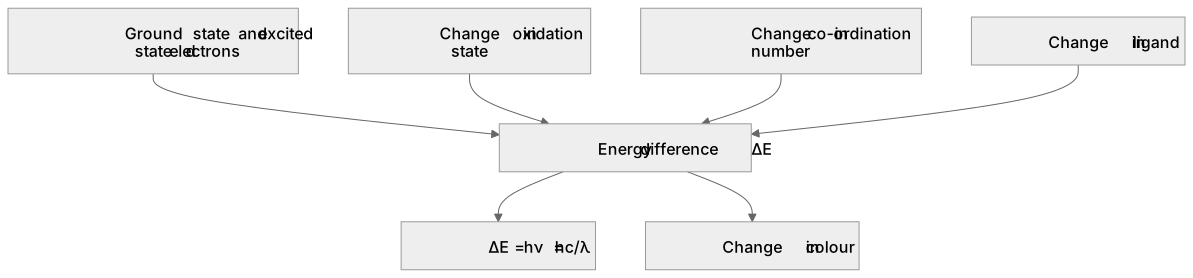
Key words
Say what each word means before you turn the card.
unit conversions
Try answering aloud or in your head before turning the card.
size of the d orbital gap
Try answering aloud or in your head before turning the card.
ligand effects on colour
Try answering aloud or in your head before turning the card.
See every definition
- unit conversions
- The wavelength must be in metres, so a wavelength quoted as 600 nm becomes 6.00 × 10⁻⁷ m before substituting into ΔE = hc/λ.
- size of the d orbital gap
- The energy difference between the ground state and the excited state of the d electrons, calculated using h = 6.63 × 10⁻³⁴ J s and c = 3.00 × 10⁸ m s⁻¹.
- ligand effects on colour
- Changes in oxidation state, co-ordination number and ligand alter ∆E and this leads to a change in colour.
Label the diagram
Some boxes have lost their names. Pick the right name for each number.
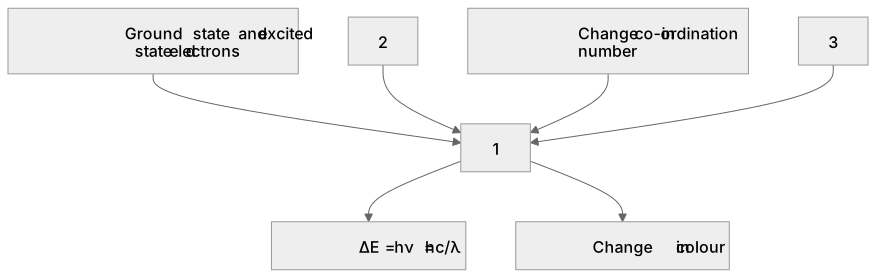
1Box 1
2Box 2
3Box 3
There is more to this lesson
The full lesson goes on to check your understanding and help you earn the marks. Create a free account to carry on, with your progress saved.
A week of Premium from your first lesson · Then the free plan continues · No card, no charge
Test your understanding of Formation of coloured ions (A-level only): The energy difference between the ground state and the excited state of the d electrons is given by: ∆E = hν = hc/λ Changes in oxidation state, co-ordination number and ligand alter ∆E and this leads to a change in colour.
Active recall beats re-reading. Take an instant quiz now to test what you’ve learned and lock it into long-term memory.
A week of Premium from your first lesson · Then the free plan continues · No card, no charge