AQA · A-Level · Chemistry
Course version: 7405 · Version from Sept 2016
Fractional distillation of crude oil: Alkanes are saturated hydrocarbons.
Two words, each doing work.
Checked against the AQA 7405 specification (opens in a new tab) on .
- Point 1 of 2
- 2 key terms
Study notes
From the checked teaching notes for this specification point.
The idea
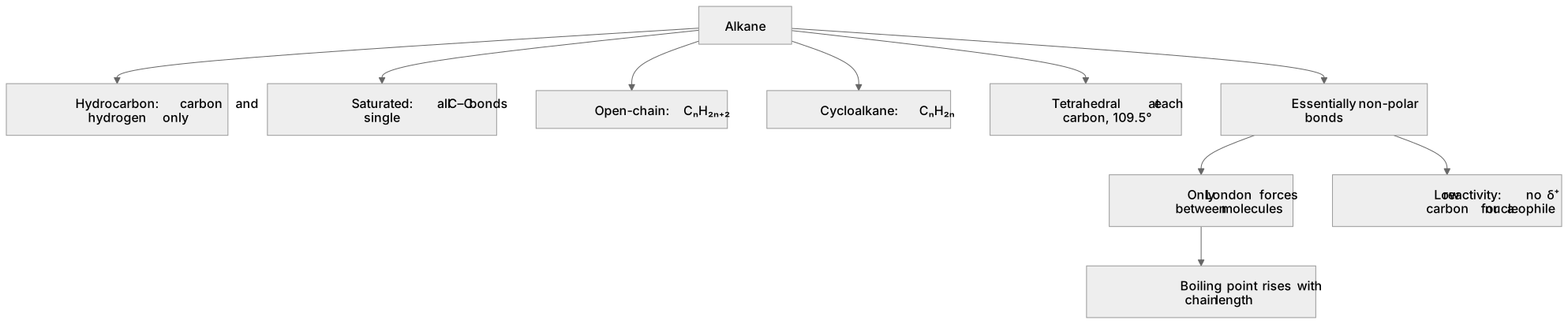
Two words, each doing work. Hydrocarbon means the molecule contains only carbon and hydrogen. Saturated means every carbon to carbon bond is a single bond, so the molecule holds as many hydrogen atoms as it possibly can. The general formula of an open-chain alkane is CₙH₂ₙ₊₂, while cycloalkanes, having closed the ring, are CₙH₂ₙ. Every carbon has four σ bonds arranged tetrahedrally at 109.5°. Because carbon and hydrogen have almost the same electronegativity the bonds are essentially non-polar, and the only forces between molecules are London forces. That explains why alkanes are so unreactive, since there is no δ⁺ carbon for a nucleophile to attack, and why boiling point rises steadily with chain length.
What earns the marks
- Hydrocarbon meaning a compound of carbon and hydrogen only.
- Saturated meaning that all the carbon to carbon bonds are single bonds.
- The general formula CₙH₂ₙ₊₂ for an open-chain alkane.
- The tetrahedral shape at each carbon with a bond angle of 109.5°.
Common mistakes and how to put them right
Defining saturated as containing no double bonds without saying between carbon atoms.
Applying CₙH₂ₙ₊₂ to a cycloalkane, which is CₙH₂ₙ.
Giving the bond angle in an alkane as 120° or as 90°.
Describing alkanes as polar because C–H bonds have slight polarity, when the molecules are effectively non-polar.
Exam tips
- Define both words separately if the question offers two marks for the term.
- Check whether the alkane is a ring before applying a general formula.
- Link low reactivity to non-polar bonds and to strong C–C and C–H bonds, not just to being stable.
Try the lesson
The start of the Fractional distillation of crude oil: Alkanes are saturated hydrocarbons. lesson, made from checked teaching notes for this specification point.
Have a go first
Which statement describes an alkane?
Listen
Two words, each doing work. Hydrocarbon means the molecule contains only carbon and hydrogen. Saturated means every carbon to carbon bond is a single bond, so the molecule holds as many hydrogen atoms as it possibly can. The general formula of an open-chain alkane is CₙH₂ₙ₊₂, while cycloalkanes, having closed the ring, are CₙH₂ₙ. Every carbon has four σ bonds arranged tetrahedrally at 109.5°. Because carbon and hydrogen have almost the same electronegativity the bonds are essentially non-polar, and the only forces between molecules are London forces. That explains why alkanes are so unreactive, since there is no δ⁺ carbon for a nucleophile to attack, and why boiling point rises steadily with chain length. A strong answer earns marks for these points. hydrocarbon meaning a compound of carbon and hydrogen only. saturated meaning that all the carbon to carbon bonds are single bonds. the general formula CₙH₂ₙ₊₂ for an open-chain alkane. the tetrahedral shape at each carbon with a bond angle of 109.5°. Exam tip: Define both words separately if the question offers two marks for the term.
See it
Key words
Say what each word means before you turn the card.
hydrocarbon
Try answering aloud or in your head before turning the card.
saturated
Try answering aloud or in your head before turning the card.
See every definition
- hydrocarbon
- A molecule that contains only carbon and hydrogen.
- saturated
- Every carbon to carbon bond is a single bond, so the molecule holds as many hydrogen atoms as it possibly can.
Label the diagram
Some boxes have lost their names. Pick the right name for each number.
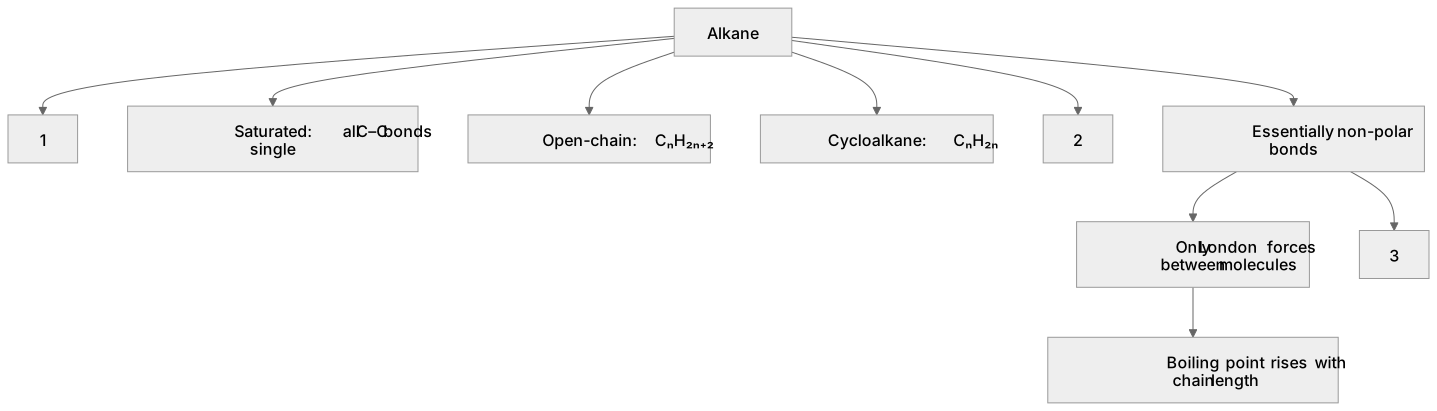
1Box 1
2Box 2
3Box 3
There is more to this lesson
The full lesson goes on to check your understanding and help you earn the marks. Create a free account to carry on, with your progress saved.
A week of Premium from your first lesson · Then the free plan continues · No card, no charge
Test your understanding of Fractional distillation of crude oil: Alkanes are saturated hydrocarbons.
Active recall beats re-reading. Take an instant quiz now to test what you’ve learned and lock it into long-term memory.
A week of Premium from your first lesson · Then the free plan continues · No card, no charge