AQA · A-Level · Chemistry
Course version: 7405 · Version from Sept 2016
Transition metal characteristics of elements Ti–Cu arise from an…
Full specification wording
General properties of transition metals (A-level only): Transition metal characteristics of elements Ti–Cu arise from an incomplete d sub-level in atoms or ions.
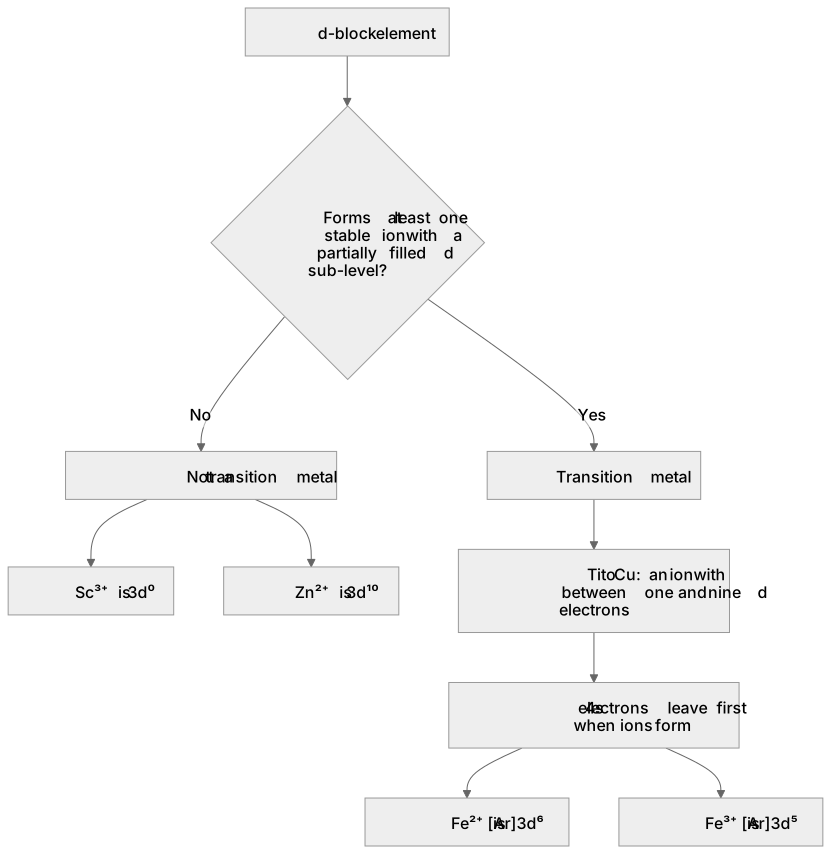
A transition metal is a d-block element that forms at least one stable ion with a partially filled d sub-level, and that single definition does all the work.
Checked against the AQA 7405 specification (opens in a new tab) on .
- Point 1 of 5
- 4 key terms
Study notes
From the checked teaching notes for this specification point.
The idea
A transition metal is a d-block element that forms at least one stable ion with a partially filled d sub-level, and that single definition does all the work. Scandium is in the block but its only common ion, Sc³⁺, is 3d⁰; zinc's only common ion, Zn²⁺, is 3d¹⁰. One is empty and one is full, so neither element is a transition metal and neither shows the characteristic chemistry. Titanium through to copper all manage an ion with between one and nine d electrons. Two configurations break the filling pattern, chromium as [Ar]3d⁵4s¹ and copper as [Ar]3d¹⁰4s¹, because a half-full or full 3d sub-level is lower in energy. When ions form the 4s electrons leave first, so Fe²⁺ is [Ar]3d⁶ and Fe³⁺ is [Ar]3d⁵.
What earns the marks
- Defining a transition metal as one that forms at least one stable ion with a partially filled d sub-level.
- Quoting Sc³⁺ as 3d⁰ or Zn²⁺ as 3d¹⁰ when explaining why those two elements are excluded.
- Stating the correct configurations [Ar]3d⁵4s¹ for chromium and [Ar]3d¹⁰4s¹ for copper.
- Removing the 4s electrons before the 3d electrons when writing the configuration of an ion.
Common mistakes and how to put them right
Saying a transition metal has a partially filled d sub-level in the atom, which wrongly admits scandium (atom is 3d¹) and wrongly excludes copper (atom is 3d¹⁰).
Put it right by specifying it must form a stable ion with a partially filled d sub-level.
Writing Fe³⁺ as [Ar]3d³4s² by taking electrons from 3d before 4s.
Put it right by removing 4s electrons first.
Giving chromium as [Ar]3d⁴4s² and copper as [Ar]3d⁹4s².
Put it right by using the anomalous half-full and full 3d configurations.
Claiming scandium is excluded because it has no d electrons, when the neutral atom is [Ar]3d¹4s².
Put it right by referencing the Sc³⁺ ion.
Exam tips
- Use the word ion in the definition, because atom alone is incorrect and will not score.
- Write the full [Ar] configuration rather than a shorthand and check the electrons total the atomic number.
- If asked about scandium or zinc, name the specific ion and its configuration as your evidence.
Try the lesson
The start of the General properties of transition metals (A-level only): Transition metal characteristics of elements Ti–Cu arise from an incomplete d sub-level in atoms or ions. lesson, made from checked teaching notes for this specification point.
Have a go first
Which electron configuration shows a Ti²⁺ ion with an incomplete d sub-level?
Listen
A transition metal is a d-block element that forms at least one stable ion with a partially filled d sub-level, and that single definition does all the work. Scandium is in the block but its only common ion, Sc³⁺, is 3d⁰; zinc's only common ion, Zn²⁺, is 3d¹⁰. One is empty and one is full, so neither element is a transition metal and neither shows the characteristic chemistry. Titanium through to copper all manage an ion with between one and nine d electrons. Two configurations break the filling pattern, chromium as [Ar]3d⁵4s¹ and copper as [Ar]3d¹⁰4s¹, because a half-full or full 3d sub-level is lower in energy. When ions form the 4s electrons leave first, so Fe²⁺ is [Ar]3d⁶ and Fe³⁺ is [Ar]3d⁵. A strong answer earns marks for these points. Defining a transition metal as one that forms at least one stable ion with a partially filled d sub-level. Quoting Sc³⁺ as 3d⁰ or Zn²⁺ as 3d¹⁰ when explaining why those two elements are excluded. Stating the correct configurations [Ar]3d⁵4s¹ for chromium and [Ar]3d¹⁰4s¹ for copper. Removing the 4s electrons before the 3d electrons when writing the configuration of an ion. A common slip: Saying a transition metal has a partially filled d sub-level in the atom, which wrongly admits scandium (atom is 3d¹) and wrongly excludes copper (atom is 3d¹⁰). Instead, specifying it must form a stable ion with a partially filled d sub-level. Exam tip: Use the word ion in the definition, because atom alone is incorrect and will not score.
See it
Key words
Say what each word means before you turn the card.
transition metal
Try answering aloud or in your head before turning the card.
scandium and zinc exceptions
Try answering aloud or in your head before turning the card.
chromium and copper anomalies
Try answering aloud or in your head before turning the card.
4s lost first
Try answering aloud or in your head before turning the card.
See every definition
- transition metal
- A d-block element that forms at least one stable ion with a partially filled d sub-level.
- scandium and zinc exceptions
- Neither element is a transition metal because Sc³⁺ is 3d⁰ and Zn²⁺ is 3d¹⁰, one empty and one full.
- chromium and copper anomalies
- Their configurations break the filling pattern, chromium as [Ar]3d⁵4s¹ and copper as [Ar]3d¹⁰4s¹, because a half-full or full 3d sub-level is lower in energy.
- 4s lost first
- When ions form the 4s electrons leave first, so Fe²⁺ is [Ar]3d⁶ and Fe³⁺ is [Ar]3d⁵.
There is more to this lesson
The full lesson goes on to check your understanding and help you earn the marks. Create a free account to carry on, with your progress saved.
A week of Premium from your first lesson · Then the free plan continues · No card, no charge
Test your understanding of General properties of transition metals (A-level only): Transition metal characteristics of elements Ti–Cu arise from an incomplete d sub-level in atoms or ions.
Active recall beats re-reading. Take an instant quiz now to test what you’ve learned and lock it into long-term memory.
A week of Premium from your first lesson · Then the free plan continues · No card, no charge