AQA · A-Level · Chemistry
Course version: 7405 · Version from Sept 2016
∆H, whilst important, is not sufficient to explain feasible change.
Full specification wording
Gibbs free-energy change, ∆G, and entropy change, ∆S (A-level only): ∆H, whilst important, is not sufficient to explain feasible change.
It is tempting to assume that only exothermic reactions happen, because systems tend to fall to lower energy.
Checked against the AQA 7405 specification (opens in a new tab) on .
- Point 1 of 6
- 4 key terms
Study notes
From the checked teaching notes for this specification point.
The idea
It is tempting to assume that only exothermic reactions happen, because systems tend to fall to lower energy. Plenty of everyday chemistry refutes this. Ammonium nitrate dissolves readily in water even though the process absorbs about 26 kJ mol⁻¹ and the solution turns cold; ice melts above 0 °C while taking energy in; thermal decompositions such as that of calcium carbonate proceed at high temperature despite being endothermic. So the sign of ∆H, on its own, is not a reliable test of whether a change will happen. Something else is pushing these processes forward, namely the increase in the dispersal of energy and matter when an ordered solid becomes free moving particles, and that contribution grows with temperature.
What earns the marks
- Stating that an endothermic process can still occur spontaneously.
- Quoting a named example, such as ammonium nitrate dissolving or a thermal decomposition.
- Identifying entropy change as the missing factor.
- Recognising that the temperature determines how much weight that factor carries.
Common mistakes and how to put them right
Asserting that all endothermic reactions are infeasible.
Treating a large negative ∆H as a guarantee that a reaction will occur at any temperature.
Confusing feasibility with the rate at which a reaction occurs.
Saying an endothermic process is feasible because it absorbs energy from the surroundings, without invoking entropy.
Claiming ∆H is irrelevant, when it is one of the two terms in the balance.
Exam tips
- Keep a worked example in mind, such as ammonium nitrate dissolving with ∆H positive and the process still spontaneous.
- Answer feasibility questions with ∆G, never with ∆H alone.
- Remember that feasible means thermodynamically possible, not observable in the lab.
Try the lesson
The start of the Gibbs free-energy change, ∆G, and entropy change, ∆S (A-level only): ∆H, whilst important, is not sufficient to explain feasible change. lesson, made from checked teaching notes for this specification point.
Have a go first
Which quantity must be considered alongside enthalpy change to decide whether a reaction is feasible?
Listen
It is tempting to assume that only exothermic reactions happen, because systems tend to fall to lower energy. Plenty of everyday chemistry refutes this. Ammonium nitrate dissolves readily in water even though the process absorbs about 26 kJ mol⁻¹ and the solution turns cold; ice melts above 0 °C while taking energy in; thermal decompositions such as that of calcium carbonate proceed at high temperature despite being endothermic. So the sign of ∆H, on its own, is not a reliable test of whether a change will happen. Something else is pushing these processes forward, namely the increase in the dispersal of energy and matter when an ordered solid becomes free moving particles, and that contribution grows with temperature. A strong answer earns marks for these points. stating that an endothermic process can still occur spontaneously. quoting a named example, such as ammonium nitrate dissolving or a thermal decomposition. identifying entropy change as the missing factor. recognising that the temperature determines how much weight that factor carries. Exam tip: Keep a worked example in mind, such as ammonium nitrate dissolving with ∆H positive and the process still spontaneous.
See it
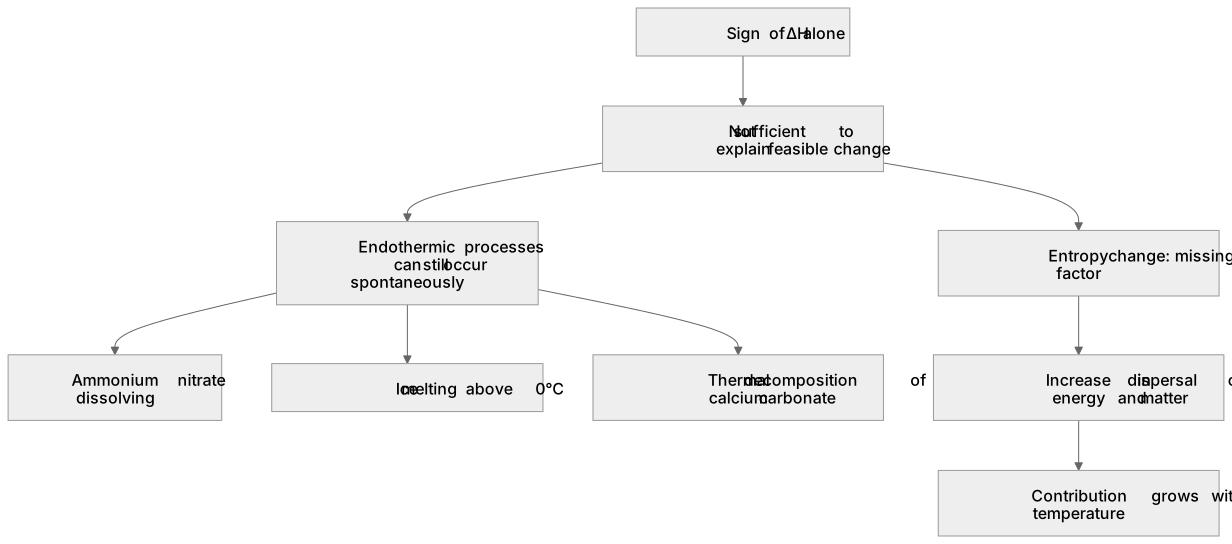
Key words
Say what each word means before you turn the card.
limits of the enthalpy criterion
Try answering aloud or in your head before turning the card.
spontaneous endothermic processes
Try answering aloud or in your head before turning the card.
entropy as the missing term
Try answering aloud or in your head before turning the card.
role of temperature
Try answering aloud or in your head before turning the card.
See every definition
- limits of the enthalpy criterion
- The sign of ∆H, on its own, is not a reliable test of whether a change will happen.
- spontaneous endothermic processes
- An endothermic process can still occur spontaneously, for example ammonium nitrate dissolving in water or a thermal decomposition.
- entropy as the missing term
- The increase in the dispersal of energy and matter when an ordered solid becomes free moving particles is the missing factor pushing these processes forward.
- role of temperature
- The contribution from the increase in dispersal of energy and matter grows with temperature, so temperature determines how much weight that factor carries.
Label the diagram
Some boxes have lost their names. Pick the right name for each number.
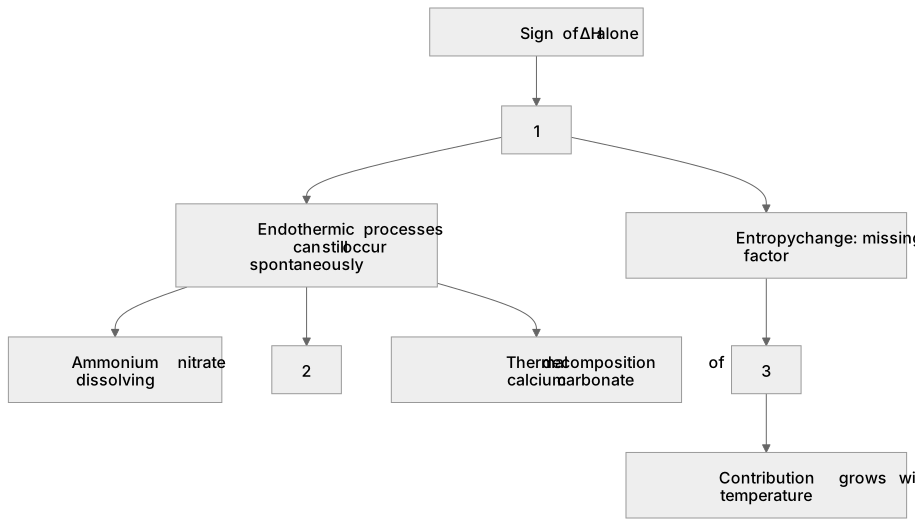
1Box 1
2Box 2
3Box 3
There is more to this lesson
The full lesson goes on to check your understanding and help you earn the marks. Create a free account to carry on, with your progress saved.
A week of Premium from your first lesson · Then the free plan continues · No card, no charge
Test your understanding of Gibbs free-energy change, ∆G, and entropy change, ∆S (A-level only): ∆H, whilst important, is not sufficient to explain feasible change.
Active recall beats re-reading. Take an instant quiz now to test what you’ve learned and lock it into long-term memory.
A week of Premium from your first lesson · Then the free plan continues · No card, no charge