Study Notes
Scope and specification alignment
This guide is written for GCSE Chemistry learners who want challenging extension material. The exact reference 3.2.2 belongs to AQA A-level Chemistry (7405), Group 2: the alkaline earth metals, rather than a GCSE specification. The chemistry is excellent enrichment for GCSE periodic-table, bonding, acids-and-alkalis and environmental-chemistry work, but first ionisation energy, detailed solubility trends and titanium extraction should be treated as A-level extension unless your teacher has explicitly included them. The official AQA content covers Mg–Ba trends, water reactions, titanium extraction, hydroxide and sulfate solubility, sulfate testing and practical uses.1
Examiner mindset: candidates earn explanation marks by linking a stated trend to atomic structure and then to a change in force, bonding or reactivity. Listing facts alone rarely accesses all marks.
1. Group 2 essentials
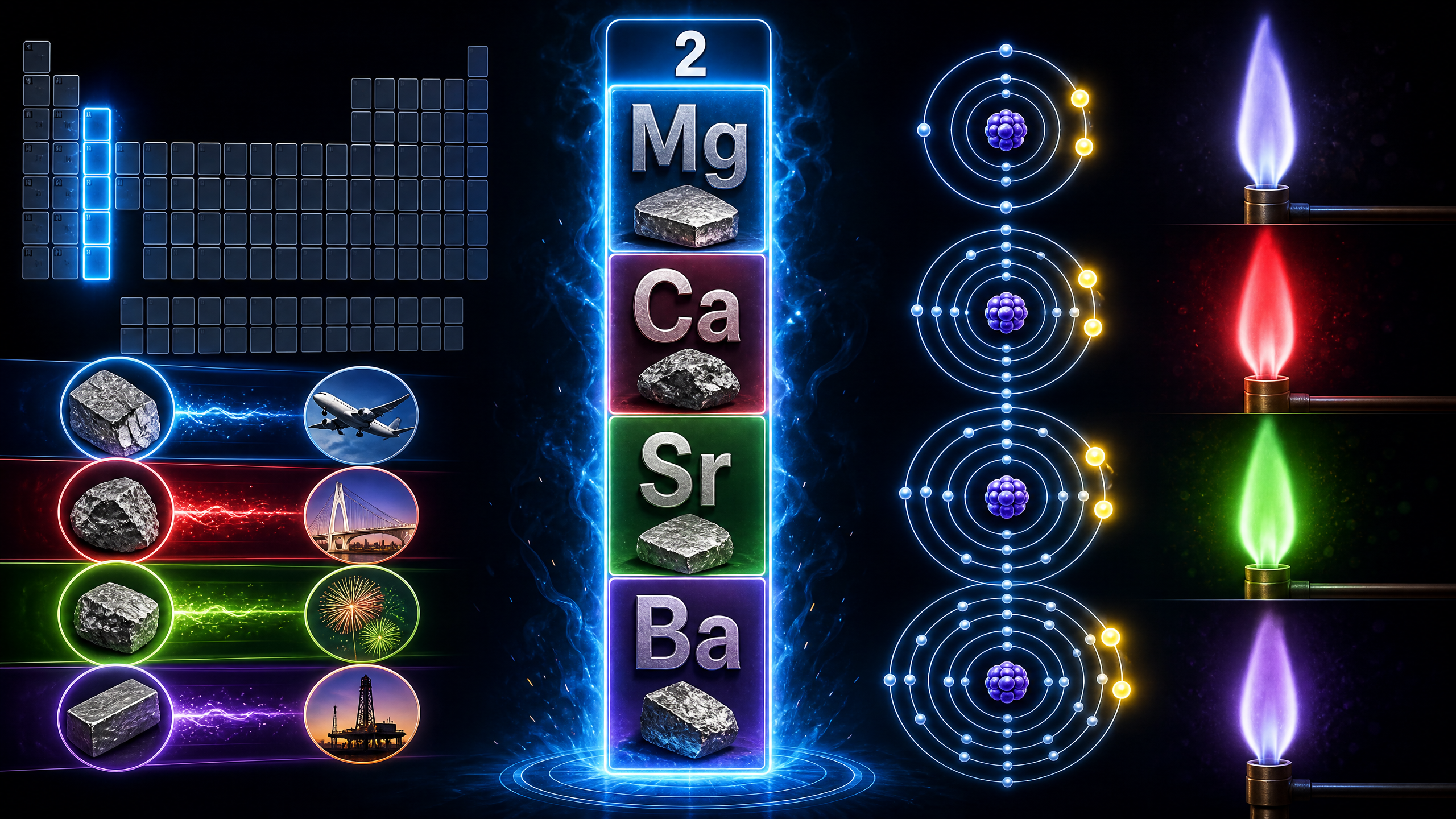
Group 2 contains beryllium, magnesium, calcium, strontium, barium and radium. The elements are called the alkaline earth metals. In questions on this unit, comparisons normally run from magnesium to barium. Every Group 2 atom has two electrons in its outer shell and commonly loses both to form an M²⁺ ion. This common electron arrangement explains why the elements have broadly similar chemistry, but their properties change down the group because the outer electrons occupy progressively more shells.
| Trend or idea | What happens from Mg to Ba | Mark-winning reason |
|---|---|---|
| Atomic radius | Increases | Each element has an additional electron shell; the outer electrons are further from the nucleus. |
| First ionisation energy | Decreases | Greater distance and shielding reduce attraction between the nucleus and the outer electron. |
| Reactivity with water | Increases | The two outer electrons are lost more easily, so M²⁺ forms more readily. |
| Hydroxide solubility | Increases | Mg(OH)₂ is sparingly soluble; lower hydroxides are more soluble. |
| Sulfate solubility | Decreases | BaSO₄ is insoluble, giving a white precipitate in the sulfate test. |
2. Atomic radius and first ionisation energy
Atomic radius increases down Group 2. Magnesium has three occupied shells, calcium has four, strontium five and barium six. Each extra shell places the outer electrons farther from the nucleus. For a two-mark question, do not overcomplicate the answer: state the increase, then say that each successive atom has an additional shell.
First ionisation energy is the energy required to remove one mole of electrons from one mole of gaseous atoms to form one mole of gaseous 1+ ions. It decreases down Group 2.2 In a full explanation, candidates should consider three factors: nuclear charge, distance and shielding. Nuclear charge does rise because there are more protons. However, the outer electron is farther from the nucleus and inner-shell electrons shield it from the nuclear attraction. Those two effects outweigh the rise in nuclear charge, so less energy is needed to remove the electron.
Use the cause-and-effect chain “more shells → more distance and shielding → weaker attraction → lower ionisation energy”. A response that merely says “barium is bigger” may receive limited credit; the mark-bearing idea is the weaker electrostatic attraction to the outer electron.
3. Melting points: use the data, not a forced pattern
All Group 2 metals have giant metallic structures. Positive metal ions are held together by strong electrostatic attraction to delocalised electrons. Their melting points are therefore relatively high because this metallic bonding must be overcome.
Be careful with the actual pattern. Magnesium is anomalous; the values are not perfectly smooth. From calcium to barium the melting point broadly decreases, but a high-quality answer should describe whatever data or graph is supplied rather than claim a universal simple decrease from magnesium to barium. Chemguide also cautions that the variation in Group 2 physical data has no simple one-line explanation.2
| Exam move | What to write |
|---|---|
| Describe a graph | Quote at least two values or elements, then identify the anomaly. |
| Explain the bonding | “The metal has a giant metallic lattice containing positive ions and delocalised electrons.” |
| Avoid overclaiming | Do not state that melting point decreases perfectly down the whole group if the data show magnesium as an exception. |
4. Reactions with water and steam
The general equation for a Group 2 metal reacting with cold water is:
M(s) + 2H₂O(l) → M(OH)₂(aq/s) + H₂(g)
Magnesium reacts very slowly with cold water, producing magnesium hydroxide and hydrogen. It reacts more readily with steam:
Mg(s) + H₂O(g) → MgO(s) + H₂(g)
Calcium reacts steadily with cold water, while barium reacts much more vigorously. The trend is not simply “the atoms get larger”; instead, a candidate should say that increasing distance and shielding make it easier to remove the two outer electrons. That makes formation of M²⁺ more favourable, so the reaction becomes faster and more vigorous down the group.1
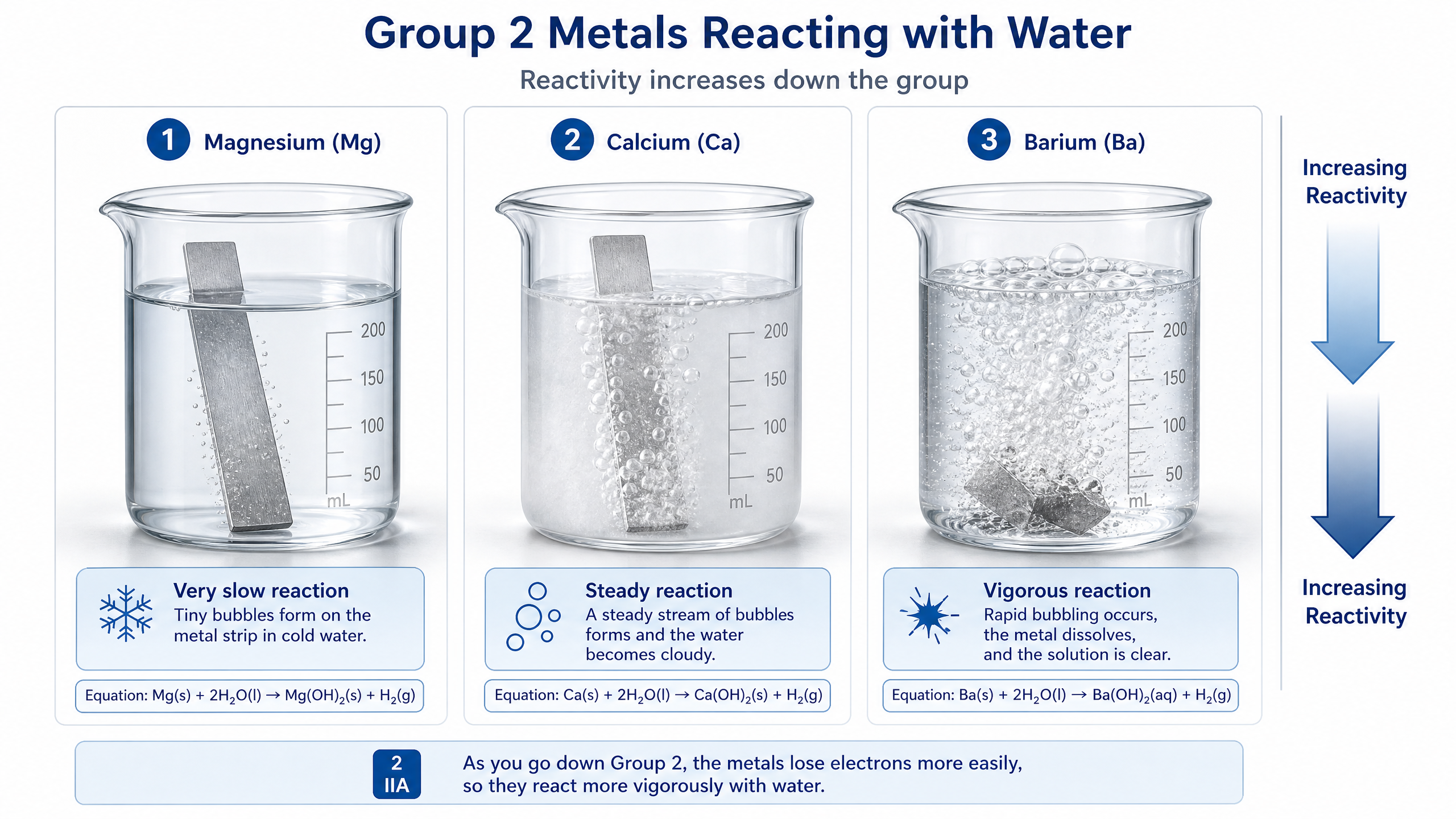
Required practical status: this content is not a separately named AQA required practical. The specification nevertheless suggests testing Mg–Ba with water and Mg with steam as a practical opportunity.1 A safe exam-aware method is to use very small pieces of metal, add them separately to water behind a safety screen, record the rate of bubbling and test the gas with a lighted splint. For magnesium and steam, heat magnesium ribbon while passing steam over it and collect hydrogen. Expected results are progressively more vigorous reactions down the group; magnesium is slow in cold water but reacts with steam. Common errors include using unequal metal masses, judging rate only by bubble size, or failing to control water volume and temperature. Examiners may test this through variables, observations, risks or the equation rather than asking students to perform it.
5. The opposite solubility trends
This is a high-frequency memory test. Hydroxide solubility increases down Group 2; sulfate solubility decreases down Group 2. Magnesium hydroxide is sparingly soluble, whereas barium hydroxide is much more soluble. Magnesium sulfate is soluble, whereas barium sulfate is insoluble.1
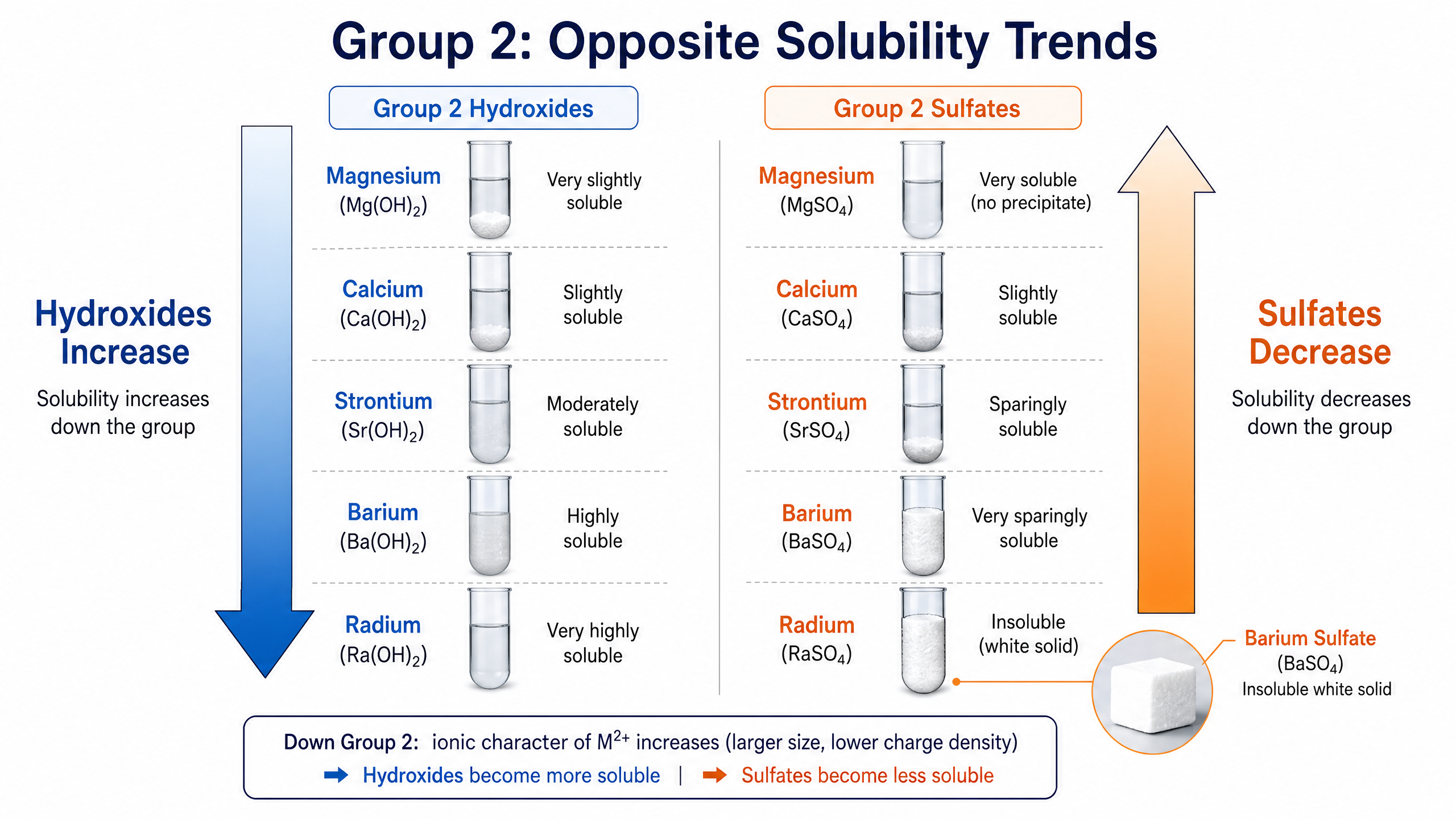
The difference has practical consequences. A more soluble hydroxide produces more hydroxide ions in a saturated solution, so the solution is more alkaline. Magnesium hydroxide is used in antacids because it can neutralise excess acid while being only sparingly soluble. Calcium hydroxide is used to neutralise acidic soil. In contrast, insoluble barium sulfate can be used in a barium meal: it is opaque to X-rays but does not dissolve enough to release a harmful concentration of barium ions into the bloodstream.1
Memory hook: HISD = Hydroxides Increase, Sulfates Decrease down Group 2.
6. Industrial and environmental applications
Magnesium is used to extract titanium from titanium(IV) chloride:
TiCl₄ + 2Mg → Ti + 2MgCl₂
Magnesium acts as the reducing agent because it removes chlorine from TiCl₄. In a balancing question, check titanium, chlorine and magnesium separately: one Ti, four Cl and two Mg atoms must appear on each side.
Calcium oxide or calcium carbonate can remove sulfur dioxide from flue gases. This links the topic to acid rain: removing SO₂ reduces formation of acidic pollutants in the atmosphere. The relevant equations may be introduced through an unfamiliar context, so focus on the chemistry: a basic calcium compound reacts with acidic sulfur dioxide to form a calcium sulfur-containing solid. A simple mark-winning statement is “CaO or CaCO₃ removes SO₂ from flue gases, reducing acid rain.”1
7. Testing for sulfate ions
To test for sulfate ions, add acidified barium chloride solution to the unknown solution. A white precipitate of barium sulfate confirms sulfate ions:
Ba²⁺(aq) + SO₄²⁻(aq) → BaSO₄(s)
The acidification is essential. Carbonate ions can also form a white precipitate with barium ions. The acid removes carbonate ions before the barium chloride is added, so they cannot give a false positive. Do not propose sulfuric acid for this stage because it contains sulfate ions and would contaminate the test. The AQA specification explicitly requires candidates to explain why barium chloride is used and why it is acidified.1
8. Formula, units and graph/data skills
There is no numerical equation on a formula sheet unique to this topic. All displayed chemical and ionic equations must be recalled and balanced. State symbols matter when asked: (s) means solid, (l) liquid, (g) gas and (aq) aqueous. Common conversion traps arise only if a question combines this topic with quantitative chemistry: 1 dm³ = 1000 cm³, 1 mol dm⁻³ = 1 mol L⁻¹, and mass must be in grams when using n = m / Mᵣ.
For a graph, put the independent variable (for example, Group 2 element or atomic number) on the horizontal axis and the dependent variable (such as first ionisation energy) on the vertical axis. Use even scales, units, a descriptive title and a best-fit line only if the data are continuous. When interpreting, state the trend, quote data and explain it. For melting-point data, identify magnesium as anomalous rather than drawing a misleading smooth line through every value.
9. Exam technique and command words
Budget approximately one minute per mark, unless the paper gives a different instruction. A three-mark “explain” response should normally contain three linked scientific ideas. For a six-mark extended answer, spend roughly six to seven minutes planning, writing a logical chain and checking vocabulary.
| Command word | What candidates must do | Useful opening |
|---|---|---|
| State / give | Supply a short fact only. | “The atomic radius increases.” |
| Describe | Say what is observed or shown. | “The reaction becomes more vigorous down the group.” |
| Explain | Give linked cause and effect. | “This is because there are more electron shells…” |
| Compare | Give similarities and differences. | “Barium has more shielding than calcium…” |
| Evaluate | Make a supported judgement. | “The conclusion is not secure because…” |
| Calculate | Show formula, substitution, answer and unit. | “n = m / Mᵣ = … mol.” |
10. References
Visual Resources
2 diagrams and illustrations
Interactive Diagrams
3 interactive diagrams to visualise key concepts
Conceptual Flow Outline
Flowchart for the acidified barium chloride sulfate test.
Conceptual Flow Outline
Cause-and-effect map connecting atomic structure, ionisation energy and reactivity.
Conceptual Flow Outline
Outline of titanium extraction using magnesium.
Worked Examples
4 detailed examples with solutions and examiner commentary
Practice Questions
Test your understanding — click to reveal model answers
State the trend in atomic radius from magnesium to barium and give one reason. [2 marks]
Hint: Think about the number of occupied electron shells.
Magnesium reacts with steam. Write the balanced equation, including state symbols. [2 marks]
Hint: Steam produces the oxide, not the hydroxide.
Explain why barium reacts more vigorously with water than magnesium. [3 marks]
Hint: Use electron shells, shielding and attraction.
Describe the sulfate test and explain why the barium chloride solution is acidified. [4 marks]
Hint: There are two parts: observation and avoiding a false positive.
A graph shows Mg at 650 °C, Ca at 842 °C, Sr at 777 °C and Ba at 727 °C. Evaluate the statement: ‘Melting point decreases steadily down Group 2.’ [3 marks]
Hint: Compare magnesium and calcium before deciding.
Explain why barium sulfate can be used for a barium meal but soluble barium salts would be unsafe. [2 marks]
Hint: Link insolubility to absorption into the bloodstream.